
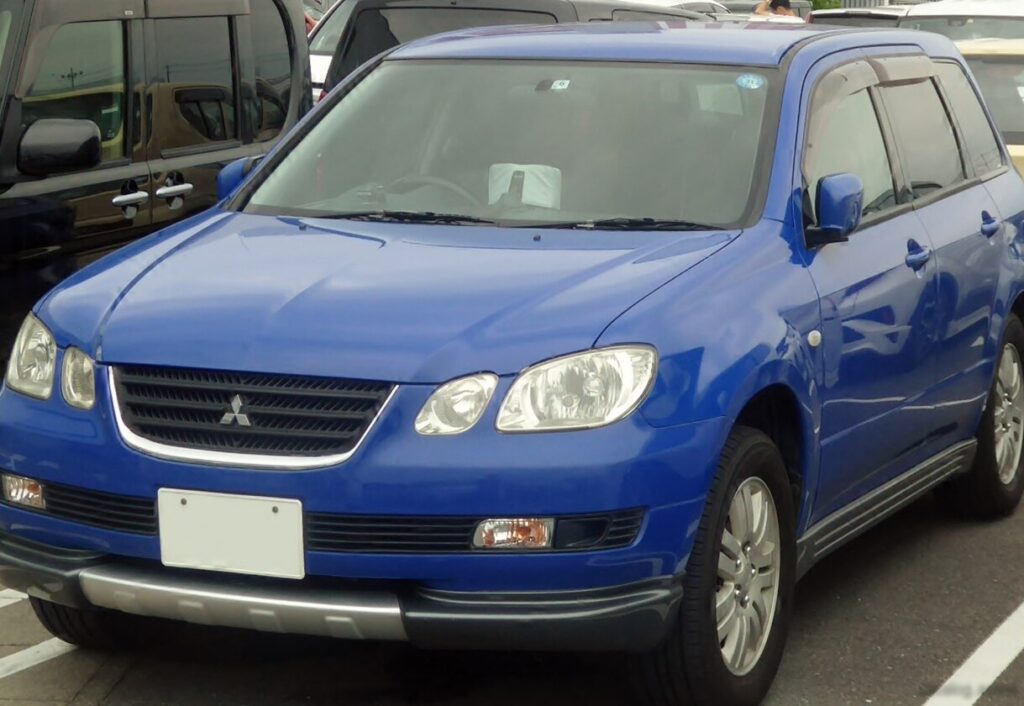
The Mitsubishi Airtrek 2.0, produced between 2001 and 2006, represents Mitsubishi’s entry into the burgeoning compact SUV market. Positioned as a practical and relatively affordable option, the 2.0-liter variant, generating 126 horsepower, served as a mid-range offering within the Airtrek lineup, slotting between the base 1.8-liter engine and the more powerful 2.4-liter versions. The Airtrek, never officially sold in the United States, was primarily aimed at the Japanese domestic market (JDM) and European consumers seeking a versatile and fuel-efficient vehicle. It was built on Mitsubishi’s GS platform, shared with other models like the Outlander.
Technical Specifications
| Brand | Mitsubishi |
| Model | Airtrek |
| Generation | Airtrek |
| Type (Engine) | 2.0 (126 Hp) |
| Start of production | 2001 |
| End of production | 2006 |
| Powertrain Architecture | Internal Combustion engine |
| Body type | SUV |
| Seats | 5 |
| Doors | 4 |
| Fuel Type | Petrol (Gasoline) |
| Weight-to-power ratio | 10.6 kg/Hp, 94.7 Hp/tonne |
| Weight-to-torque ratio | 7.7 kg/Nm, 130.1 Nm/tonne |
| Power | 126 Hp @ 5500 rpm |
| Power per litre | 63.1 Hp/l |
| Torque | 173 Nm @ 4500 rpm (127.6 lb.-ft. @ 4500 rpm) |
| Engine layout | Front, Longitudinal |
| Engine Model/Code | 4G63 |
| Engine displacement | 1997 cm3 (121.86 cu. in.) |
| Number of cylinders | 4 |
| Engine configuration | Inline |
| Cylinder Bore | 85 mm (3.35 in.) |
| Piston Stroke | 88 mm (3.46 in.) |
| Compression ratio | 9.5:1 |
| Number of valves per cylinder | 4 |
| Fuel injection system | Multi-port manifold injection |
| Engine aspiration | Naturally aspirated engine |
| Valvetrain | OHC |
| Engine oil capacity | 4.3 l (4.54 US qt | 3.78 UK qt) |
| Kerb Weight | 1330 kg (2932.15 lbs.) |
| Max. weight | 1605 kg (3538.42 lbs.) |
| Max load | 275 kg (606.27 lbs.) |
| Trunk (boot) space – minimum | 402 l (14.2 cu. ft.) |
| Trunk (boot) space – maximum | 1049 l (37.05 cu. ft.) |
| Fuel tank capacity | 60 l (15.85 US gal | 13.2 UK gal) |
| Length | 4410 mm (173.62 in.) |
| Width | 1750 mm (68.9 in.) |
| Height | 1550 mm (61.02 in.) |
| Wheelbase | 2626 mm (103.39 in.) |
| Front track | 1495 mm (58.86 in.) |
| Rear (Back) track | 1495 mm (58.86 in.) |
| Drivetrain Architecture | The Internal combustion engine (ICE) drives the front wheels of the vehicle. |
| Drive wheel | Front wheel drive |
| Number of gears and type of gearbox | 4 gears, automatic transmission |
| Front suspension | Wishbone |
| Rear suspension | Coil spring |
| Front brakes | Ventilated discs |
| Rear brakes | Drum |
| Assisting systems | ABS (Anti-lock braking system) |
| Steering type | Steering rack and pinion |
| Power steering | Hydraulic Steering |
| Tires size | 215/60 R16 |
Powertrain & Engine Architecture
The heart of the Airtrek 2.0 is Mitsubishi’s 4G63 inline-four cylinder engine. This engine, a staple in many Mitsubishi vehicles, is known for its durability and relatively simple design. The 4G63 in the Airtrek 2.0 features a single overhead camshaft (SOHC) valvetrain with four valves per cylinder. Fuel delivery is managed by a multi-port fuel injection system, providing adequate, though not exceptional, performance. The engine’s 9.5:1 compression ratio strikes a balance between efficiency and power output. Paired with this engine is a four-speed automatic transmission. This transmission, while providing convenience, isn’t known for its sportiness or fuel efficiency compared to more modern automatic gearboxes. The transmission’s gear ratios are tuned for everyday driving, prioritizing smooth operation over rapid acceleration.
Driving Characteristics
The 126 horsepower and 173 Nm (127.6 lb-ft) of torque delivered by the 2.0-liter engine and automatic transmission combination result in a driving experience best described as adequate. Acceleration is not brisk, and overtaking maneuvers require planning. Compared to the manual transmission versions of the Airtrek 2.0, the automatic suffers from a noticeable power loss due to the torque converter. The four-speed automatic also contributes to higher engine speeds during highway cruising, impacting fuel economy. However, the automatic transmission provides a comfortable and easy-to-drive experience, particularly in urban environments. The front-wheel-drive configuration offers predictable handling, but lacks the all-weather capability of the available four-wheel-drive versions.
Equipment & Trim Levels
The Airtrek 2.0 typically came equipped with a reasonable level of standard features. Interior appointments included cloth upholstery, air conditioning, power windows, and a basic audio system. Higher trim levels offered upgrades such as alloy wheels, a sunroof, and more sophisticated audio systems. Optional extras included leather upholstery, navigation systems (depending on the market), and upgraded safety features. The dashboard layout is functional and straightforward, prioritizing usability over aesthetic flair. The interior space is competitive for its class, offering comfortable seating for five adults.
Chassis & Braking
The Airtrek 2.0 utilizes a front independent wishbone suspension and a rear coil spring suspension. This setup provides a comfortable ride quality, absorbing bumps and irregularities in the road surface effectively. The front brakes are ventilated discs, offering good stopping power, while the rear brakes are drums, a cost-saving measure common in this segment. Anti-lock Braking System (ABS) is standard, enhancing safety during emergency braking situations. The steering is rack and pinion with hydraulic power assistance, providing a reasonably responsive feel.
Market Reception & Comparison
The Mitsubishi Airtrek 2.0 received mixed reviews from automotive critics. While praised for its practicality, spacious interior, and relatively affordable price, it was often criticized for its uninspiring performance and somewhat dated interior design. Compared to other compact SUVs available in Europe and Japan, such as the Honda CR-V and Toyota RAV4, the Airtrek 2.0 offered a more budget-friendly option, but lacked the refinement and driving dynamics of its competitors. Fuel economy was average for its class, and reliability was generally considered good, though not exceptional. The 1.8L version was more fuel efficient, but significantly slower. The 2.4L offered more power, but at a higher price point.
Legacy
The Mitsubishi Airtrek, while not a sales blockbuster, established Mitsubishi as a player in the compact SUV segment. The 2.0-liter variant, with its reliable 4G63 engine and relatively simple automatic transmission, has proven to be a durable and dependable vehicle in the used car market. Parts availability is generally good, and maintenance costs are reasonable. Today, the Airtrek 2.0 represents an affordable and practical option for those seeking a compact SUV with a proven track record. While it may not offer the latest technology or the most exciting driving experience, its simplicity and durability continue to appeal to budget-conscious buyers.
