
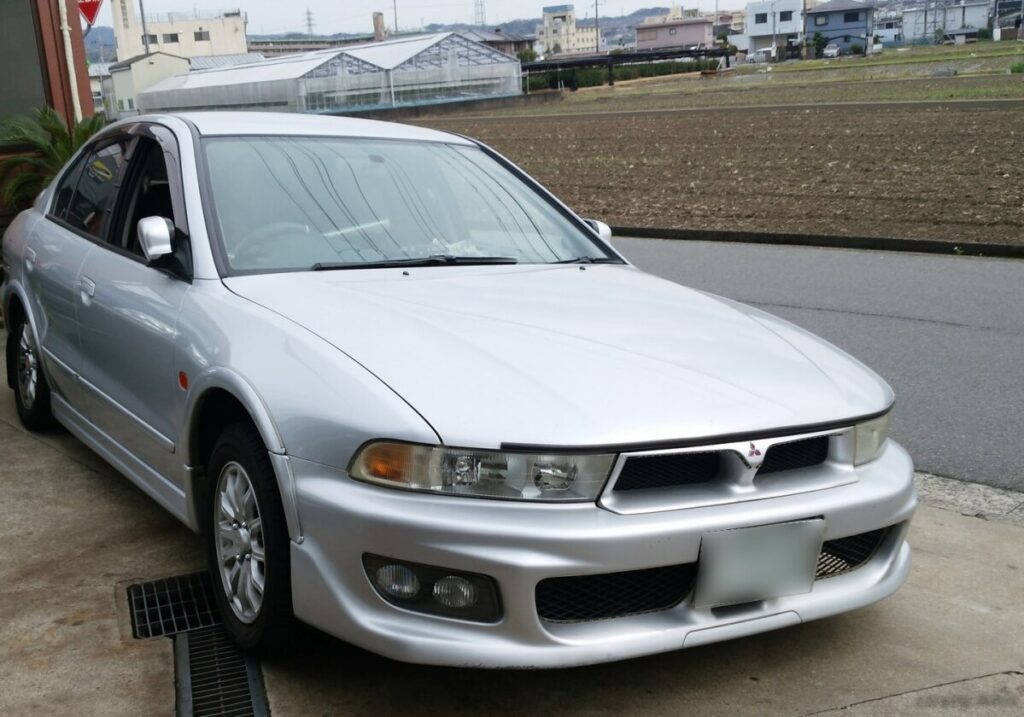
The Mitsubishi Aspire, known as the EAO generation, was a mid-size sedan produced by Mitsubishi Motors from 1997 to 2002. Positioned as a comfortable and relatively upscale offering, the Aspire aimed to compete with established players in the segment like the Toyota Camry and Honda Accord, particularly in markets outside of North America. The 2.0-liter 16V GDI (Gasoline Direct Injection) engine paired with a four-speed automatic transmission represented a mid-range offering within the Aspire lineup, balancing performance with fuel efficiency and ease of use. This variant was aimed at buyers prioritizing a smooth driving experience over outright sportiness.
Technical Specifications
| Brand | Mitsubishi |
| Model | Aspire |
| Generation | Aspire (EAO) |
| Type (Engine) | 2.0 16V GDI (145 Hp) |
| Start of production | 1997 |
| End of production | 2002 |
| Powertrain Architecture | Internal Combustion engine |
| Body type | Sedan |
| Seats | 5 |
| Doors | 4 |
| Fuel consumption (urban) | 7.04 l/100 km (33.4 US mpg, 40.1 UK mpg, 14.2 km/l) |
| Fuel Type | Petrol (Gasoline) |
| Weight-to-power ratio | 8.9 kg/Hp, 112.4 Hp/tonne |
| Weight-to-torque ratio | 6.8 kg/Nm, 148.1 Nm/tonne |
| Power | 145 Hp @ 5700 rpm |
| Power per litre | 72.5 Hp/l |
| Torque | 191 Nm @ 3750 rpm (140.87 lb.-ft. @ 3750 rpm) |
| Engine layout | Front, Transverse |
| Engine displacement | 1999 cm3 (121.99 cu. in.) |
| Number of cylinders | 4 |
| Engine configuration | Inline |
| Cylinder Bore | 81.5 mm (3.21 in.) |
| Piston Stroke | 95.8 mm (3.77 in.) |
| Compression ratio | 11:1 |
| Number of valves per cylinder | 4 |
| Fuel injection system | Direct injection |
| Engine aspiration | Naturally aspirated engine |
| Valvetrain | DOHC |
| Kerb Weight | 1290 kg (2843.96 lbs.) |
| Max. weight | 1565 kg (3450.23 lbs.) |
| Max load | 275 kg (606.27 lbs.) |
| Trunk (boot) space – minimum | 470 l (16.6 cu. ft.) |
| Fuel tank capacity | 64 l (16.91 US gal | 14.08 UK gal) |
| Length | 4660 mm (183.46 in.) |
| Width | 1740 mm (68.5 in.) |
| Height | 1420 mm (55.91 in.) |
| Wheelbase | 2635 mm (103.74 in.) |
| Front track | 1510 mm (59.45 in.) |
| Rear (Back) track | 1505 mm (59.25 in.) |
| Drivetrain Architecture | The Internal combustion engine (ICE) drives the front wheels of the vehicle. |
| Drive wheel | Front wheel drive |
| Number of gears and type of gearbox | 4 gears, automatic transmission |
| Front suspension | Coil spring |
| Rear suspension | Coil spring |
| Front brakes | Ventilated discs |
| Rear brakes | Drum |
| Assisting systems | ABS (Anti-lock braking system) |
| Steering type | Steering rack and pinion |
| Power steering | Hydraulic Steering |
| Tires size | 195/60 R15 H |
Powertrain & Engine Architecture
The heart of this Aspire variant is the 4G63 2.0-liter inline-four engine, notable for its adoption of GDI (Gasoline Direct Injection) technology. This system injects fuel directly into the combustion chamber, allowing for more precise fuel control, increased power output, and improved fuel economy compared to traditional port fuel injection. The engine features a double overhead camshaft (DOHC) valvetrain with four valves per cylinder, contributing to its relatively high specific output. The 4G63 engine in this configuration produced 145 horsepower at 5700 rpm and 191 Nm (140.87 lb-ft) of torque at 3750 rpm. The four-speed automatic transmission was a conventional hydraulic unit, chosen for its smoothness and ease of use, rather than outright performance. It was not known for being particularly advanced, but it was reliable and well-suited to the engine’s power characteristics.
Driving Characteristics
The 2.0-liter GDI engine with the four-speed automatic provided a comfortable and adequate driving experience. Acceleration was respectable, but not particularly brisk. The automatic transmission’s gear ratios were tuned for fuel efficiency and smooth cruising, rather than aggressive acceleration. Compared to the available manual transmission, the automatic resulted in a noticeable decrease in responsiveness. The 1.8-liter engine, while more fuel-efficient, felt significantly underpowered, while higher-spec Aspires with larger engines offered considerably more performance. The suspension provided a comfortable ride, absorbing bumps and imperfections in the road well, but it wasn’t particularly sporty or engaging. Steering was light and precise, making it easy to maneuver in urban environments.
Equipment & Trim Levels
The 2.0-liter GDI automatic Aspire typically came equipped with a reasonable level of standard features. These included power windows, power locks, air conditioning, and an AM/FM radio with a cassette player. Higher trim levels offered options such as alloy wheels, a sunroof, upgraded audio systems, and leather upholstery. Interior materials were generally of good quality for the price point, with a focus on comfort and durability. The dashboard layout was functional and straightforward, with easy-to-read gauges and well-placed controls.
Chassis & Braking
The Aspire utilized a conventional front-wheel-drive chassis with coil spring suspension at all four corners. The front suspension featured MacPherson struts, while the rear employed a multi-link setup. Braking duties were handled by ventilated discs at the front and drum brakes at the rear. Anti-lock Braking System (ABS) was standard, enhancing safety and control during emergency braking situations. The suspension was tuned for comfort, prioritizing ride quality over handling precision. Stabilizer bars were fitted to both the front and rear axles to reduce body roll during cornering.
Market Reception & Comparison
The Mitsubishi Aspire 2.0 GDI automatic received generally positive reviews from automotive critics. It was praised for its comfortable ride, spacious interior, and fuel-efficient engine. However, some critics noted that the automatic transmission could feel sluggish at times, and the overall driving experience lacked the engagement of some of its competitors. Compared to the 1.8-liter version, the 2.0 GDI offered a noticeable improvement in performance, but at the cost of slightly reduced fuel economy. The 2.0 GDI automatic represented a good balance between performance, comfort, and fuel efficiency, making it a popular choice for buyers seeking a practical and reliable mid-size sedan.
Legacy
The Mitsubishi Aspire, while not a groundbreaking vehicle, established Mitsubishi as a credible competitor in the mid-size sedan segment. The 4G63 GDI engine proved to be a reliable and durable powerplant, with many examples still on the road today. The four-speed automatic transmission, while not the most advanced, was generally dependable. In the used car market, the 2.0-liter GDI automatic Aspire remains a relatively affordable and practical option, offering a comfortable ride and decent fuel economy. However, potential buyers should be aware of the potential for age-related issues, such as worn suspension components and corrosion. Overall, the Aspire 2.0 GDI automatic represents a solid and dependable choice for those seeking a well-rounded mid-size sedan.
