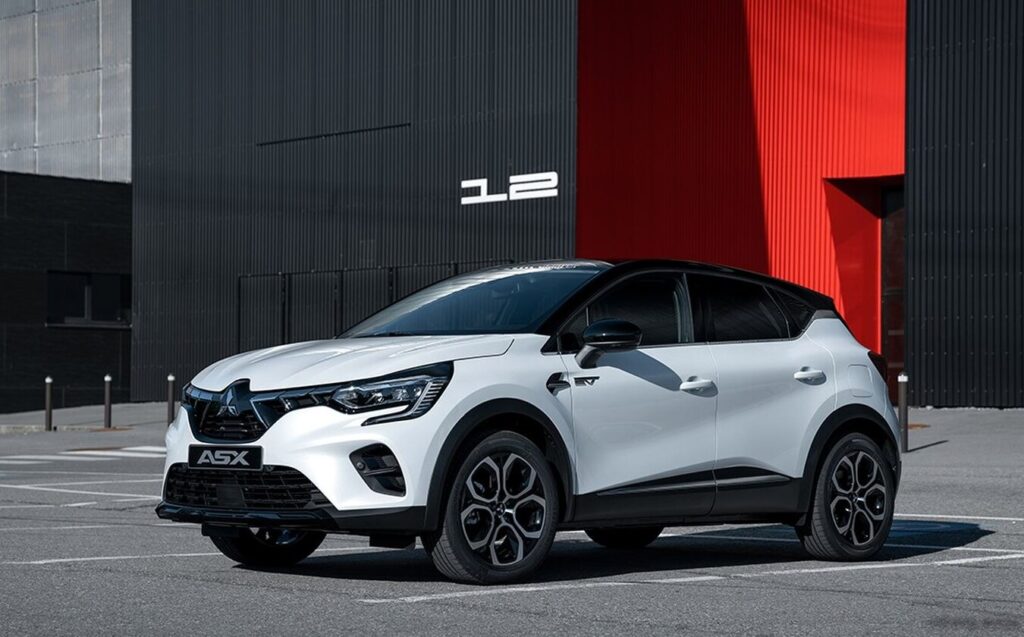
The Mitsubishi ASX II 1.3 Turbo (140 Hp) Mild Hybrid represents a significant update to Mitsubishi’s popular compact crossover SUV, launched in March 2023 and continuing through June 2024. This variant occupies a key position in the ASX II lineup, offering a balance between fuel efficiency, performance, and affordability. It’s designed to appeal to buyers seeking a modern, practical, and technologically advanced vehicle within the competitive C-segment crossover market. The ASX II is primarily marketed in Europe and other regions outside of North America, where Mitsubishi’s presence is more limited.
Technical Specifications
| Brand | Mitsubishi |
| Model | ASX |
| Generation | ASX II |
| Type (Engine) | 1.3 Turbo (140 Hp) Mild Hybrid |
| Start of production | March, 2023 |
| End of production | June, 2024 |
| Powertrain Architecture | MHEV (Mild Hybrid Electric Vehicle) |
| Body type | SUV, Crossover |
| Seats | 5 |
| Doors | 5 |
| Fuel consumption at Low speed (WLTP) | 7-7.4 l/100 km (33.6 – 31.8 US mpg) |
| Fuel consumption at Medium speed (WLTP) | 5.3-5.7 l/100 km (44.4 – 41.3 US mpg) |
| Fuel consumption at high speed (WLTP) | 4.9-5.3 l/100 km (48 – 44.4 US mpg) |
| Fuel consumption at very high speed (WLTP) | 6.1-6.5 l/100 km (38.6 – 36.2 US mpg) |
| Combined fuel consumption (WLTP) | 5.7-6.1 l/100 km (41.3 – 38.6 US mpg) |
| CO2 emissions (WLTP) | 129-138 g/km |
| Fuel Type | Petrol (Gasoline) |
| Acceleration 0 – 100 km/h | 10.3 sec |
| Acceleration 0 – 62 mph | 10.3 sec |
| Acceleration 0 – 60 mph | 9.8 sec |
| Maximum speed | 196 km/h (121.79 mph) |
| Emission standard | Euro 6d |
| Weight-to-power ratio | 9.5 kg/Hp |
| Weight-to-torque ratio | 5.1 kg/Nm |
| Battery voltage | 12 V |
| Power | 140 Hp @ 4500-6000 rpm |
| Torque | 260 Nm @ 1750-3500 rpm (191.77 lb.-ft.) |
| Engine layout | Front, Transverse |
| Engine displacement | 1333 cm3 (81.34 cu. in.) |
| Number of cylinders | 4 |
| Engine configuration | Inline |
| Cylinder Bore | 72.2 mm (2.84 in.) |
| Piston Stroke | 81.34 mm (3.2 in.) |
| Compression ratio | 10.5:1 |
| Number of valves per cylinder | 4 |
| Fuel injection system | Direct injection |
| Engine aspiration | Turbocharger, Intercooler |
| Valvetrain | DOHC |
| Kerb Weight | 1324 kg (2918.92 lbs.) |
| Max. weight | 1799 kg (3966.12 lbs.) |
| Max load | 475 kg (1047.2 lbs.) |
| Trunk (boot) space – minimum | 422-536 l (14.9 – 18.93 cu. ft.) |
| Trunk (boot) space – maximum | 1275 l (45.03 cu. ft.) |
| Fuel tank capacity | 48 l (12.68 US gal) |
| Max. roof load | 80 kg (176.37 lbs.) |
| Permitted trailer load with brakes (12%) | 1200 kg (2645.55 lbs.) |
| Permitted trailer load without brakes | 665 kg (1466.07 lbs.) |
| Permitted towbar download | 75 kg (165.35 lbs.) |
| Length | 4227 mm (166.42 in.) |
| Width | 1797 mm (70.75 in.) |
| Width including mirrors | 2003 mm (78.86 in.) |
| Height | 1585 mm (62.4 in.) |
| Wheelbase | 2639 mm (103.9 in.) |
| Front track | 1560 mm (61.42 in.) |
| Rear (Back) track | 1547 mm (60.91 in.) |
| Front overhang | 876 mm (34.49 in.) |
| Rear overhang | 712 mm (28.03 in.) |
| Ride height (ground clearance) | 174 mm (6.85 in.) |
| Minimum turning circle | 11.1 m (36.42 ft.) |
| Drivetrain Architecture | Front wheel drive, MHEV |
| Number of gears and type of gearbox | 6 gears, manual transmission |
| Front suspension | Independent type McPherson |
| Rear suspension | Torsion |
| Front brakes | Ventilated discs |
| Rear brakes | Drum |
| Tires size | 215/60 R17 |
| Wheel rims size | 7J x 17 |
INTRODUCTION
The Mitsubishi ASX II 1.3 Turbo Mild Hybrid, introduced in 2023, is a key component of the second-generation ASX lineup. Built on the Renault-Nissan-Mitsubishi Alliance’s CMF-B platform, it shares its underpinnings with the Renault Captur and Nissan Juke. This collaboration allows Mitsubishi to offer a competitive crossover at a reasonable price point. The 1.3 Turbo Mild Hybrid variant is positioned as a mid-range option, offering a step up in performance and fuel efficiency compared to the base models while remaining more accessible than the higher-spec trims. It’s aimed at buyers who prioritize practicality, fuel economy, and a comfortable driving experience.
Powertrain & Engine Architecture
At the heart of the ASX II 1.3 Turbo Mild Hybrid lies the H4J412 1.3-liter turbocharged inline-four cylinder engine. This engine utilizes direct fuel injection and a turbocharger with an intercooler to deliver a balance of power and efficiency. The engine produces 140 horsepower at 4,500-6,000 rpm and 260 Nm (191.77 lb.-ft.) of torque between 1,750 and 3,500 rpm. The “Mild Hybrid” designation refers to a 48-volt system that assists the engine during acceleration and allows for extended periods of engine-off coasting, improving fuel economy. The system includes a belt-driven starter-generator (BSG) and a small lithium-ion battery. The engine is paired with a 6-speed manual transmission, directing power to the front wheels. The engine features a DOHC valvetrain and incorporates a particulate filter to meet stringent Euro 6d emission standards.
Driving Characteristics
The 1.3 Turbo Mild Hybrid powertrain delivers adequate performance for everyday driving. Acceleration from 0-100 km/h (0-62 mph) takes approximately 10.3 seconds. While not particularly sporty, the turbocharger provides a noticeable boost in power during overtaking maneuvers. The mild hybrid system contributes to smoother acceleration from a standstill and helps to reduce turbo lag. The 6-speed manual transmission offers precise shifts, and the gear ratios are well-suited for both city and highway driving. Compared to higher-output versions (if available in other markets), this variant prioritizes fuel efficiency over outright performance. The manual transmission provides a more engaging driving experience than an automatic, but requires more driver involvement.
Equipment & Trim Levels
The ASX II 1.3 Turbo Mild Hybrid typically comes equipped with a range of standard features, including air conditioning, a touchscreen infotainment system with smartphone integration (Apple CarPlay and Android Auto), Bluetooth connectivity, and a suite of safety features such as automatic emergency braking, lane departure warning, and traffic sign recognition. Interior upholstery is typically cloth, with options for upgraded materials available. Higher trim levels may add features like a larger touchscreen, navigation system, a rearview camera, parking sensors, and keyless entry. Optional extras often include a panoramic sunroof, heated seats, and premium audio systems.
Chassis & Braking
The ASX II utilizes a McPherson strut front suspension and a torsion beam rear suspension. This setup provides a comfortable ride quality and predictable handling. The front brakes are ventilated discs, while the rear brakes are drums. This configuration is typical for vehicles in this weight class and price range. The electric power steering provides light and responsive steering feel. The vehicle’s weight of 1324 kg (2918.92 lbs.) contributes to its manageable handling characteristics. Stabilizer bars are included on both axles to reduce body roll during cornering.
Market Reception & Comparison
The Mitsubishi ASX II 1.3 Turbo Mild Hybrid has been generally well-received by automotive critics, who praise its fuel efficiency, comfortable ride, and modern features. Compared to other trims in the ASX II lineup, the 1.3 Turbo Mild Hybrid offers a good balance between performance and economy. It’s a more compelling option than the base engine for drivers who frequently travel on highways or carry passengers. Fuel economy figures of 5.7-6.1 l/100 km (41.3 – 38.6 US mpg) are competitive within the C-segment crossover class. Reliability is expected to be good, given Mitsubishi’s reputation for building durable vehicles, although long-term data is still emerging.
Legacy
The Mitsubishi ASX II 1.3 Turbo Mild Hybrid represents a step forward in Mitsubishi’s efforts to offer fuel-efficient and technologically advanced vehicles. The 1.3-liter turbocharged engine and mild hybrid system are expected to provide reliable performance for years to come. As the model matures, its position in the used car market will likely be strong, particularly among buyers seeking a practical and economical crossover SUV. The integration of Renault-Nissan-Mitsubishi Alliance technology suggests a continued focus on cost-effectiveness and shared development, potentially leading to further improvements in future iterations of the ASX.