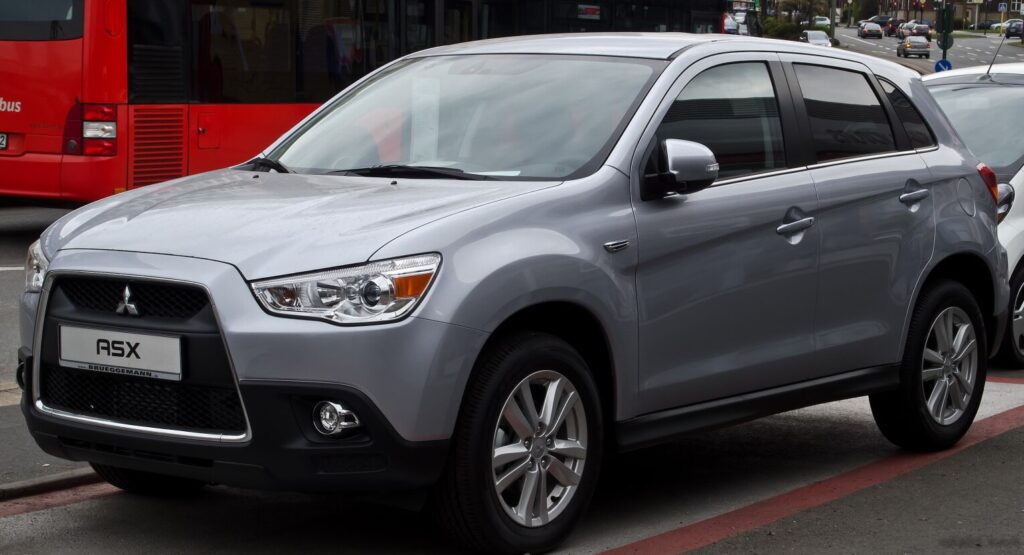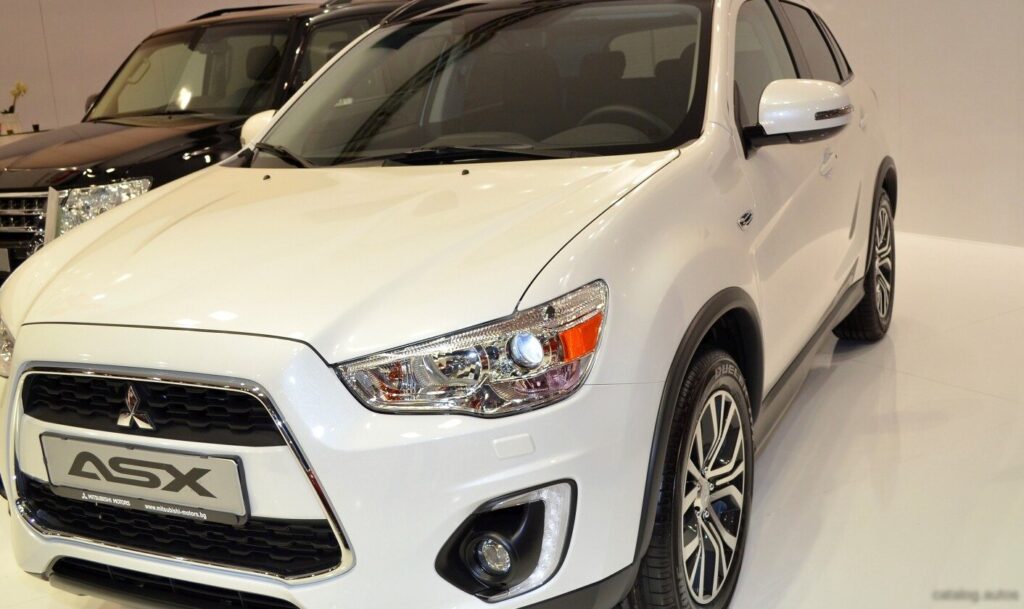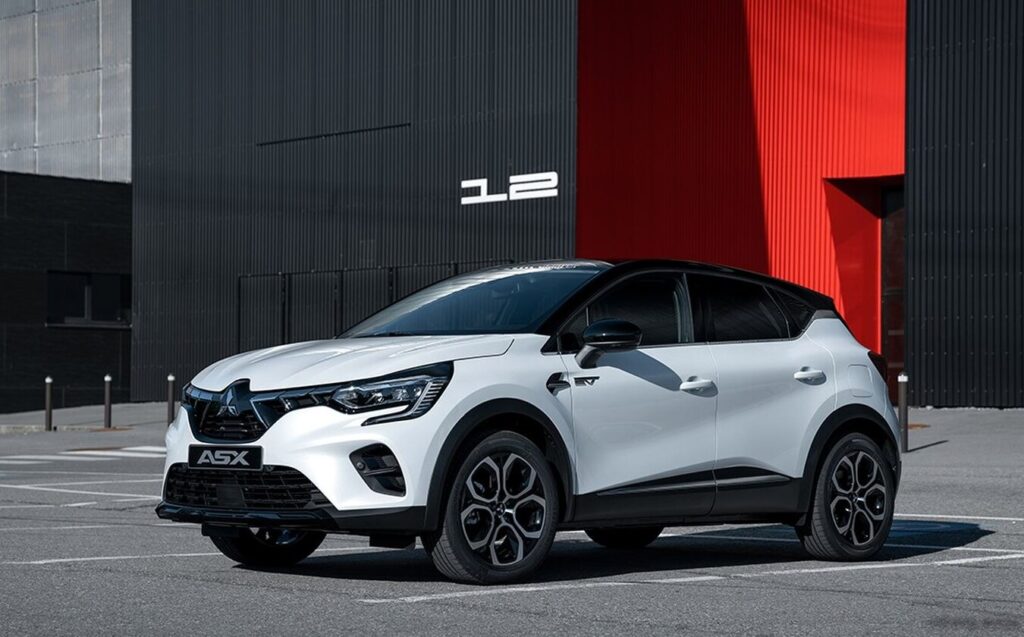
The Mitsubishi ASX II 1.6 (143 Hp) Hybrid Multi-Mode is a compact crossover SUV produced by Mitsubishi Motors from March 2023 to June 2024. It represents a significant update to the ASX line, incorporating a full hybrid electric vehicle (FHEV) powertrain. This variant was positioned as a fuel-efficient and technologically advanced option within the broader ASX II range, appealing to buyers seeking lower running costs and reduced emissions. The ASX II itself is based on the Renault-Nissan-Mitsubishi Alliance’s CMF-B platform, shared with models like the Renault Captur and Nissan Juke.
Technical Specifications
| Brand | Mitsubishi |
| Model | ASX |
| Generation | ASX II |
| Type (Engine) | 1.6 (143 Hp) Hybrid Multi-Mode |
| Start of production | March, 2023 |
| End of production | June, 2024 |
| Powertrain Architecture | FHEV (Full Hybrid Electric Vehicle) |
| Body type | SUV, Crossover |
| Seats | 5 |
| Doors | 5 |
| Fuel consumption at Low speed (WLTP) | 4.4-5.1 l/100 km (53.5 – 46.1 US mpg, 64.2 – 55.4 UK mpg, 22.7 – 19.6 km/l) |
| Fuel consumption at Medium speed (WLTP) | 4.2-4.4 l/100 km (56 – 53.5 US mpg, 67.3 – 64.2 UK mpg, 23.8 – 22.7 km/l) |
| Fuel consumption at high speed (WLTP) | 4.3-4.5 l/100 km (54.7 – 52.3 US mpg, 65.7 – 62.8 UK mpg, 23.3 – 22.2 km/l) |
| Fuel consumption at very high speed (WLTP) | 5.5-5.9 l/100 km (42.8 – 39.9 US mpg, 51.4 – 47.9 UK mpg, 18.2 – 16.9 km/l) |
| Combined fuel consumption (WLTP) | 4.7-5.1 l/100 km (50 – 46.1 US mpg, 60.1 – 55.4 UK mpg, 21.3 – 19.6 km/l) |
| CO2 emissions (WLTP) | 106-114 g/km |
| Fuel Type | Petrol (Gasoline) |
| Acceleration 0 – 100 km/h | 9.9 sec |
| Acceleration 0 – 62 mph | 9.9 sec |
| Acceleration 0 – 60 mph | 9.4 sec |
| Maximum speed | 170 km/h (105.63 mph) |
| Emission standard | Euro 6d |
| Weight-to-power ratio | 9.9 kg/Hp, 100.7 Hp/tonne |
| Weight-to-torque ratio | 9.6 kg/Nm, 104.2 Nm/tonne |
| Gross battery capacity | 1.3 kWh |
| Battery voltage | 285 V |
| Battery technology | Lithium-ion (Li-Ion) |
| Electric motor power | 49 Hp |
| Electric motor Torque | 205 Nm (151.2 lb.-ft.) |
| Electric motor location | Integrated into the transmission |
| Electric motor type | Synchronous |
| System power | 143 Hp |
| Power | 94 Hp @ 5600 rpm |
| Torque | 148 Nm @ 3600 rpm (109.16 lb.-ft. @ 3600 rpm) |
| Engine layout | Front, Transverse |
| Engine Model/Code | H4M 632 |
| Engine displacement | 1598 cm3 (97.52 cu. in.) |
| Number of cylinders | 4 |
| Engine configuration | Inline |
| Cylinder Bore | 78 mm (3.07 in.) |
| Piston Stroke | 83.6 mm (3.29 in.) |
| Compression ratio | 10.8:1 |
| Number of valves per cylinder | 4 |
| Fuel injection system | Multi-port manifold injection |
| Engine aspiration | Naturally aspirated engine |
| Valvetrain | DOHC |
| Kerb Weight | 1420-1438 kg (3130.56 – 3170.25 lbs.) |
| Max. weight | 1896 kg (4179.96 lbs.) |
| Max load | 458-476 kg (1009.72 – 1049.4 lbs.) |
| Trunk (boot) space – minimum | 326-440 l (11.51 – 15.54 cu. ft.) |
| Trunk (boot) space – maximum | 1149 l (40.58 cu. ft.) |
| Fuel tank capacity | 48 l (12.68 US gal | 10.56 UK gal) |
| Max. roof load | 80 kg (176.37 lbs.) |
| Permitted trailer load with brakes (12%) | 750 kg (1653.47 lbs.) |
| Permitted trailer load without brakes | 720 kg (1587.33 lbs.) |
| Permitted towbar download | 75 kg (165.35 lbs.) |
| Length | 4227 mm (166.42 in.) |
| Width | 1797 mm (70.75 in.) |
| Width including mirrors | 2003 mm (78.86 in.) |
| Height | 1585 mm (62.4 in.) |
| Wheelbase | 2639 mm (103.9 in.) |
| Front track | 1560 mm (61.42 in.) |
| Rear (Back) track | 1547 mm (60.91 in.) |
| Front overhang | 876 mm (34.49 in.) |
| Rear overhang | 712 mm (28.03 in.) |
| Ride height (ground clearance) | 174 mm (6.85 in.) |
| Minimum turning circle (turning diameter) | 11.1 m (36.42 ft.) |
| Drivetrain Architecture | The Internal combustion engine (ICE) and electric motor drive the front wheels of the car with the ability to work in full electric or mixed mode. |
| Drive wheel | Front wheel drive |
| Number of gears and type of gearbox | 6 gears, automatic transmission Multi-Mode |
| Front suspension | Independent type McPherson |
| Rear suspension | Torsion |
| Front brakes | Ventilated discs |
| Rear brakes | Disc |
| Assisting systems | ABS (Anti-lock braking system) |
| Steering type | Steering rack and pinion |
| Power steering | Electric Steering |
| Tires size | 215/60 R17; 215/55 R18 |
| Wheel rims size | 7J x 17; 7J x 18 |
INTRODUCTION
The Mitsubishi ASX II 1.6 Hybrid Multi-Mode, launched in 2023, represents Mitsubishi’s entry into the increasingly competitive compact hybrid SUV segment. Building upon the foundation of the second-generation ASX, this variant combines a 1.6-liter petrol engine with an electric motor and a multi-mode automatic transmission to deliver improved fuel efficiency and reduced emissions. The ASX has historically been a significant model for Mitsubishi in Europe and other global markets, offering a practical and affordable SUV option. This hybrid version aimed to broaden its appeal to environmentally conscious buyers. The “Multi-Mode” transmission is a key feature, allowing for various driving modes including electric-only operation at lower speeds.
Powertrain & Engine Architecture
At the heart of the ASX II 1.6 Hybrid is the H4M 632 1.6-liter inline-four cylinder petrol engine. This engine produces 94 horsepower at 5600 rpm and 148 Nm (109.16 lb-ft) of torque at 3600 rpm. It utilizes multi-port fuel injection and a double overhead camshaft (DOHC) valvetrain. The engine is naturally aspirated, meaning it doesn’t employ a turbocharger. The hybrid system adds a 49 hp electric motor, integrated with the multi-mode automatic transmission, boosting the total system output to 143 hp. The 1.3 kWh lithium-ion battery pack provides energy storage for the electric motor. The multi-mode transmission isn’t a traditional continuously variable transmission (CVT) but rather a sophisticated automated manual transmission that can operate in various modes, including EV, series hybrid, and parallel hybrid, optimizing for efficiency or performance as needed. The system also incorporates a Start & Stop system to further reduce fuel consumption during idling.
Driving Characteristics
The 1.6 Hybrid Multi-Mode ASX offers a comfortable and refined driving experience, particularly in urban environments. The electric motor provides instant torque, resulting in brisk acceleration from a standstill. The multi-mode transmission generally shifts smoothly, although it can occasionally feel less responsive than a traditional automatic during aggressive acceleration. The combined output of 143 hp provides adequate performance for everyday driving, with a 0-100 km/h (0-62 mph) time of 9.9 seconds. Compared to higher-powered ASX variants, this version prioritizes fuel economy over outright speed. The hybrid system allows for short distances of electric-only driving, further enhancing efficiency in city traffic. The steering is light and precise, making it easy to maneuver in tight spaces. The suspension is tuned for comfort, absorbing bumps and imperfections in the road surface effectively.
Equipment & Trim Levels
The ASX II 1.6 Hybrid Multi-Mode typically came equipped with a generous array of standard features. These included air conditioning, a touchscreen infotainment system with smartphone integration (Apple CarPlay and Android Auto), Bluetooth connectivity, and a suite of safety features such as ABS, electronic stability control, and multiple airbags. Higher trim levels offered additional features like a larger touchscreen display, navigation system, a rearview camera, parking sensors, and premium interior upholstery. Optional extras often included a panoramic sunroof, heated seats, and advanced driver-assistance systems (ADAS) such as adaptive cruise control and lane departure warning.
Chassis & Braking
The ASX II utilizes a front-wheel-drive configuration. The front suspension employs an independent McPherson strut setup, while the rear suspension features a torsion beam. This configuration provides a good balance between ride comfort and handling. The braking system consists of ventilated discs at the front and solid discs at the rear, providing adequate stopping power. ABS (Anti-lock Braking System) is standard, enhancing safety during emergency braking situations. The vehicle’s weight, ranging from 1420-1438 kg (3130.56 – 3170.25 lbs.), is relatively moderate for its class, contributing to its manageable handling characteristics.
Market Reception & Comparison
The Mitsubishi ASX II 1.6 Hybrid Multi-Mode was generally well-received by automotive critics for its fuel efficiency and comfortable ride. However, some reviewers noted that its performance wasn’t as exhilarating as some of its rivals. Compared to other ASX trims, such as those powered by petrol engines without hybrid assistance, the 1.6 Hybrid offered significantly improved fuel economy, but at a slightly higher purchase price. Against competitors like the Toyota C-HR Hybrid and Nissan Juke Hybrid, the ASX II offered a competitive package in terms of price, features, and fuel efficiency. Its real-world fuel consumption figures of 4.7-5.1 l/100 km (50-46.1 US mpg) were a key selling point.
Legacy
The Mitsubishi ASX II 1.6 Hybrid Multi-Mode, despite its relatively short production run, represents an important step in Mitsubishi’s electrification strategy. The powertrain, while not without its quirks, proved to be reasonably reliable in early reports. On the used car market, these models are likely to appeal to buyers seeking a fuel-efficient and well-equipped compact SUV. The longevity of the hybrid components, particularly the battery pack, will be a key factor in determining the long-term value of these vehicles. The ASX II 1.6 Hybrid’s contribution lies in offering a practical and accessible hybrid option within the competitive crossover SUV segment.