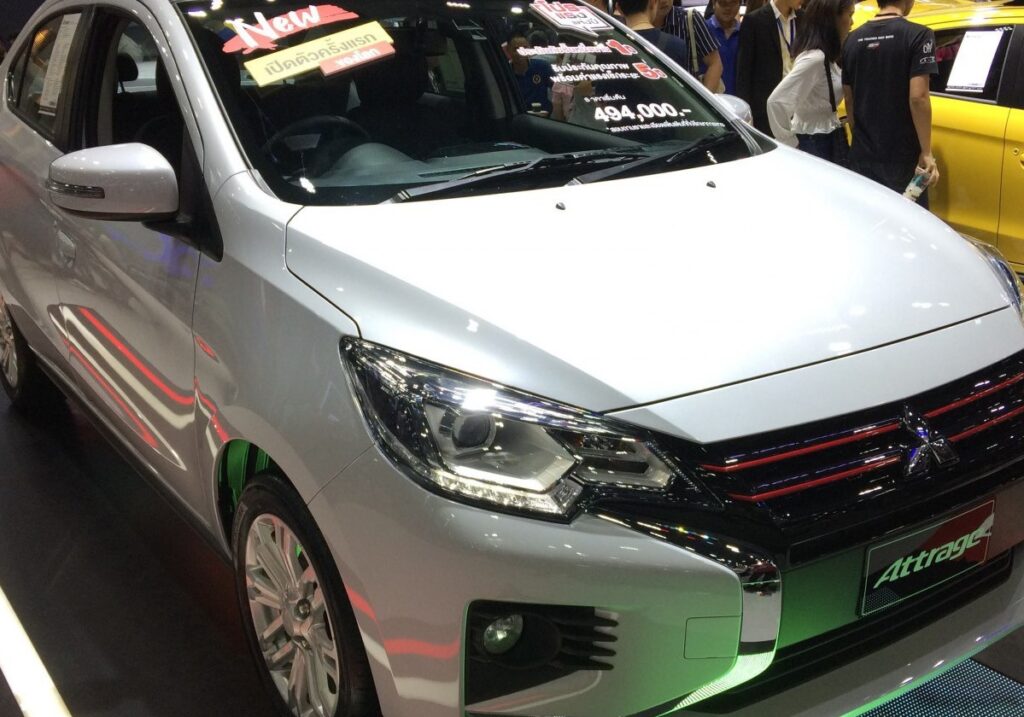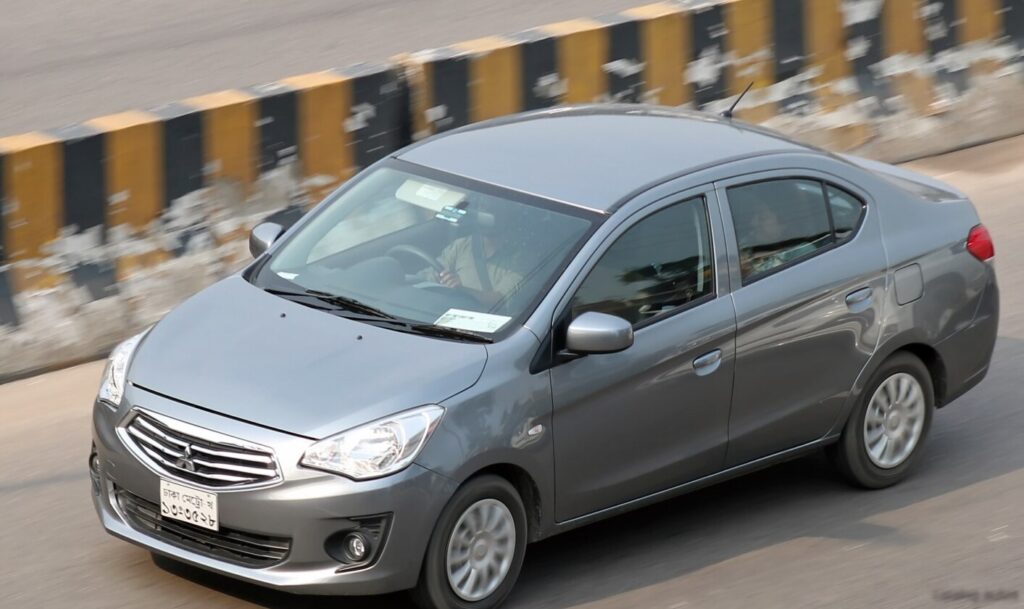
The Mitsubishi Attrage (A10), specifically the 1.2 MIVEC variant producing 78 horsepower, was a subcompact sedan manufactured by Mitsubishi Motors from 2013 to 2019. Positioned as an entry-level offering within the Attrage lineup, it primarily served markets in Southeast Asia, the Philippines, and parts of Latin America. The A10 generation Attrage represented Mitsubishi’s attempt to provide an affordable and fuel-efficient vehicle in a segment dominated by competitors like the Toyota Vios and Honda City. This model was not officially sold in the United States.
Technical Specifications
| Brand | Mitsubishi |
| Model | Attrage |
| Generation | Attrage (A10) |
| Type (Engine) | 1.2 MIVEC (78 Hp) |
| Start of production | 2013 |
| End of production | 2019 |
| Powertrain Architecture | Internal Combustion engine |
| Body type | Sedan |
| Seats | 5 |
| Doors | 4 |
| Fuel Type | Petrol (Gasoline) |
| Weight-to-power ratio | 11.3 kg/Hp, 88.1 Hp/tonne |
| Weight-to-torque ratio | 8.9 kg/Nm, 113 Nm/tonne |
| Power | 78 Hp @ 6000 rpm |
| Power per litre | 65.4 Hp/l |
| Torque | 100 Nm @ 4000 rpm (73.76 lb.-ft. @ 4000 rpm) |
| Engine layout | Front, Transverse |
| Engine Model/Code | 3A92 |
| Engine displacement | 1193 cm3 (72.8 cu. in.) |
| Number of cylinders | 3 |
| Engine configuration | Inline |
| Cylinder Bore | 75 mm (2.95 in.) |
| Piston Stroke | 90 mm (3.54 in.) |
| Compression ratio | 10.5:1 |
| Number of valves per cylinder | 4 |
| Fuel injection system | Multi-port manifold injection |
| Engine aspiration | Naturally aspirated engine |
| Valvetrain | DOHC |
| Engine oil capacity | 3 l (3.17 US qt | 2.64 UK qt) |
| Coolant capacity | 4 l (4.23 US qt | 3.52 UK qt) |
| Kerb Weight | 885 kg (1951.09 lbs.) |
| Fuel tank capacity | 42 l (11.1 US gal | 9.24 UK gal) |
| Length | 4245 mm (167.13 in.) |
| Width | 1670 mm (65.75 in.) |
| Height | 1515 mm (59.65 in.) |
| Wheelbase | 2550 mm (100.39 in.) |
| Front track | 1445 mm (56.89 in.) |
| Rear track | 1430 mm (56.3 in.) |
| Front overhang | 795 mm (31.3 in.) |
| Rear overhang | 900 mm (35.43 in.) |
| Ride height (ground clearance) | 170 mm (6.69 in.) |
| Minimum turning circle | 9.6 m (31.5 ft.) |
| Drivetrain Architecture | Front wheel drive |
| Number of gears and type of gearbox | 5 gears, manual transmission |
| Front suspension | Independent type McPherson |
| Rear suspension | Torsion |
| Front brakes | Ventilated discs |
| Rear brakes | Drum |
| Assisting systems | ABS (Anti-lock braking system) |
| Steering type | Steering rack and pinion |
| Power steering | Electric Steering |
| Tires size | 175/65 R14 |
Powertrain & Engine Architecture
The heart of the Attrage 1.2 MIVEC is the 3A92 engine, a 1.2-liter inline-three cylinder gasoline engine. This engine utilizes Mitsubishi’s MIVEC (Mitsubishi Innovative Valve timing Electronic Control) technology, which continuously adjusts the intake valve timing to optimize performance and fuel efficiency across the engine’s operating range. The 3A92 is a naturally aspirated engine, relying on atmospheric pressure for intake, and employs a multi-point fuel injection system. The engine’s relatively simple design contributed to its affordability and ease of maintenance. The 78 horsepower and 100 Nm (74 lb-ft) of torque were delivered at 6000 and 4000 rpm respectively. The standard transmission for this variant was a five-speed manual gearbox, designed for durability and cost-effectiveness. An optional four-speed automatic transmission was available, but it impacted fuel economy and performance.
Driving Characteristics
The 1.2L MIVEC engine paired with the five-speed manual transmission provided adequate, though not exhilarating, performance. Acceleration was modest, and the vehicle was best suited for city driving and shorter commutes. The lightweight nature of the Attrage (885 kg / 1951 lbs) helped to mitigate the effects of the relatively low horsepower output. The manual transmission offered precise shifts, but the gear ratios were tuned for fuel economy rather than sporty driving. Compared to potential higher-spec variants (which were not widely available in many markets), this version lacked the punch needed for highway overtaking or spirited driving. The automatic transmission further dulled performance, resulting in noticeable hesitation during acceleration.
Equipment & Trim Levels
The Attrage 1.2 MIVEC typically came with a basic level of equipment. Standard features generally included air conditioning, power windows, and a basic audio system with AM/FM radio and USB connectivity. Safety features were also limited, usually consisting of dual front airbags and ABS (Anti-lock Braking System). Higher trim levels, when available, added features like alloy wheels, a more sophisticated audio system, and keyless entry. Interior upholstery was typically cloth, and the dashboard design was functional but lacked premium materials. Optional extras included a rear parking sensor and a navigation system.
Chassis & Braking
The Attrage A10 utilized a front-engine, front-wheel-drive layout. The front suspension consisted of independent McPherson struts, providing a reasonable level of ride comfort. The rear suspension employed a torsion beam setup, which was a cost-effective solution for maintaining rear stability. Braking duties were handled by ventilated discs at the front and drum brakes at the rear. The braking system, while adequate for everyday driving, lacked the stopping power of more advanced setups. The electric power steering provided light and easy steering, making it convenient for maneuvering in urban environments.
Market Reception & Comparison
The Mitsubishi Attrage 1.2 MIVEC was generally well-received as an affordable and fuel-efficient option in its target markets. Critics praised its low running costs and practicality, but noted its lack of refinement and performance. Compared to competitors like the Toyota Vios and Honda City, the Attrage offered a lower price point but lacked the same level of build quality and driving experience. Fuel economy was a strong point, with the manual transmission version achieving around 5.8 liters per 100 kilometers (40.6 mpg) in combined driving conditions. Reliability was generally good, although some owners reported minor issues with the air conditioning system.
Legacy
The Mitsubishi Attrage 1.2 MIVEC, while not a groundbreaking vehicle, served as a dependable and economical transportation option for many buyers. The 3A92 engine proved to be relatively reliable, and parts availability remains reasonable in regions where the Attrage was sold. In the used car market, these models are often sought after by first-time car buyers or those looking for a budget-friendly commuter vehicle. While not known for its performance or luxury, the Attrage 1.2 MIVEC represents a practical and affordable entry point into Mitsubishi ownership.