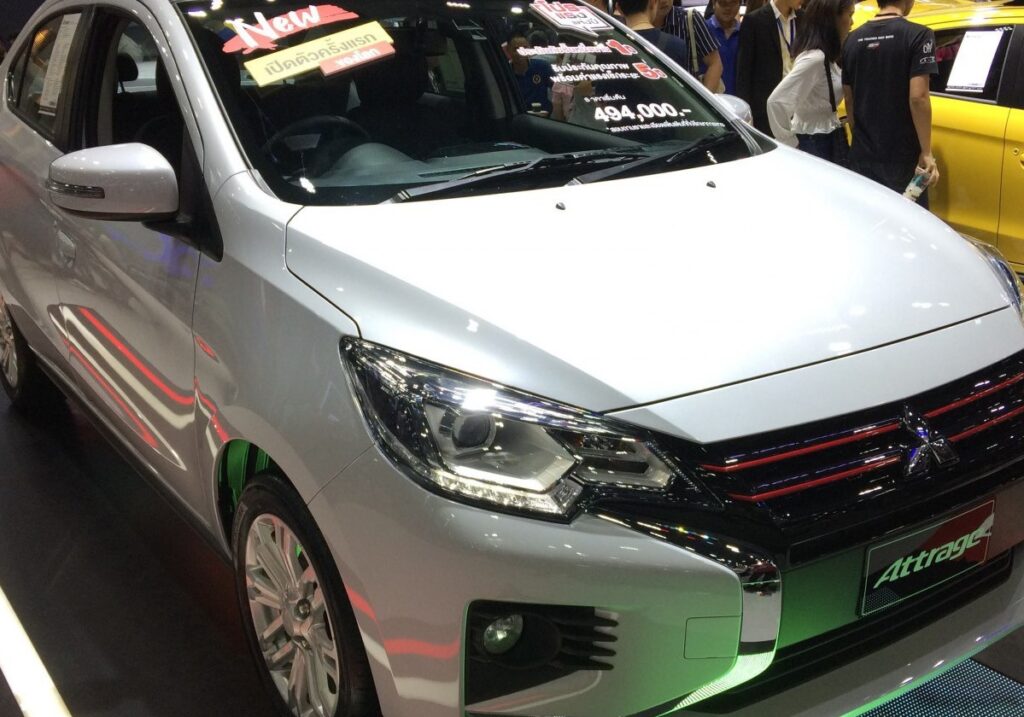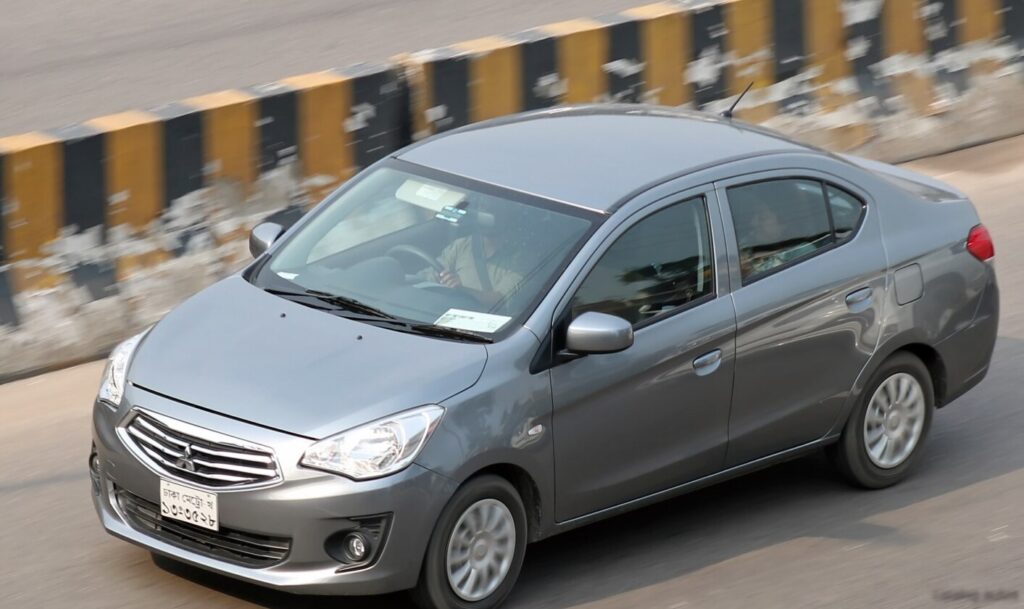
The Mitsubishi Attrage 1.2 MIVEC (78 hp) with a Continuously Variable Transmission (CVT) was a subcompact sedan produced by Mitsubishi Motors from 2013 to 2019. Part of the A10 generation, the Attrage was primarily aimed at emerging markets and budget-conscious buyers, offering an affordable and fuel-efficient transportation solution. In the United States, it was positioned as one of the least expensive new cars available, competing with other entry-level sedans. This particular variant, with its small displacement engine and CVT, represented the base model in many regions, prioritizing economy over outright performance.
Technical Specifications
| Brand | Mitsubishi |
| Model | Attrage |
| Generation | Attrage (A10) |
| Type (Engine) | 1.2 MIVEC (78 Hp) CVT |
| Start of production | 2013 |
| End of production | 2019 |
| Powertrain Architecture | Internal Combustion engine |
| Body type | Sedan |
| Seats | 5 |
| Doors | 4 |
| Fuel Type | Petrol (Gasoline) |
| Weight-to-power ratio | 11.7 kg/Hp, 85.2 Hp/tonne |
| Weight-to-torque ratio | 9.2 kg/Nm, 109.3 Nm/tonne |
| Power | 78 Hp @ 6000 rpm |
| Power per litre | 65.4 Hp/l |
| Torque | 100 Nm @ 4000 rpm (73.76 lb.-ft. @ 4000 rpm) |
| Engine layout | Front, Transverse |
| Engine Model/Code | 3A92 |
| Engine displacement | 1193 cm3 (72.8 cu. in.) |
| Number of cylinders | 3 |
| Engine configuration | Inline |
| Cylinder Bore | 75 mm (2.95 in.) |
| Piston Stroke | 90 mm (3.54 in.) |
| Compression ratio | 10.5:1 |
| Number of valves per cylinder | 4 |
| Fuel injection system | Multi-port manifold injection |
| Engine aspiration | Naturally aspirated engine |
| Valvetrain | DOHC |
| Engine oil capacity | 3 l (3.17 US qt | 2.64 UK qt) |
| Coolant | 4 l (4.23 US qt | 3.52 UK qt) |
| Kerb Weight | 915-930 kg (2017.23 – 2050.3 lbs.) |
| Fuel tank capacity | 42 l (11.1 US gal | 9.24 UK gal) |
| Length | 4245 mm (167.13 in.) |
| Width | 1670 mm (65.75 in.) |
| Height | 1515 mm (59.65 in.) |
| Wheelbase | 2550 mm (100.39 in.) |
| Front track | 1445 mm (56.89 in.) |
| Rear (Back) track | 1430 mm (56.3 in.) |
| Front overhang | 795 mm (31.3 in.) |
| Rear overhang | 900 mm (35.43 in.) |
| Ride height (ground clearance) | 170 mm (6.69 in.) |
| Minimum turning circle (turning diameter) | 9.6 m (31.5 ft.) |
| Drivetrain Architecture | The Internal combustion engine (ICE) drives the front wheels of the vehicle. |
| Drive wheel | Front wheel drive |
| Front suspension | Independent, type McPherson with coil spring and anti-roll bar |
| Rear suspension | Torsion |
| Front brakes | Ventilated discs |
| Rear brakes | Drum |
| Assisting systems | ABS (Anti-lock braking system) |
| Steering type | Steering rack and pinion |
| Power steering | Electric Steering |
| Tires size | 175/65 R14; 185/55 R15 |
Powertrain & Engine Architecture
The heart of the Attrage 1.2 MIVEC is the 3A92 engine, a 1.2-liter inline-three cylinder gasoline engine. This engine utilizes Mitsubishi’s MIVEC (Mitsubishi Innovative Valve timing Electronic Control) technology, which continuously adjusts the intake valve timing to optimize performance and fuel efficiency across the engine’s operating range. The 3A92 is a naturally aspirated engine, relying on atmospheric pressure for intake, and employs multi-point fuel injection. The engine’s relatively simple design contributes to its reliability and ease of maintenance. The engine is paired with a CVT (Continuously Variable Transmission), which provides smooth, stepless gear changes. Unlike traditional automatic transmissions with fixed gear ratios, a CVT uses a belt and pulley system to offer an infinite number of gear ratios within its range, maximizing fuel efficiency.
Driving Characteristics
The 78 horsepower output and CVT pairing resulted in modest, but adequate, performance. Acceleration was not a strong point, with 0-60 mph times estimated around 13-14 seconds. The CVT, while contributing to fuel economy, often resulted in a “rubber band” feel, where engine RPMs would rise quickly under acceleration without a corresponding increase in speed. This was particularly noticeable when attempting to overtake or merge onto highways. The CVT was programmed to prioritize fuel efficiency, holding lower RPMs whenever possible. Compared to potential higher-trim versions with a manual transmission (not widely available in all markets), the 1.2L CVT offered less engaging driving experience but superior fuel economy.
Equipment & Trim Levels
The base-level Attrage 1.2 MIVEC CVT typically came with a fairly basic set of standard features. These generally included air conditioning, power windows, power door locks, and a basic audio system with USB connectivity. Safety features included ABS (Anti-lock Braking System) and dual front airbags. Higher trim levels, when available, added features such as alloy wheels, a more sophisticated audio system, keyless entry, and sometimes a rearview camera. Interior upholstery was typically cloth, with a simple, functional dashboard layout. Options were limited, often restricted to paint colors and perhaps an upgraded audio system.
Chassis & Braking
The Attrage utilized a front-engine, front-wheel-drive layout. The front suspension consisted of an independent McPherson strut setup with coil springs and an anti-roll bar, providing a reasonable level of ride comfort. The rear suspension employed a torsion beam axle, a cost-effective and space-saving design. Braking duties were handled by ventilated discs at the front and drum brakes at the rear. The drum brakes on the rear were a cost-saving measure common in this segment. Steering was rack-and-pinion with electric power assistance, offering light and easy steering feel.
Market Reception & Comparison
The Mitsubishi Attrage 1.2 MIVEC CVT was generally well-received as an affordable and fuel-efficient option in its class. Critics praised its low price point and impressive fuel economy, but often criticized its lack of power and somewhat unrefined driving experience. Compared to other subcompact sedans, such as the Nissan Versa or Hyundai Accent, the Attrage offered a competitive price but often lagged behind in terms of interior refinement and performance. Fuel economy figures typically ranged from 37-40 mpg combined, making it a particularly attractive option for budget-conscious drivers.
Legacy
The Mitsubishi Attrage 1.2 MIVEC CVT, while not a performance icon, served a valuable role in providing affordable transportation. The 3A92 engine proved to be relatively reliable, and the CVT, while sometimes criticized for its driving characteristics, generally held up well over time with proper maintenance. In the used car market, these Attrages are often sought after for their low purchase price and fuel efficiency. However, potential buyers should be aware of the limitations in performance and the importance of maintaining the CVT according to the manufacturer’s recommendations. The Attrage represents a practical and economical choice for those seeking basic, reliable transportation.