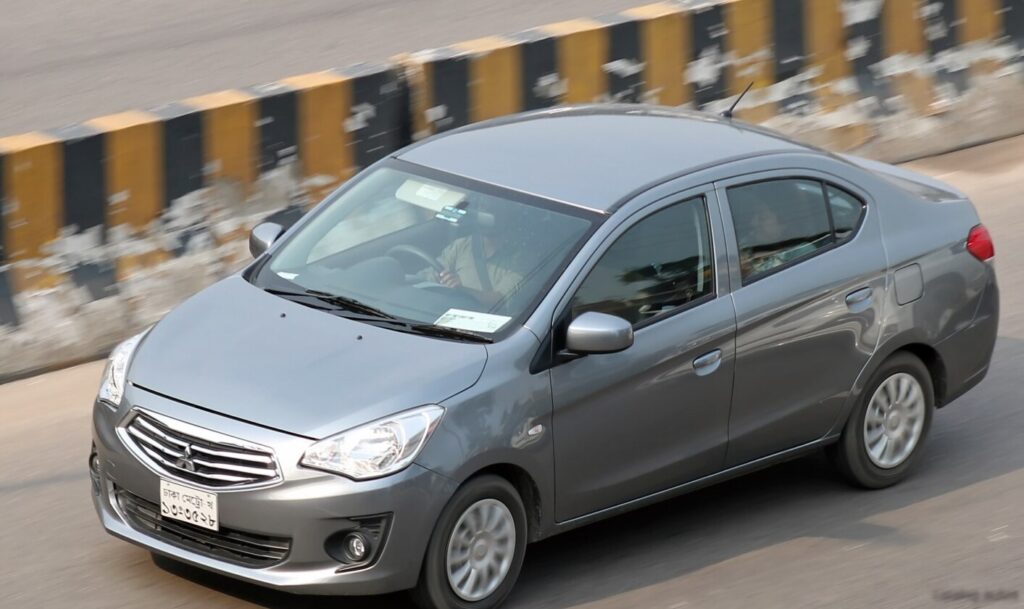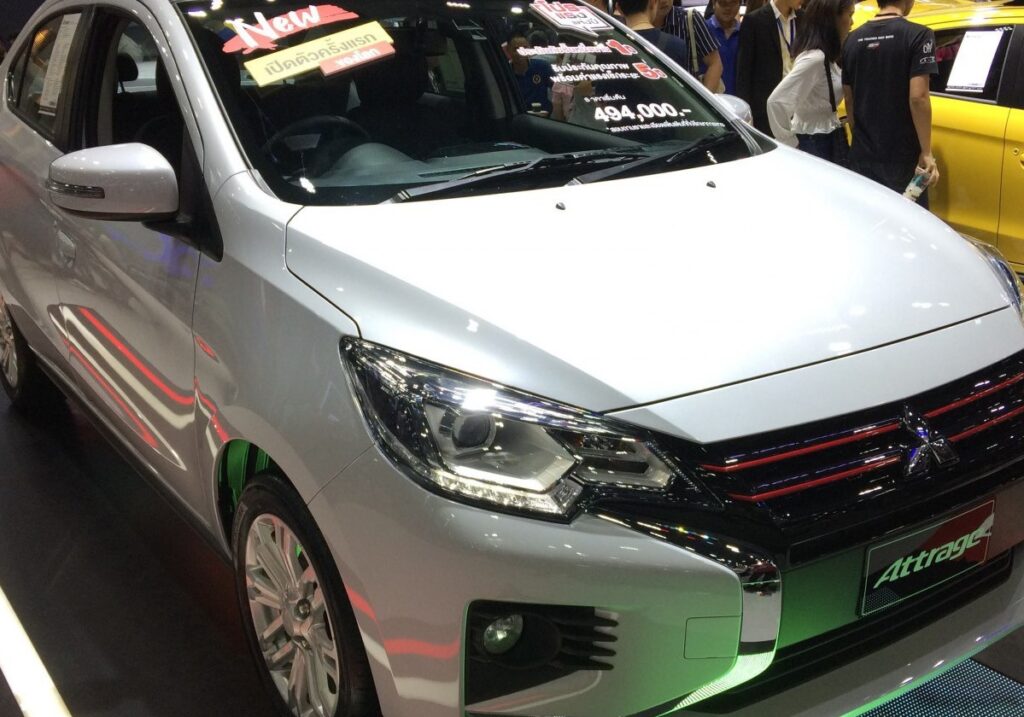
The Mitsubishi Attrage, specifically the A10 facelift model produced from November 2019 onwards with the 1.2-liter MIVEC engine paired with a Continuously Variable Transmission (CVT), represents an entry-level offering within Mitsubishi’s global sedan lineup. Introduced as a budget-friendly and fuel-efficient option, the Attrage primarily targeted emerging markets in Southeast Asia, Latin America, and parts of Africa. While not officially sold in the United States, it’s a significant model for Mitsubishi in regions where compact, affordable sedans are in high demand. This variant, producing 78 horsepower, occupied the base trim level, focusing on practicality and economy over outright performance.
Technical Specifications
| Brand | Mitsubishi |
| Model | Attrage |
| Generation | Attrage (A10, facelift 2019) |
| Type (Engine) | 1.2 MIVEC (78 Hp) CVT |
| Start of production | November, 2019 |
| Powertrain Architecture | Internal Combustion engine |
| Body type | Sedan |
| Seats | 5 |
| Doors | 4 |
| Fuel Type | Petrol (Gasoline) |
| Weight-to-power ratio | 12.1 kg/Hp, 82.7 Hp/tonne |
| Weight-to-torque ratio | 9.4 kg/Nm, 106 Nm/tonne |
| Power | 78 Hp @ 6000 rpm |
| Power per litre | 65.4 Hp/l |
| Torque | 100 Nm @ 4000 rpm, 73.76 lb.-ft. @ 4000 rpm |
| Engine layout | Front, Transverse |
| Engine Model/Code | 3A92 |
| Engine displacement | 1193 cm3, 72.8 cu. in. |
| Number of cylinders | 3 |
| Engine configuration | Inline |
| Cylinder Bore | 75 mm, 2.95 in. |
| Piston Stroke | 90 mm, 3.54 in. |
| Compression ratio | 10.5:1 |
| Number of valves per cylinder | 4 |
| Fuel injection system | Multi-port manifold injection |
| Engine aspiration | Naturally aspirated engine |
| Valvetrain | DOHC |
| Engine oil capacity | 3 l, 3.17 US qt | 2.64 UK qt |
| Coolant | 4.6 l, 4.86 US qt | 4.05 UK qt |
| Kerb Weight | 943-958 kg, 2078.96 – 2112.03 lbs. |
| Fuel tank capacity | 42 l, 11.1 US gal | 9.24 UK gal |
| Length | 4305 mm, 169.49 in. |
| Width | 1670 mm, 65.75 in. |
| Height | 1515 mm, 59.65 in. |
| Wheelbase | 2550 mm, 100.39 in. |
| Front track | 1445 mm, 56.89 in. |
| Rear (Back) track | 1430 mm, 56.3 in. |
| Ride height (ground clearance) | 170 mm, 6.69 in. |
| Minimum turning circle (turning diameter) | 9.6 m, 31.5 ft. |
| Drivetrain Architecture | The Internal combustion engine (ICE) drives the front wheels of the vehicle. |
| Drive wheel | Front wheel drive |
| Number of gears and type of gearbox | automatic transmission CVT |
| Front suspension | Independent, type McPherson with coil spring and anti-roll bar |
| Rear suspension | Torsion |
| Front brakes | Ventilated discs |
| Rear brakes | Drum |
| Assisting systems | ABS (Anti-lock braking system) |
| Steering type | Steering rack and pinion |
| Power steering | Electric Steering |
| Tires size | 175/65 R14; 185/55 R15 |
| Wheel rims size | 5.0J x 14; 5.5J x 15 |
Powertrain & Engine Architecture
The heart of this Attrage variant is the 3A92 1.2-liter inline-three cylinder engine. This engine utilizes Mitsubishi’s MIVEC (Mitsubishi Innovative Valve timing Electronic Control) technology, which continuously adjusts the intake valve timing to optimize performance and fuel efficiency across the engine’s operating range. The 3A92 is a naturally aspirated engine, relying on conventional multi-point fuel injection. It’s a relatively simple design, contributing to its reliability and ease of maintenance. The engine produces 78 horsepower at 6000 rpm and 100 Nm (74 lb-ft) of torque at 4000 rpm. This power is then sent to the front wheels via a Continuously Variable Transmission (CVT). The CVT is designed to provide smooth, stepless acceleration and maximize fuel economy by keeping the engine operating in its most efficient range. Unlike traditional automatic transmissions with fixed gear ratios, the CVT offers an infinite number of ratios within its operating range.
Driving Characteristics
The 1.2L MIVEC/CVT combination in the Attrage prioritizes fuel economy and ease of driving over sporty performance. Acceleration is adequate for city driving and highway merging, but it’s not particularly brisk. The CVT contributes to a smooth driving experience, eliminating the shift shock often associated with traditional automatics. However, some drivers may find the CVT’s tendency to hold the engine at a constant rpm during acceleration to be somewhat droning. Compared to potential manual transmission versions (not widely available in all markets), the CVT offers less driver engagement but greater convenience. Higher trim levels with more powerful engines offered noticeably quicker acceleration and a more responsive driving experience, but at the cost of fuel efficiency.
Equipment & Trim Levels
The base-level Attrage 1.2 MIVEC CVT typically came equipped with essential features such as air conditioning, power windows, power door locks, and a basic audio system. Safety features generally included dual front airbags and ABS (Anti-lock Braking System). Interior upholstery was typically cloth, and the dashboard featured a functional but minimalist design. Optional extras, depending on the market, could include alloy wheels, a touchscreen infotainment system, and rear parking sensors. The focus was on providing a practical and affordable vehicle with the necessary amenities for everyday use.
Chassis & Braking
The Attrage utilizes a front-engine, front-wheel-drive layout. The front suspension consists of independent McPherson struts with coil springs and an anti-roll bar, while the rear suspension employs a torsion beam setup. This configuration provides a comfortable ride quality, although it’s not particularly sporty. The braking system features ventilated discs on the front wheels and drum brakes on the rear. The use of drum brakes on the rear was a cost-saving measure common in this segment. Electric power steering provides light and easy steering feel, making it well-suited for urban driving.
Market Reception & Comparison
The Mitsubishi Attrage 1.2 MIVEC CVT was generally well-received in its target markets as a practical and affordable sedan. Critics praised its fuel efficiency and comfortable ride, but noted its lack of performance. Compared to other trims in the Attrage lineup, such as those with larger engines, the 1.2L variant offered the lowest price point and the best fuel economy. However, it also provided the least amount of power and the slowest acceleration. Competitors in this segment included the Toyota Yaris Ativ (Vios), Honda Amaze, and Nissan Almera, all of which offered similar levels of practicality and affordability.
Legacy
The 3A92 1.2L MIVEC engine and the CVT transmission pairing in the Attrage have proven to be relatively reliable in real-world use. The engine’s simple design and the CVT’s robust construction contribute to its durability. In the used car market, the Attrage 1.2 MIVEC CVT remains a popular choice for budget-conscious buyers seeking a fuel-efficient and dependable sedan. While it may not offer the excitement of more powerful vehicles, its practicality and affordability have ensured its continued relevance in the compact car segment.