
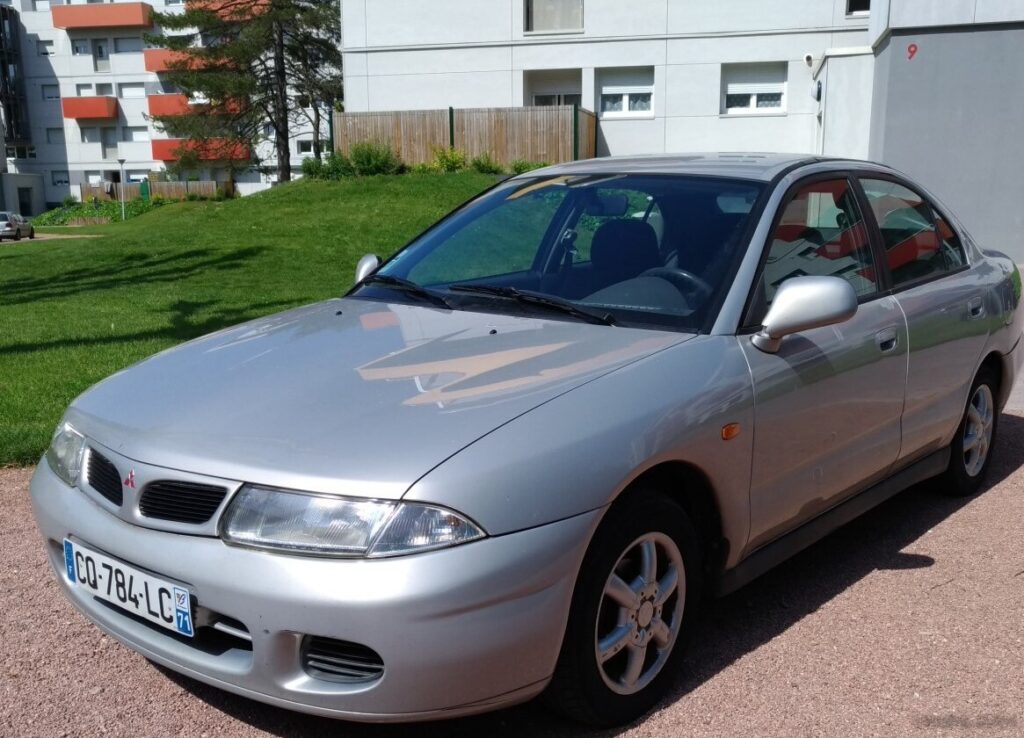
The Mitsubishi Carisma 1.3 i 16V, produced primarily for the European market in 2003, represented an entry-level offering within the broader Carisma range. Positioned as an affordable and economical sedan, it served as a stepping stone into the compact family car segment. The Carisma, built between 1995 and 2004, was Mitsubishi’s attempt to establish a stronger foothold in the competitive European C-segment, sharing its platform (the 1HX0/A3 platform) with the Volvo S40 and V40 following Mitsubishi’s partnership with Volvo. This particular 1.3L variant aimed at buyers prioritizing fuel efficiency and low running costs over outright performance.
Technical Specifications
| Brand | Mitsubishi |
| Model | Carisma |
| Generation | Carisma |
| Type (Engine) | 1.3 i 16V (82 Hp) |
| Start of production | 2003 year |
| End of production | 2003 year |
| Powertrain Architecture | Internal Combustion engine |
| Body type | Sedan |
| Seats | 5 |
| Doors | 4 |
| Fuel consumption (urban) | 8.4 l/100 km (28 US mpg, 33.6 UK mpg, 11.9 km/l) |
| Fuel consumption (extra urban) | 5.2 l/100 km (45.2 US mpg, 54.3 UK mpg, 19.2 km/l) |
| Fuel consumption (combined) | 6.4 l/100 km (36.8 US mpg, 44.1 UK mpg, 15.6 km/l) |
| Fuel Type | Petrol (Gasoline) |
| Acceleration 0 – 100 km/h | 14.1 sec |
| Acceleration 0 – 62 mph | 14.1 sec |
| Acceleration 0 – 60 mph | 13.4 sec |
| Maximum speed | 175 km/h (108.74 mph) |
| Weight-to-power ratio | 14.3 kg/Hp, 70.1 Hp/tonne |
| Weight-to-torque ratio | 9.8 kg/Nm, 102.6 Nm/tonne |
| Power | 82 Hp @ 5000 rpm |
| Power per litre | 63.1 Hp/l |
| Torque | 120 Nm @ 4000 rpm (88.51 lb.-ft. @ 4000 rpm) |
| Engine layout | Front, Transverse |
| Engine Model/Code | 4G13 |
| Engine displacement | 1299 cm3 (79.27 cu. in.) |
| Number of cylinders | 4 |
| Engine configuration | Inline |
| Cylinder Bore | 71 mm (2.8 in.) |
| Piston Stroke | 82 mm (3.23 in.) |
| Compression ratio | 10:1 |
| Number of valves per cylinder | 4 |
| Fuel injection system | Multi-port manifold injection |
| Engine aspiration | Naturally aspirated engine |
| Valvetrain | OHC |
| Engine oil capacity | 3.3 l (3.49 US qt | 2.9 UK qt) |
| Coolant capacity | 6.3 l (6.66 US qt | 5.54 UK qt) |
| Kerb Weight | 1170 kg (2579.41 lbs.) |
| Max. weight | 1675 kg (3692.74 lbs.) |
| Max load | 505 kg (1113.33 lbs.) |
| Trunk (boot) space – minimum | 460 l (16.24 cu. ft.) |
| Fuel tank capacity | 60 l (15.85 US gal | 13.2 UK gal) |
| Length | 4435 mm (174.61 in.) |
| Width | 1710 mm (67.32 in.) |
| Height | 1405 mm (55.31 in.) |
| Wheelbase | 2550 mm (100.39 in.) |
| Front track | 1455 mm (57.28 in.) |
| Rear (Back) track | 1475 mm (58.07 in.) |
| Drivetrain Architecture | The Internal combustion engine (ICE) drives the front wheels of the vehicle. |
| Drive wheel | Front wheel drive |
| Number of gears and type of gearbox | 5 gears, manual transmission |
| Front suspension | Spring Strut |
| Rear suspension | Coil spring |
| Front brakes | Ventilated discs |
| Rear brakes | Disc |
| Assisting systems | ABS (Anti-lock braking system) |
| Steering type | Steering rack and pinion |
| Power steering | Hydraulic Steering |
| Tires size | 195/60 R15 |
Powertrain & Engine Architecture
The Carisma 1.3 i 16V was powered by Mitsubishi’s 4G13 engine, a 1.3-liter inline-four cylinder gasoline engine. This engine featured a single overhead camshaft (SOHC) valvetrain with four valves per cylinder, contributing to its 16V designation. The 4G13 utilized a multi-port fuel injection system, delivering fuel directly into the intake ports for improved combustion efficiency. The engine produced 82 horsepower at 5000 rpm and 120 Nm (88.51 lb-ft) of torque at 4000 rpm. The engine’s relatively modest output was typical for this displacement class in the early 2000s, prioritizing fuel economy over high performance. The engine was transversely mounted in the front of the vehicle, driving the front wheels. The 5-speed manual transmission was the standard offering for this variant, providing a balance between fuel efficiency and drivability.
Driving Characteristics
The 1.3L Carisma offered a predictable, if uninspiring, driving experience. Acceleration was leisurely, taking approximately 14.1 seconds to reach 62 mph (100 km/h). The engine felt strained when pushed hard, particularly when overtaking or climbing hills. The 5-speed manual transmission was well-matched to the engine’s characteristics, allowing drivers to keep the engine in its optimal power band. Compared to the more powerful 1.8L and 2.0L variants, the 1.3L lacked the punch needed for spirited driving. However, its lighter weight and lower power output resulted in slightly better fuel economy. The gear ratios were geared towards economy, with a relatively long final drive. Steering was light and precise, making it easy to maneuver in urban environments.
Equipment & Trim Levels
The 1.3 i 16V typically represented the base trim level of the Carisma range. Standard equipment generally included power steering, central locking, electric front windows, and an AM/FM radio. Safety features included ABS (Anti-lock Braking System) and driver and passenger airbags. Interior upholstery was typically cloth, with a simple and functional dashboard layout. Optional extras, depending on the market, could include air conditioning, alloy wheels, and a CD player. The interior plastics were durable but lacked the premium feel of higher-spec models.
Chassis & Braking
The Carisma 1.3 i 16V utilized a MacPherson strut front suspension and a coil spring rear suspension. This setup provided a comfortable ride, although it wasn’t particularly sporty. The front brakes were ventilated discs, while the rear brakes were solid discs. The braking system was adequate for the car’s weight and performance, but lacked the stopping power of larger, more powerful models. The car’s relatively light weight helped to compensate for the modest braking performance. Stabilizer bars were fitted to both the front and rear axles to reduce body roll during cornering.
Market Reception & Comparison
The Carisma 1.3 i 16V was generally well-received as an affordable and reliable family car. Critics praised its fuel efficiency and low running costs, but noted its lack of performance. Compared to rivals such as the Ford Focus and Vauxhall/Opel Astra, the Carisma offered a competitive package, particularly in terms of value for money. The 1.8L and 2.0L Carisma models offered significantly more performance, but at a higher price point. The 1.9L TDI diesel variant provided excellent fuel economy and strong torque, but was more expensive to purchase and maintain. The 1.3L model appealed to buyers who prioritized economy and practicality over driving excitement.
Legacy
The Mitsubishi Carisma, while not a runaway success, established Mitsubishi as a credible player in the European C-segment. The 1.3 i 16V powertrain proved to be relatively reliable, with few major mechanical issues reported. On the used car market today, these models are typically very affordable, making them attractive to first-time buyers or those seeking a cheap and economical runabout. However, age and mileage can take their toll, and potential buyers should be aware of the possibility of rust and wear and tear on suspension components. Parts availability is generally good, although some specific trim pieces may be difficult to find. The Carisma 1.3 i 16V remains a testament to Mitsubishi’s commitment to providing practical and affordable transportation.
