
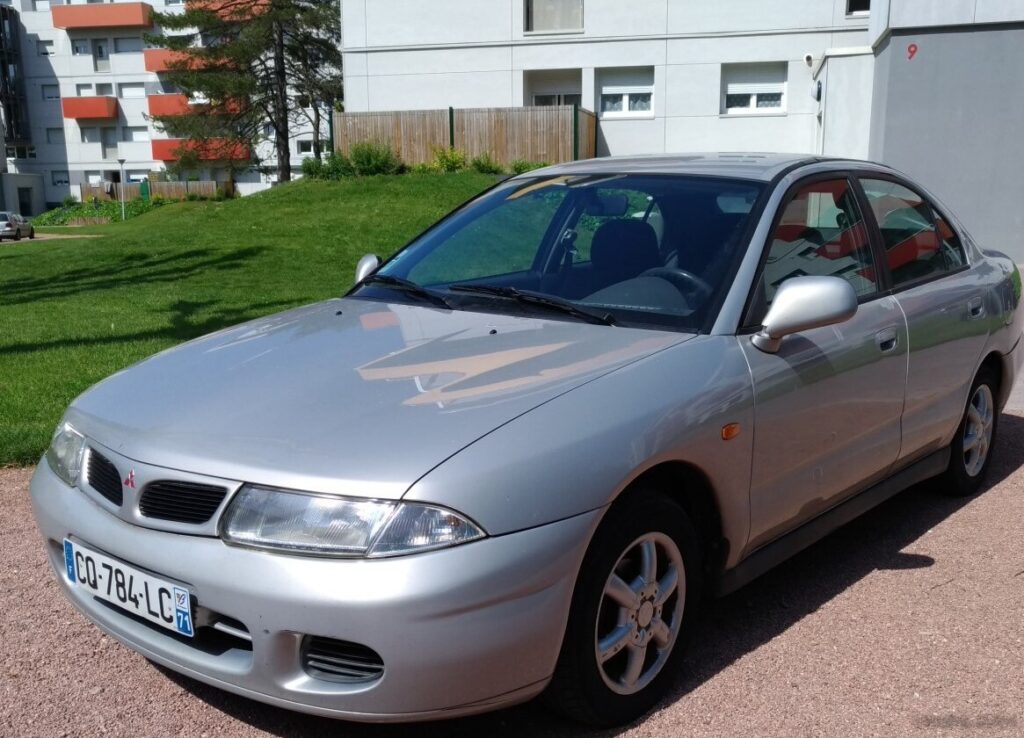
The Mitsubishi Carisma 1.6, equipped with a 90 horsepower engine and automatic transmission, was a mainstay of Mitsubishi’s European lineup from 1995 to 2000. Positioned as an entry-level to mid-range offering, it aimed to provide comfortable and economical transportation for families and commuters. The Carisma, built under the collaborative Diamond Star Motors venture with Chrysler, represented Mitsubishi’s attempt to establish a stronger foothold in the competitive C-segment, challenging established rivals like the Ford Focus and Opel/Vauxhall Astra. This particular variant, the 1.6L automatic, was designed to appeal to buyers prioritizing ease of use over outright performance.
Technical Specifications
| Brand | Mitsubishi |
| Model | Carisma |
| Generation | Carisma |
| Type (Engine) | 1.6 (90 Hp) Automatic |
| Start of production | 1995 |
| End of production | 2000 |
| Powertrain Architecture | Internal Combustion engine |
| Body type | Sedan |
| Seats | 5 |
| Doors | 4 |
| Fuel consumption (urban) | 11 l/100 km (21.4 US mpg) |
| Fuel consumption (extra urban) | 6.8 l/100 km (34.6 US mpg) |
| Fuel Type | Petrol (Gasoline) |
| Acceleration 0 – 100 km/h | 14.3 sec |
| Acceleration 0 – 62 mph | 14.3 sec |
| Acceleration 0 – 60 mph | 13.6 sec |
| Maximum speed | 180 km/h (111.85 mph) |
| Weight-to-power ratio | 12 kg/Hp |
| Weight-to-torque ratio | 7.9 kg/Nm |
| Power | 90 Hp @ 5500 rpm |
| Power per litre | 56.4 Hp/l |
| Torque | 137 Nm @ 4000 rpm (101.05 lb.-ft. @ 4000 rpm) |
| Engine layout | Front, Transverse |
| Engine displacement | 1597 cm3 (97.45 cu. in.) |
| Number of cylinders | 4 |
| Engine configuration | Inline |
| Cylinder Bore | 81 mm (3.19 in.) |
| Piston Stroke | 77.5 mm (3.05 in.) |
| Compression ratio | 10:1 |
| Number of valves per cylinder | 4 |
| Fuel injection system | Multi-port manifold injection |
| Engine aspiration | Naturally aspirated engine |
| Valvetrain | OHC |
| Kerb Weight | 1080 kg (2380.99 lbs.) |
| Max. weight | 1610 kg (3549.44 lbs.) |
| Max load | 530 kg (1168.45 lbs.) |
| Trunk (boot) space – maximum | 460 l (16.24 cu. ft.) |
| Fuel tank capacity | 60 l (15.85 US gal | 13.2 UK gal) |
| Length | 4435 mm (174.61 in.) |
| Width | 1710 mm (67.32 in.) |
| Height | 1405 mm (55.31 in.) |
| Wheelbase | 2550 mm (100.39 in.) |
| Front track | 1455 mm (57.28 in.) |
| Rear (Back) track | 1475 mm (58.07 in.) |
| Drivetrain Architecture | The Internal combustion engine (ICE) drives the front wheels of the vehicle. |
| Drive wheel | Front wheel drive |
| Number of gears and type of gearbox | 4 gears, automatic transmission |
| Front suspension | Spring Strut |
| Rear suspension | Coil spring |
| Front brakes | Ventilated discs |
| Rear brakes | Drum |
| Assisting systems | ABS (Anti-lock braking system) |
| Steering type | Steering rack and pinion |
| Power steering | Hydraulic Steering |
| Tires size | 185/70 R14 |
| Wheel rims size | 14 |
Powertrain & Engine Architecture
The Carisma 1.6 Automatic utilized Mitsubishi’s 4G18 engine, a 1.6-liter inline-four cylinder powerplant. This engine featured a single overhead camshaft (SOHC) valvetrain with four valves per cylinder. Fuel delivery was managed by a multi-point fuel injection system, contributing to reasonable fuel efficiency for its time. The engine produced 90 horsepower at 5500 rpm and 137 Nm (101 lb-ft) of torque at 4000 rpm. The automatic transmission was a conventional four-speed unit, chosen for its ease of use and suitability for urban driving. While not particularly sophisticated, it provided smooth shifts under normal conditions. The engine code varied slightly depending on the market, with variations like 4G18-GDI appearing in some regions, though the 90hp automatic typically used the standard 4G18.
Driving Characteristics
The 1.6L automatic Carisma offered a comfortable, if not exhilarating, driving experience. Acceleration was modest, taking around 14.3 seconds to reach 62 mph (100 km/h). The automatic transmission, while convenient, did sap some power from the engine, resulting in a noticeable difference in performance compared to the five-speed manual version. Gear ratios were optimized for fuel economy and smooth cruising rather than sporty acceleration. The car felt most at home during relaxed highway driving, where the engine could operate within its optimal range. Compared to the more powerful 1.8L and 2.0L variants, the 1.6 automatic prioritized fuel efficiency and affordability over performance.
Equipment & Trim Levels
The Carisma 1.6 Automatic typically came equipped with a reasonable level of standard features. These included power steering, central locking, electric front windows, and an AM/FM radio. Higher trim levels, often denoted by names like ‘GLX’ or ‘SE’, added features such as alloy wheels, air conditioning, a sunroof, and upgraded interior trim. Interior upholstery was typically cloth, with a relatively simple dashboard layout. Optional extras included a CD player, upgraded sound system, and metallic paint finishes.
Chassis & Braking
The Carisma utilized a front-wheel-drive layout with a MacPherson strut suspension at the front and a coil spring suspension at the rear. The front brakes were ventilated discs, providing adequate stopping power, while the rear brakes were drums. This configuration was typical for cars in this class at the time, balancing cost and performance. The suspension was tuned for comfort, providing a relatively smooth ride over most road surfaces. Anti-lock brakes (ABS) were often included as standard equipment, enhancing safety.
Market Reception & Comparison
The Mitsubishi Carisma 1.6 Automatic was generally well-received by critics as a practical and affordable family car. However, it wasn’t considered a standout performer in its class. Reviewers often noted its comfortable ride and reasonable fuel economy, but also criticized its lack of excitement and somewhat bland styling. Compared to rivals like the Ford Focus and Opel/Vauxhall Astra, the Carisma offered a competitive package but lacked the brand recognition and driving dynamics of some of its competitors. Fuel economy was comparable to other 1.6L automatics of the era, and reliability was generally good, though some owners reported minor electrical issues.
Legacy
The Mitsubishi Carisma, while not a sales phenomenon, established Mitsubishi as a credible player in the European C-segment. The 1.6L automatic variant, in particular, remains a relatively affordable and reliable option on the used car market. The 4G18 engine is known for its durability, and the four-speed automatic transmission, while not the most advanced, is generally robust. Today, these cars are often sought after by budget-conscious buyers looking for a dependable and economical mode of transportation. While parts availability may be becoming more challenging, the Carisma 1.6 Automatic continues to offer a practical and affordable solution for those seeking a classic 1990s family sedan.
