
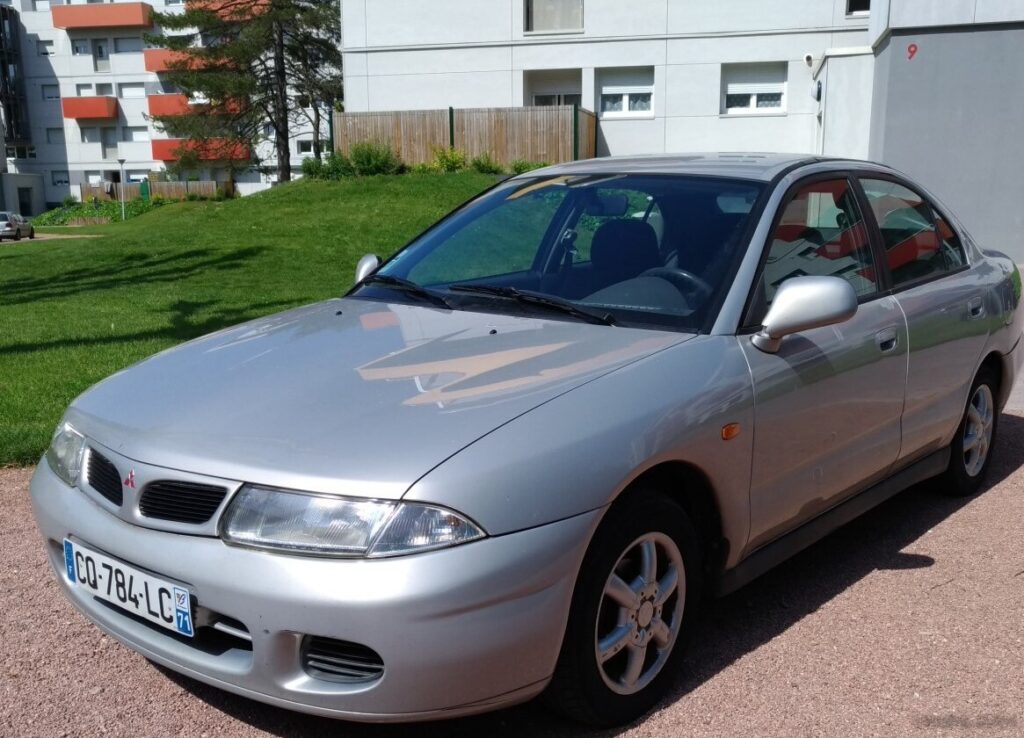
The Mitsubishi Carisma 1.6 i 16V Automatic, produced between 1999 and 2003, represented a mainstream offering within Mitsubishi’s compact sedan lineup. Positioned as a comfortable and practical family vehicle, it aimed to provide a balance between affordability, fuel efficiency, and reasonable performance. The Carisma, internally designated as the DQ platform, was a collaborative effort with Chrysler (who marketed a similar vehicle as the Chrysler/Plymouth Neon) and was intended to replace the aging Mitsubishi Lancer in the European market. This particular 1.6L, 103 horsepower variant with an automatic transmission served as a key entry point into the Carisma range, appealing to buyers prioritizing ease of use over outright sporting performance.
Technical Specifications
| Brand | Mitsubishi |
| Model | Carisma |
| Generation | Carisma |
| Type (Engine) | 1.6 i 16V (103 Hp) Automatic |
| Start of production | 1999 year |
| End of production | 2003 year |
| Powertrain Architecture | Internal Combustion engine |
| Body type | Sedan |
| Seats | 5 |
| Doors | 4 |
| Fuel consumption (economy) – urban | 11.3 l/100 km (20.8 US mpg, 25 UK mpg, 8.8 km/l) |
| Fuel consumption (economy) – extra urban | 6.7 l/100 km (35.1 US mpg, 42.2 UK mpg, 14.9 km/l) |
| Fuel consumption (economy) – combined | 8.4 l/100 km (28 US mpg, 33.6 UK mpg, 11.9 km/l) |
| Fuel Type | Petrol (Gasoline) |
| Acceleration 0 – 100 km/h | 15.1 sec |
| Acceleration 0 – 62 mph | 15.1 sec |
| Acceleration 0 – 60 mph | 14.3 sec |
| Maximum speed | 185 km/h (114.95 mph) |
| Weight-to-power ratio | 11.5 kg/Hp, 86.9 Hp/tonne |
| Weight-to-torque ratio | 8.4 kg/Nm, 119 Nm/tonne |
| Power | 103 Hp @ 6000 rpm |
| Power per litre | 64.5 Hp/l |
| Torque | 141 Nm @ 4500 rpm (104 lb.-ft. @ 4500 rpm) |
| Engine layout | Front, Transverse |
| Engine displacement | 1597 cm3 (97.45 cu. in.) |
| Number of cylinders | 4 |
| Engine configuration | Inline |
| Cylinder Bore | 81 mm (3.19 in.) |
| Piston Stroke | 77.5 mm (3.05 in.) |
| Compression ratio | 10:1 |
| Number of valves per cylinder | 4 |
| Fuel injection system | Multi-port manifold injection |
| Engine aspiration | Naturally aspirated engine |
| Valvetrain | DOHC |
| Kerb Weight | 1185 kg (2612.48 lbs.) |
| Max. weight | 1695 kg (3736.84 lbs.) |
| Max load | 510 kg (1124.36 lbs.) |
| Trunk (boot) space – minimum | 460 l (16.24 cu. ft.) |
| Fuel tank capacity | 60 l (15.85 US gal | 13.2 UK gal) |
| Length | 4475 mm (176.18 in.) |
| Width | 1710 mm (67.32 in.) |
| Height | 1405 mm (55.31 in.) |
| Wheelbase | 2550 mm (100.39 in.) |
| Front track | 1475 mm (58.07 in.) |
| Rear (Back) track | 1470 mm (57.87 in.) |
| Drivetrain Architecture | The Internal combustion engine (ICE) drives the front wheels of the vehicle. |
| Drive wheel | Front wheel drive |
| Number of gears and type of gearbox | 4 gears, automatic transmission |
| Front suspension | Spring Strut |
| Rear suspension | Coil spring |
| Front brakes | Ventilated discs |
| Rear brakes | Disc |
| Assisting systems | ABS (Anti-lock braking system) |
| Steering type | Steering rack and pinion |
| Power steering | Hydraulic Steering |
| Tires size | 195/60 R15 |
| Wheel rims size | 15 |
Powertrain & Engine Architecture
The Carisma 1.6 i 16V utilized Mitsubishi’s 4G91 engine, a 1.6-liter inline-four cylinder powerplant. This engine featured a double overhead camshaft (DOHC) valvetrain with four valves per cylinder, contributing to its relatively efficient breathing. Fuel delivery was handled by a multi-point fuel injection system. The engine produced 103 horsepower at 6000 rpm and 141 Nm (104 lb-ft) of torque at 4500 rpm. Paired with this engine was a four-speed automatic transmission, designed for smooth and convenient operation. This transmission wasn’t known for its sportiness, prioritizing comfort and ease of driving over rapid gear changes. The engine code for this configuration varied slightly depending on the market, but commonly included variations of the 4G91 designation.
Driving Characteristics
The 1.6L automatic Carisma offered a comfortable, if not particularly exhilarating, driving experience. Acceleration was modest, taking around 15 seconds to reach 60 mph. The automatic transmission, while smooth, contributed to a noticeable lack of responsiveness compared to the five-speed manual versions. Gear ratios were tuned for fuel economy and relaxed cruising rather than spirited driving. The engine felt strained when pushed hard, and overtaking maneuvers required careful planning. However, for everyday commuting and general transportation, the 1.6L automatic provided adequate performance for most drivers. The focus was on usability and minimizing driver effort.
Equipment & Trim Levels
The 1.6 i 16V Automatic typically came with a reasonable level of standard equipment. This included power steering, central locking, electric front windows, and an AM/FM radio. Higher trim levels, often denoted by suffixes like ‘GL’ or ‘GDI’ (though GDI versions typically featured a different engine), added features such as alloy wheels, air conditioning, and upgraded interior trim. Interior upholstery was generally cloth, with a functional and durable design. Optional extras included a sunroof, upgraded audio systems, and metallic paint finishes.
Chassis & Braking
The Carisma featured a typical front-wheel-drive chassis layout with a MacPherson strut suspension at the front and a coil spring suspension at the rear. The suspension was tuned for comfort, providing a relatively smooth ride over most road surfaces. Braking consisted of ventilated discs at the front and solid discs at the rear. An Anti-lock Braking System (ABS) was standard, enhancing safety. Stabilizer bars were fitted to both the front and rear axles to reduce body roll during cornering, though the car wasn’t designed for aggressive handling.
Market Reception & Comparison
The Carisma 1.6 i 16V Automatic was generally well-received as a practical and affordable family car. Critics praised its comfortable ride and spacious interior, but noted its lack of sporting pretensions. Compared to the higher-performance variants, such as the 2.0L GDI models, the 1.6L automatic offered significantly less power and a slower driving experience. However, it also delivered better fuel economy and lower running costs. Against competitors like the Ford Focus, Opel/Vauxhall Astra, and Peugeot 306, the Carisma offered a competitive package, particularly in terms of value for money.
Legacy
The Mitsubishi Carisma, while not a groundbreaking vehicle, proved to be a reliable and durable family car. The 1.6L engine, when properly maintained, is known for its longevity. The automatic transmission, while not the most sophisticated, is generally dependable. Today, the Carisma 1.6 i 16V Automatic can be found on the used car market at very affordable prices. Its simplicity and relatively low maintenance costs make it an attractive option for budget-conscious buyers seeking a practical and dependable vehicle. However, potential buyers should be aware of the car’s age and the possibility of wear and tear on components such as the suspension and braking system. Finding parts may become increasingly challenging as the model ages, but many components are still available through aftermarket suppliers.
