
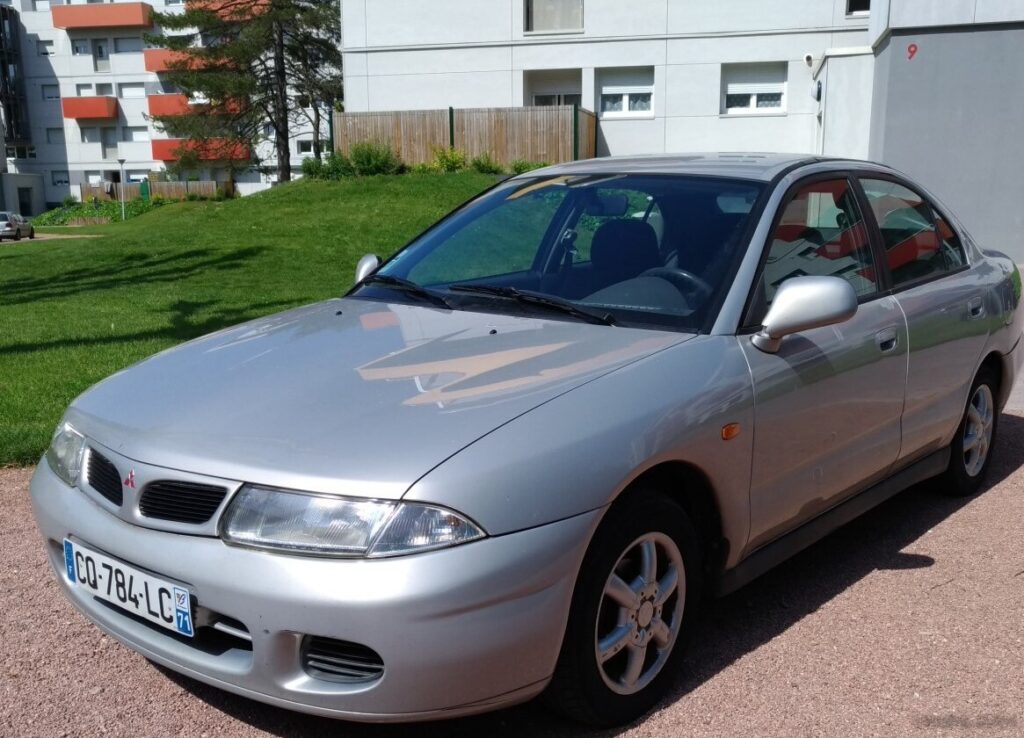
The Mitsubishi Carisma 1.8 16V GDI, produced between 1997 and 2003, represented a significant step forward for Mitsubishi’s presence in the competitive European compact sedan market. Positioned as a mid-range offering within the Carisma lineup, it aimed to bridge the gap between the more economical base models and the higher-performance variants. The Carisma itself was a collaborative effort with Chrysler (then DaimlerChrysler), sharing its platform – the 1HX0/A3 – with the Chrysler Neon and Volvo S40. This model sought to offer a blend of practicality, efficiency, and a touch of sporting character, leveraging Mitsubishi’s GDI (Gasoline Direct Injection) technology.
Technical Specifications
| Brand | Mitsubishi |
| Model | Carisma |
| Generation | Carisma |
| Type (Engine) | 1.8 16V GDI (125 Hp) |
| Start of production | 1997 |
| End of production | 2003 |
| Powertrain Architecture | Internal Combustion engine |
| Body type | Sedan |
| Seats | 5 |
| Doors | 4 |
| Fuel consumption (urban) | 8.6 l/100 km (27.4 US mpg) |
| Fuel consumption (extra urban) | 5.2 l/100 km (45.2 US mpg) |
| Fuel Type | Petrol (Gasoline) |
| Acceleration 0 – 100 km/h | 9.4 sec |
| Acceleration 0 – 62 mph | 9.4 sec |
| Acceleration 0 – 60 mph | 8.9 sec |
| Maximum speed | 235 km/h (146.02 mph) |
| Weight-to-power ratio | 9.7 kg/Hp |
| Weight-to-torque ratio | 7 kg/Nm |
| Power | 125 Hp @ 5500 rpm |
| Power per litre | 68.2 Hp/l |
| Torque | 174 Nm @ 3750 rpm (128.34 lb.-ft. @ 3750 rpm) |
| Engine layout | Front, Transverse |
| Engine displacement | 1834 cm3 (111.92 cu. in.) |
| Number of cylinders | 4 |
| Engine configuration | Inline |
| Cylinder Bore | 81 mm (3.19 in.) |
| Piston Stroke | 89 mm (3.5 in.) |
| Compression ratio | 12.5:1 |
| Number of valves per cylinder | 4 |
| Fuel injection system | Direct injection |
| Engine aspiration | Naturally aspirated engine |
| Valvetrain | DOHC |
| Kerb Weight | 1215 kg (2678.62 lbs.) |
| Max. weight | 1685 kg (3714.79 lbs.) |
| Max load | 470 kg (1036.17 lbs.) |
| Trunk (boot) space – maximum | 430 l (15.19 cu. ft.) |
| Fuel tank capacity | 60 l (15.85 US gal | 13.2 UK gal) |
| Length | 4435 mm (174.61 in.) |
| Width | 1710 mm (67.32 in.) |
| Height | 1405 mm (55.31 in.) |
| Wheelbase | 2550 mm (100.39 in.) |
| Front track | 1455 mm (57.28 in.) |
| Rear (Back) track | 1475 mm (58.07 in.) |
| Minimum turning circle | 11.2 m (36.75 ft.) |
| Drivetrain Architecture | Front wheel drive |
| Number of gears | 5 gears, manual transmission |
| Front suspension | Spring Strut |
| Rear suspension | Coil spring |
| Front brakes | Ventilated discs |
| Rear brakes | Drum |
| Assisting systems | ABS (Anti-lock braking system) |
| Steering type | Steering rack and pinion |
| Power steering | Hydraulic Steering |
| Tires size | 185/65 R14 |
| Wheel rims size | 14 |
Powertrain & Engine Architecture
The heart of the Carisma 1.8 GDI was the 4G93 engine, a 1.8-liter inline-four cylinder powerplant. What set this engine apart was its Gasoline Direct Injection (GDI) system. Unlike traditional port fuel injection, GDI injects fuel directly into the combustion chamber, allowing for more precise fuel control, higher compression ratios (12.5:1 in this case), and improved thermal efficiency. This resulted in increased power output and reduced emissions. The engine featured a double overhead camshaft (DOHC) valvetrain with four valves per cylinder, further enhancing its breathing and performance. The 174 Nm (128.34 lb-ft) of torque was available at 3750 rpm, providing reasonable responsiveness for everyday driving. The 5-speed manual transmission was the standard offering, providing a direct connection to the engine and allowing drivers to fully utilize the available power.
Driving Characteristics
The 1.8 GDI Carisma offered a noticeable step up in performance compared to the lower-displacement models. The 0-60 mph time of around 8.9 seconds was respectable for its class in the late 1990s and early 2000s. The GDI system contributed to a smoother power delivery than traditional engines, with a linear increase in horsepower as the revs climbed. While not a sports car, the Carisma 1.8 GDI provided enough power for confident overtaking and highway cruising. The manual transmission, while not particularly sporty in its ratios, was precise and easy to use. Compared to the later, more powerful Carisma variants, the 1.8 GDI prioritized fuel efficiency and everyday usability over outright performance.
Equipment & Trim Levels
The Carisma 1.8 GDI typically came equipped with a reasonable level of standard features. These included power steering, central locking, electric front windows, and an anti-lock braking system (ABS). Interior upholstery was generally cloth, with a functional and straightforward dashboard layout. Optional extras could include air conditioning, alloy wheels, and a radio/cassette player (later upgraded to CD players). The trim level often dictated the availability of these options, with higher trims offering more standard equipment. The focus was on providing a comfortable and well-equipped vehicle without excessive luxury.
Chassis & Braking
The Carisma utilized a relatively conventional chassis setup for a front-wheel-drive sedan. The front suspension employed MacPherson strut springs, while the rear featured a coil spring setup. This provided a comfortable ride quality, although it wasn’t particularly sporty in handling. The braking system consisted of ventilated discs at the front and drum brakes at the rear. While adequate for normal driving conditions, the rear drum brakes were a cost-saving measure and didn’t offer the same stopping power as disc brakes all around. The Carisma’s weight of around 1215 kg (2678.62 lbs) was typical for its class.
Market Reception & Comparison
The Mitsubishi Carisma 1.8 GDI was generally well-received by automotive critics. It was praised for its fuel efficiency, smooth engine, and comfortable ride. However, some reviewers noted that the interior design was somewhat bland and that the handling wasn’t as engaging as some of its rivals. Compared to other trims in the Carisma lineup, the 1.8 GDI offered a good balance between performance and economy. It was more powerful and refined than the base 1.6-liter models, but less expensive and more fuel-efficient than the higher-performance 2.0-liter variants. It competed with other compact sedans such as the Ford Focus, Opel/Vauxhall Astra, and Volkswagen Golf.
Legacy
The Mitsubishi Carisma 1.8 GDI, while not a groundbreaking vehicle, played an important role in establishing Mitsubishi as a credible player in the European compact car market. The GDI engine technology, while relatively early in its development, demonstrated Mitsubishi’s commitment to innovation and efficiency. Today, the Carisma 1.8 GDI can be found as an affordable used car. While age and mileage can affect reliability, the engine itself is generally considered to be durable if properly maintained. The GDI system, however, can be prone to carbon buildup over time, requiring periodic cleaning. Overall, the Carisma 1.8 GDI remains a practical and economical choice for those seeking a reliable and fuel-efficient compact sedan.
