
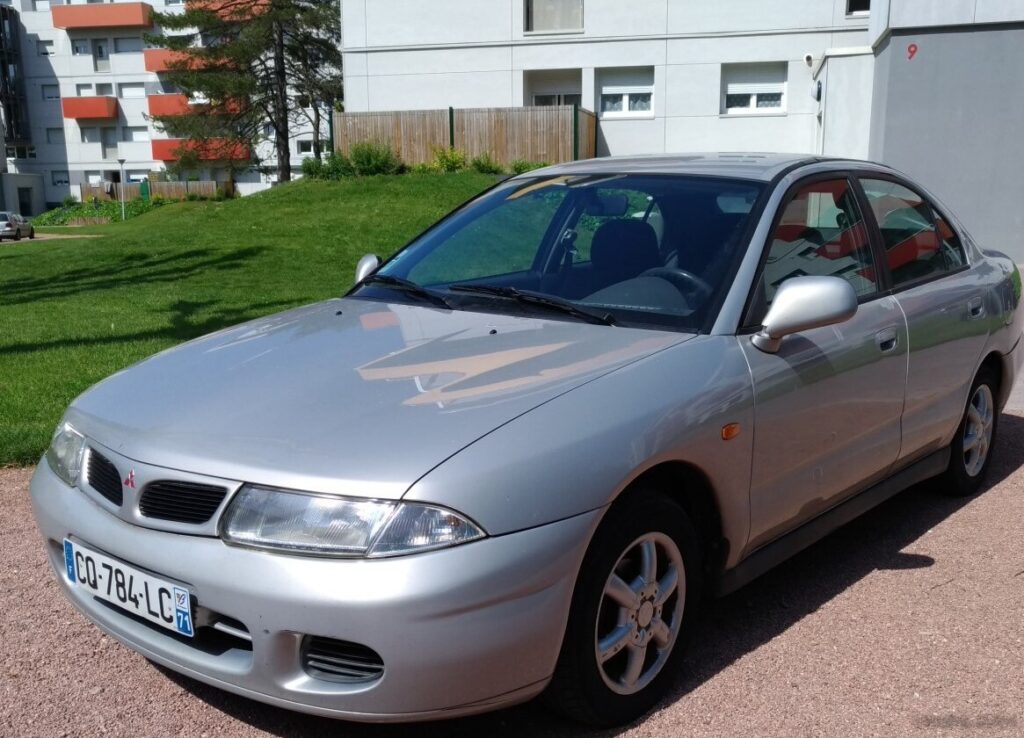
The Mitsubishi Carisma 1.9 TD, producing 90 horsepower, was a diesel-powered variant of the Carisma range manufactured between 1996 and 2000. Positioned as an economy-focused option within the lineup, it aimed to provide fuel efficiency and practicality for buyers in the European market. The Carisma, internally designated as the EQ platform, represented Mitsubishi’s attempt to establish a stronger foothold in the competitive C-segment, offering a blend of comfort, space, and modern features. This particular 1.9 TD model served as a cost-effective alternative to the gasoline-powered versions and the more powerful 2.0-liter diesel.
Technical Specifications
| Brand | Mitsubishi |
| Model | Carisma |
| Type (Engine) | 1.9 TD (90 Hp) |
| Start of production | 1996 |
| End of production | 2000 |
| Powertrain Architecture | Internal Combustion engine |
| Body type | Sedan |
| Seats | 5 |
| Doors | 4 |
| Fuel consumption (urban) | 8 l/100 km (29.4 US mpg) |
| Fuel consumption (extra urban) | 4.8 l/100 km (49 US mpg) |
| Fuel Type | Diesel |
| Acceleration 0 – 100 km/h | 13.2 sec |
| Acceleration 0 – 62 mph | 13.2 sec |
| Acceleration 0 – 60 mph | 12.5 sec |
| Maximum speed | 180 km/h (111.85 mph) |
| Weight-to-power ratio | 12.7 kg/Hp |
| Weight-to-torque ratio | 6.5 kg/Nm |
| Power | 90 Hp @ 4250 rpm |
| Power per litre | 48.1 Hp/l |
| Torque | 176 Nm @ 2250 rpm (129.81 lb.-ft. @ 2250 rpm) |
| Engine layout | Front, Transverse |
| Engine Model/Code | F8QT |
| Engine displacement | 1870 cm3 (114.11 cu. in.) |
| Number of cylinders | 4 |
| Engine configuration | Inline |
| Cylinder Bore | 80 mm (3.15 in.) |
| Piston Stroke | 93 mm (3.66 in.) |
| Compression ratio | 20.5:1 |
| Number of valves per cylinder | 2 |
| Fuel injection system | Direct injection |
| Engine aspiration | Turbocharger |
| Valvetrain | OHC |
| Engine oil capacity | 5.1 l (5.39 US qt | 4.49 UK qt) |
| Kerb Weight | 1145 kg (2524.29 lbs.) |
| Max. weight | 1675 kg (3692.74 lbs.) |
| Max load | 530 kg (1168.45 lbs.) |
| Trunk (boot) space – maximum | 430 l (15.19 cu. ft.) |
| Fuel tank capacity | 60 l (15.85 US gal | 13.2 UK gal) |
| Length | 4445 mm (175 in.) |
| Width | 1710 mm (67.32 in.) |
| Height | 1405 mm (55.31 in.) |
| Wheelbase | 2550 mm (100.39 in.) |
| Front track | 1455 mm (57.28 in.) |
| Rear (Back) track | 1475 mm (58.07 in.) |
| Drivetrain Architecture | The Internal combustion engine (ICE) drives the front wheels of the vehicle. |
| Drive wheel | Front wheel drive |
| Number of gears and type of gearbox | 5 gears, manual transmission |
| Front suspension | Spring Strut |
| Rear suspension | Coil spring |
| Front brakes | Ventilated discs |
| Rear brakes | Drum |
| Assisting systems | ABS (Anti-lock braking system) |
| Steering type | Steering rack and pinion |
| Power steering | Hydraulic Steering |
| Tires size | 185/65 R14 |
Powertrain & Engine Architecture
The Carisma 1.9 TD was powered by the F8QT engine, a 1.9-liter inline-four cylinder diesel engine. This engine was a product of Mitsubishi’s diesel technology of the time, featuring direct injection and a turbocharger to boost power output. The direct injection system, crucial for efficient combustion, delivered fuel directly into the cylinders under high pressure. The turbocharger, driven by exhaust gases, forced more air into the engine, increasing power and torque. The engine utilized a single overhead camshaft (OHC) valvetrain, operating two valves per cylinder. The F8QT engine was known for its relatively robust construction, but also for its susceptibility to wear and tear on components like the turbocharger and injection pump with higher mileage.
Driving Characteristics
The 90 horsepower output of the 1.9 TD, coupled with 176 Nm (129.81 lb-ft) of torque, provided adequate, though not exhilarating, performance. Acceleration from 0 to 60 mph took around 12.5 seconds, and top speed was approximately 112 mph. Compared to the gasoline-powered Carisma variants, the 1.9 TD offered significantly better fuel economy, but at the expense of outright speed. The five-speed manual transmission was the standard offering, and its gear ratios were tuned for maximizing fuel efficiency and providing reasonable acceleration in everyday driving situations. The turbocharger provided a noticeable boost in power at lower engine speeds, aiding in overtaking maneuvers. However, the engine could feel strained when pushed hard, and lacked the refinement of more modern diesel engines.
Equipment & Trim Levels
The 1.9 TD trim typically included basic features such as power steering, central locking, and electric front windows. Interior upholstery was generally cloth, and the dashboard featured a functional, if somewhat dated, design. Optional extras included air conditioning, alloy wheels, and a radio/cassette player. The 1.9 TD was often positioned as the entry-level diesel option, with higher trims offering more luxurious appointments and additional features. The focus was on providing a practical and affordable vehicle for everyday use.
Chassis & Braking
The Carisma 1.9 TD featured a front-wheel-drive layout with a MacPherson strut suspension at the front and a coil spring suspension at the rear. The front brakes were ventilated discs, providing adequate stopping power, while the rear brakes were drums. ABS (Anti-lock Braking System) was standard, enhancing safety by preventing wheel lockup during hard braking. The suspension setup was tuned for comfort, providing a relatively smooth ride, but it wasn’t particularly sporty. Stabilizer bars were fitted to both the front and rear axles to reduce body roll during cornering.
Market Reception & Comparison
The Mitsubishi Carisma 1.9 TD was generally well-received as a fuel-efficient and practical family car. Critics praised its spacious interior and comfortable ride, but noted its lack of performance compared to some of its rivals. Compared to the gasoline-powered Carisma models, the 1.9 TD offered significantly better fuel economy, making it an attractive option for high-mileage drivers. However, it was often criticized for its noisy engine and somewhat agricultural feel. In terms of reliability, the F8QT engine was generally considered to be reasonably durable, but required regular maintenance to prevent issues with the turbocharger and fuel injection system.
Legacy
The Mitsubishi Carisma 1.9 TD, while not a particularly groundbreaking vehicle, played a role in establishing Mitsubishi as a competitor in the European C-segment. The F8QT engine, despite its limitations, proved to be a reliable powerplant when properly maintained. Today, the Carisma 1.9 TD can be found in the used car market at very affordable prices. While it may not offer the refinement or performance of more modern vehicles, it remains a practical and economical option for those seeking a simple and reliable family car. Parts availability can be a challenge, but the relatively straightforward mechanical design makes it a viable option for DIY mechanics.
