
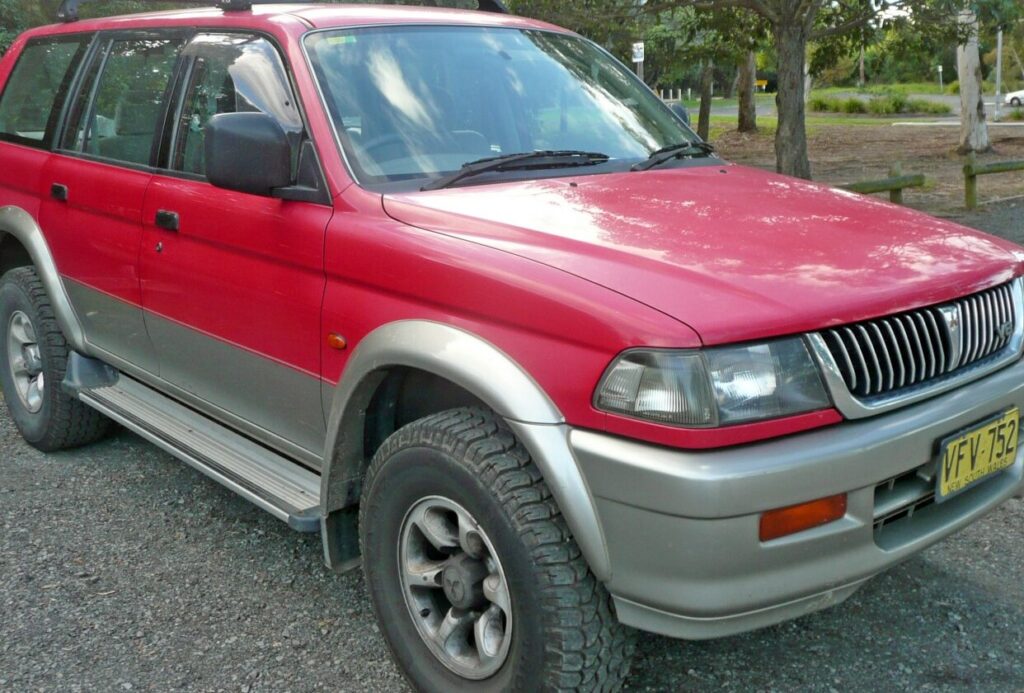
The Mitsubishi Challenger (W) 2.8 TD, produced between 1996 and 2001, was a mid-size SUV designed primarily for markets outside of North America. Representing the second generation of the Challenger series, the (W) model aimed to provide a robust and capable vehicle for families and those requiring off-road ability. This particular variant, equipped with the 4M40T 2.8-liter turbocharged diesel engine producing 140 horsepower, occupied a middle ground in the Challenger lineup, offering a balance between fuel efficiency, torque, and affordability. It was positioned below the gasoline-powered variants and above the lower-powered diesel options.
Technical Specifications
| Brand | Mitsubishi |
| Model | Challenger |
| Generation | Challenger (W) |
| Type (Engine) | 2.8 TD (140 Hp) |
| Start of production | 1996 |
| End of production | 2001 |
| Powertrain Architecture | Internal Combustion engine |
| Body type | SUV |
| Seats | 5 |
| Doors | 5 |
| Fuel consumption (urban) | 15 l/100 km (15.7 US mpg, 18.8 UK mpg, 6.7 km/l) |
| Fuel consumption (extra urban) | 9 l/100 km (26.1 US mpg, 31.4 UK mpg, 11.1 km/l) |
| Fuel Type | Diesel |
| Maximum speed | 155 km/h (96.31 mph) |
| Weight-to-power ratio | 13.2 kg/Hp, 75.7 Hp/tonne |
| Weight-to-torque ratio | 5.9 kg/Nm, 169.7 Nm/tonne |
| Power | 140 Hp @ 4000 rpm |
| Power per litre | 49.4 Hp/l |
| Torque | 314 Nm @ 2000 rpm (231.59 lb.-ft. @ 2000 rpm) |
| Engine layout | Front, Longitudinal |
| Engine Model/Code | 4M40T |
| Engine displacement | 2835 cm3 (173 cu. in.) |
| Number of cylinders | 4 |
| Engine configuration | Inline |
| Cylinder Bore | 95 mm (3.74 in.) |
| Piston Stroke | 100 mm (3.94 in.) |
| Compression ratio | 21:1 |
| Number of valves per cylinder | 2 |
| Fuel injection system | Precombustion chamber injection |
| Engine aspiration | Turbocharger |
| Engine oil capacity | 6.5 l (6.87 US qt | 5.72 UK qt) |
| Kerb Weight | 1850 kg (4078.55 lbs.) |
| Fuel tank capacity | 74 l (19.55 US gal | 16.28 UK gal) |
| Length | 4530 mm (178.35 in.) |
| Width | 1775 mm (69.88 in.) |
| Height | 1730 mm (68.11 in.) |
| Wheelbase | 2725 mm (107.28 in.) |
| Front track | 1465 mm (57.68 in.) |
| Rear track | 1480 mm (58.27 in.) |
| Drive wheel | All wheel drive (4×4) |
| Number of gears and type of gearbox | 5 gears, manual transmission |
| Front suspension | Torsion |
| Rear suspension | Coil spring |
| Front brakes | Ventilated discs |
| Rear brakes | Disc |
| Assisting systems | ABS (Anti-lock braking system) |
| Steering type | Steering rack and pinion |
| Power steering | Hydraulic Steering |
| Tires size | 265/70 R15 |
Powertrain & Engine Architecture
The heart of this Challenger variant is the 4M40T 2.8-liter inline-four diesel engine. This engine, a staple in Mitsubishi’s lineup for many years, utilized a precombustion chamber injection system. This system, common in older diesel engines, involved injecting fuel into a precombustion chamber connected to the main cylinder, promoting more complete combustion. The addition of a turbocharger significantly boosted power output, bringing it to 140 horsepower at 4000 rpm and a respectable 314 Nm (231.59 lb.-ft.) of torque at 2000 rpm. The engine’s longitudinal mounting and the availability of a five-speed manual transmission were standard. While an automatic transmission was offered in some markets, it wasn’t as common with this engine configuration.
Driving Characteristics
The 2.8 TD Challenger with a manual transmission offered a practical driving experience. The engine’s torque peak at 2000 rpm meant that strong pulling power was readily available for everyday driving and off-road situations. However, it wasn’t a particularly fast vehicle; acceleration was adequate but not exhilarating. The five-speed manual gearbox allowed drivers to keep the engine in its optimal power band, but the shift quality could feel somewhat notchy compared to more modern transmissions. Compared to the gasoline-powered Challengers, the diesel offered significantly better fuel economy, but at the expense of refinement and outright performance. The 2.8 TD was a workhorse, prioritizing usability over sporty driving dynamics.
Equipment & Trim Levels
The Challenger (W) 2.8 TD typically came with a fairly basic level of equipment, reflecting its positioning as a value-oriented SUV. Standard features generally included power steering, air conditioning (often optional), and a basic audio system. Interior upholstery was usually cloth, and the dashboard featured a functional, if somewhat utilitarian, design. Higher trim levels, when available, might add features like alloy wheels, upgraded audio systems, and power windows. However, the focus remained on providing a durable and capable vehicle rather than luxurious appointments.
Chassis & Braking
The Challenger (W) featured a body-on-frame construction, contributing to its robust nature and off-road capability. Front suspension utilized a torsion bar setup, while the rear employed coil springs. This configuration provided a comfortable ride on paved roads while maintaining sufficient articulation for off-road use. Braking consisted of ventilated discs at the front and solid discs at the rear. An Anti-lock Braking System (ABS) was often included as standard equipment, enhancing safety. The vehicle’s relatively high curb weight of 1850 kg (4078.55 lbs) meant that braking performance wasn’t particularly strong, requiring drivers to plan ahead when stopping.
Market Reception & Comparison
The Mitsubishi Challenger (W) 2.8 TD was generally well-received in markets where diesel-powered SUVs were popular, such as Europe, Australia, and parts of Asia. Critics praised its off-road capability, fuel efficiency, and robust construction. However, some noted its relatively basic interior and lack of refinement compared to more modern SUVs. Compared to the gasoline-powered Challenger variants, the 2.8 TD offered superior fuel economy and torque, making it a better choice for those who frequently towed or drove off-road. Compared to other diesel SUVs of the time, such as the Toyota Land Cruiser Prado, the Challenger offered a more affordable alternative, albeit with slightly less prestige.
Legacy
The Mitsubishi Challenger (W) 2.8 TD has proven to be a relatively reliable vehicle, particularly the engine itself. The 4M40T diesel is known for its durability and longevity, provided it receives regular maintenance. Today, these Challengers can be found in the used car market at relatively affordable prices. While they may not offer the same level of comfort or technology as modern SUVs, they remain a viable option for those seeking a capable and dependable off-road vehicle. Parts availability can be a concern in some regions, but the engine’s widespread use in other Mitsubishi vehicles means that components are often obtainable. The 2.8 TD Challenger represents a solid, no-frills SUV that prioritized functionality and durability over luxury and performance.
