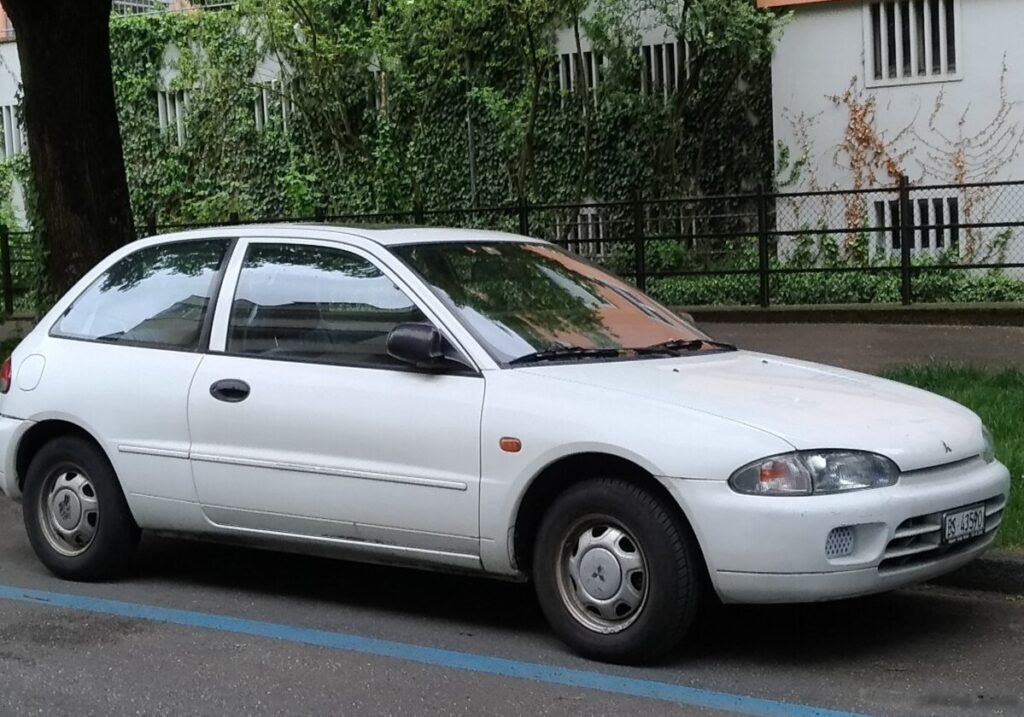
The Mitsubishi Colt IV (CAO) 1.3 GLi 12V, designated with engine code CA1A, was a popular subcompact hatchback produced between 1992 and 1996. Positioned as an entry-level offering within the fourth-generation Colt lineup, it aimed to provide affordable and economical transportation. This variant played a significant role in Mitsubishi’s European and Asian markets, offering a practical and reliable option for first-time car buyers and city commuters. The Colt IV, built on the CA platform, represented a significant step forward in design and engineering for Mitsubishi’s small car offerings.
Technical Specifications
| Brand | Mitsubishi |
| Model | Colt |
| Generation | Colt IV (CAO) |
| Type | 1.3 GLi 12V (CA1A) (75 Hp) |
| Start of production | 1992 |
| End of production | 1996 |
| Powertrain Architecture | Internal Combustion engine |
| Body type | Hatchback |
| Seats | 5 |
| Doors | 3 |
| Fuel consumption (combined) | 6.9 l/100 km (34.1 US mpg, 40.9 UK mpg, 14.5 km/l) |
| Fuel Type | Petrol (Gasoline) |
| Acceleration 0 – 100 km/h | 12.5 sec |
| Acceleration 0 – 62 mph | 12.5 sec |
| Acceleration 0 – 60 mph | 11.9 sec |
| Maximum speed | 170 km/h (105.63 mph) |
| Weight-to-power ratio | 12.1 kg/Hp, 82.6 Hp/tonne |
| Weight-to-torque ratio | 8.4 kg/Nm, 118.9 Nm/tonne |
| Power | 75 Hp @ 6000 rpm |
| Power per litre | 57.7 Hp/l |
| Torque | 108 Nm @ 3000 rpm (79.66 lb.-ft. @ 3000 rpm) |
| Engine layout | Front, Transverse |
| Engine displacement | 1299 cm3 (79.27 cu. in.) |
| Number of cylinders | 4 |
| Engine configuration | Inline |
| Cylinder Bore | 71 mm (2.8 in.) |
| Piston Stroke | 82 mm (3.23 in.) |
| Compression ratio | 9.5:1 |
| Number of valves per cylinder | 3 |
| Fuel injection system | Multi-port manifold injection |
| Engine aspiration | Naturally aspirated engine |
| Valvetrain | OHC |
| Kerb Weight | 908 kg (2001.8 lbs.) |
| Max. weight | 1450 kg (3196.7 lbs.) |
| Max load | 542 kg (1194.91 lbs.) |
| Trunk (boot) space – minimum | 240 l (8.48 cu. ft.) |
| Trunk (boot) space – maximum | 574 l (20.27 cu. ft.) |
| Fuel tank capacity | 50 l (13.21 US gal | 11 UK gal) |
| Length | 3955 mm (155.71 in.) |
| Width | 1690 mm (66.54 in.) |
| Height | 1365 mm (53.74 in.) |
| Wheelbase | 2440 mm (96.06 in.) |
| Front track | 1450 mm (57.09 in.) |
| Rear (Back) track | 1460 mm (57.48 in.) |
| Drivetrain Architecture | The Internal combustion engine (ICE) drives the front wheels of the vehicle. |
| Drive wheel | Front wheel drive |
| Number of gears and type of gearbox | 5 gears, manual transmission |
| Front suspension | Wishbone |
| Rear suspension | Several levers and rods |
| Front brakes | Disc |
| Rear brakes | Drum |
| Assisting systems | ABS (Anti-lock braking system) |
| Steering type | Steering rack and pinion |
| Power steering | Hydraulic Steering |
| Tires size | 175/70 R13 |
INTRODUCTION
The Mitsubishi Colt IV 1.3 GLi 12V (CA1A) represented a core offering in the Colt range during its 1992-1996 production run. This three-door hatchback was designed to appeal to buyers seeking a practical, economical, and relatively affordable vehicle. It was a key model in Mitsubishi’s strategy to compete in the increasingly popular subcompact segment, particularly in Europe and Asia. The CA platform provided a lighter and more efficient base compared to its predecessor, contributing to improved fuel economy and handling. The 1.3 GLi trim level signified a mid-range specification, offering a balance between price and features.
Powertrain & Engine Architecture
At the heart of the 1.3 GLi was the 4G13 engine, a 1.3-liter inline-four cylinder gasoline engine. The ‘CA1A’ designation refers to the specific engine code for this configuration. This engine featured a single overhead camshaft (OHC) design and three valves per cylinder (two intake, one exhaust). Fuel delivery was managed by a multi-port fuel injection system, contributing to improved efficiency and smoother operation compared to carbureted engines. The 4G13 engine produced 75 horsepower at 6000 rpm and 108 Nm (79.66 lb-ft) of torque at 3000 rpm. The engine’s relatively simple design prioritized reliability and ease of maintenance. The engine was transversely mounted, driving the front wheels. The standard transmission was a five-speed manual gearbox, known for its light shift action and reasonable durability.
Driving Characteristics
The 1.3 GLi, with its 75 horsepower and relatively lightweight chassis, offered adequate performance for urban driving and shorter journeys. Acceleration to 60 mph took around 11.9 seconds, and top speed was approximately 105.63 mph. While not a performance-oriented vehicle, the engine provided sufficient power for everyday driving situations. The five-speed manual transmission allowed drivers to keep the engine in its optimal power band. Compared to higher-spec Colt models with larger engines (like the 1.6 or 1.8 liter variants), the 1.3 GLi felt noticeably less powerful, particularly when fully loaded or tackling steep inclines. However, this trade-off was offset by improved fuel economy. The gear ratios were tuned for economy, meaning the engine could feel strained at higher speeds. The steering was light and responsive, making it easy to maneuver in tight spaces.
Equipment & Trim Levels
The 1.3 GLi trim level offered a reasonable level of equipment for its price point. Standard features typically included power steering, a basic stereo system, cloth upholstery, and a rear wiper. The interior was functional and durable, though not particularly luxurious. Optional extras available for the 1.3 GLi included air conditioning, electric windows, and upgraded stereo systems. The dashboard layout was straightforward and easy to use, with clearly labeled controls. The seats provided adequate support for shorter journeys, but could become uncomfortable on longer trips. The GLi trim sat between the base-model Colt and the more fully equipped GLX variant.
Chassis & Braking
The Colt IV utilized a front-wheel-drive layout with a relatively simple suspension setup. The front suspension consisted of independent wishbones, while the rear suspension employed a multi-link system. This configuration provided a reasonable balance between ride comfort and handling. Braking duties were handled by disc brakes at the front and drum brakes at the rear. An Anti-lock Braking System (ABS) was included as standard, enhancing safety by preventing wheel lockup during hard braking. The steering was rack and pinion, providing precise and responsive control. The tires were typically 175/70 R13, offering a good compromise between grip and fuel efficiency.
Market Reception & Comparison
The Mitsubishi Colt IV 1.3 GLi was generally well-received by automotive critics as a practical and economical small car. It was praised for its fuel efficiency, reliability, and ease of driving. However, some critics noted its lack of power and relatively basic interior. Compared to rivals such as the Ford Fiesta, Opel Corsa, and Peugeot 205, the Colt offered a competitive package in terms of price and features. The 1.3 GLi variant was often seen as a sensible choice for buyers prioritizing economy and reliability over performance. Fuel economy was a key selling point, with the 1.3 GLi achieving around 34.1 US mpg in combined driving conditions. Maintenance costs were also relatively low, thanks to the engine’s simple design and readily available parts.
Legacy
The Mitsubishi Colt IV 1.3 GLi 12V (CA1A) has proven to be a relatively reliable and durable vehicle. Many examples are still on the road today, testament to the quality of its engineering. The 4G13 engine is known for its longevity, provided it is properly maintained. In the used car market, these Colts are often sought after as affordable and dependable transportation. While not a collector’s item, well-maintained examples hold their value reasonably well. The Colt IV 1.3 GLi represents a significant chapter in Mitsubishi’s history, demonstrating their commitment to producing practical and affordable vehicles for the mass market.