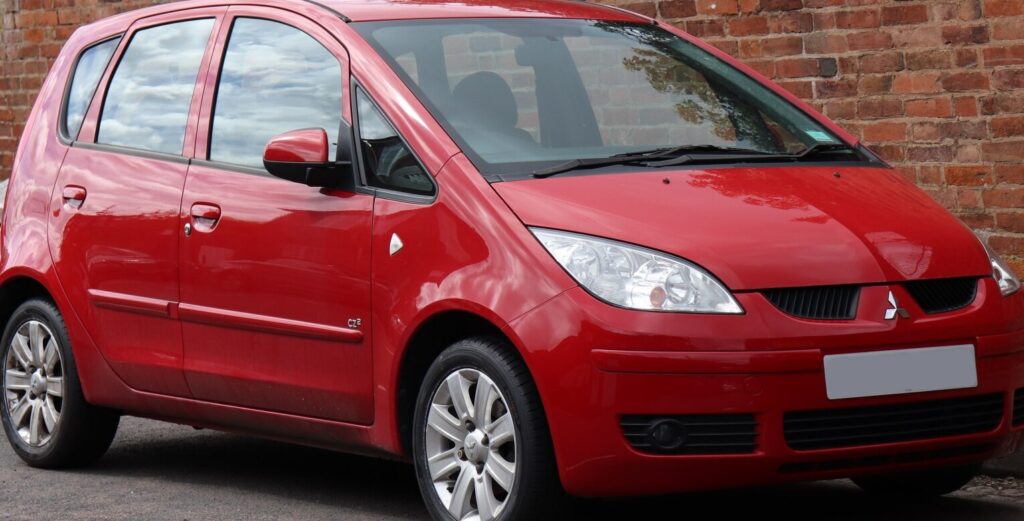
The Mitsubishi Colt VI (Z30) 1.3 i 16V CZ3 Automatic, produced between 2005 and 2008, represented an entry-level offering within the broader Colt VI range. Positioned as a practical and economical hatchback, it aimed to provide affordable transportation within the European market, where the Colt VI was primarily sold. This variant, characterized by its 1.3-liter engine and four-speed automatic transmission, was designed for urban driving and prioritized fuel efficiency over outright performance. It sat below the more powerful 1.5-liter and turbocharged variants in the lineup, targeting buyers seeking a no-frills, reliable city car.
Technical Specifications
| Brand | Mitsubishi |
| Model | Colt |
| Generation | Colt VI (Z30) |
| Type (Engine) | 1.3 i 16V CZ3 (95 Hp) Automatic |
| Start of production | 2005 |
| End of production | 2008 |
| Powertrain Architecture | Internal Combustion engine |
| Body type | Hatchback |
| Seats | 5 |
| Doors | 3 |
| Fuel consumption (urban) | 7.5 l/100 km (31.4 US mpg) |
| Fuel consumption (extra urban) | 5 l/100 km (47 US mpg) |
| Fuel Type | Petrol (Gasoline) |
| Acceleration 0 – 100 km/h | 11.8 sec |
| Acceleration 0 – 62 mph | 11.8 sec |
| Acceleration 0 – 60 mph | 11.2 sec |
| Maximum speed | 180 km/h (111.85 mph) |
| Weight-to-power ratio | 9.8 kg/Hp |
| Weight-to-torque ratio | 7.4 kg/Nm |
| Power | 95 Hp @ 6000 rpm |
| Power per litre | 71.3 Hp/l |
| Torque | 125 Nm @ 4000 rpm (92.2 lb.-ft. @ 4000 rpm) |
| Engine layout | Front, Transverse |
| Engine Model/Code | M 135.930 |
| Engine displacement | 1332 cm3 (81.28 cu. in.) |
| Number of cylinders | 4 |
| Engine configuration | Inline |
| Cylinder Bore | 75 mm (2.95 in.) |
| Piston Stroke | 75.4 mm (2.97 in.) |
| Compression ratio | 10.5:1 |
| Number of valves per cylinder | 4 |
| Fuel injection system | Multi-port manifold injection |
| Engine aspiration | Naturally aspirated |
| Valvetrain | DOHC |
| Engine oil capacity | 4.2 l (4.44 US qt | 3.7 UK qt) |
| Coolant capacity | 4.6 l (4.86 US qt | 4.05 UK qt) |
| Kerb Weight | 930 kg (2050.3 lbs.) |
| Max. weight | 1435 kg (3163.63 lbs.) |
| Max load | 505 kg (1113.33 lbs.) |
| Trunk (boot) space – minimum | 155 l (5.47 cu. ft.) |
| Trunk (boot) space – maximum | 760 l (26.84 cu. ft.) |
| Fuel tank capacity | 47 l (12.42 US gal | 10.34 UK gal) |
| Length | 3810 mm (150 in.) |
| Width | 1695 mm (66.73 in.) |
| Height | 1520 mm (59.84 in.) |
| Wheelbase | 2500 mm (98.43 in.) |
| Front track | 1450 mm (57.09 in.) |
| Rear track | 1445 mm (56.89 in.) |
| Drivetrain Architecture | Front wheel drive |
| Number of gears | 6 |
| Gearbox type | Automatic transmission |
| Front suspension | Spring Strut |
| Rear suspension | Torsion |
| Front brakes | Ventilated discs |
| Rear brakes | Disc |
| Assisting systems | ABS (Anti-lock braking system) |
| Steering type | Steering rack and pinion |
| Power steering | Electric |
| Tires size | 175/65 R14 |
| Wheel rims size | 5.5J x 14 |
INTRODUCTION
The Mitsubishi Colt VI, launched in 2002 and continuing through 2008, represented a significant departure for the Colt nameplate. Moving away from the rear-wheel-drive heritage of earlier models, the Z30 generation adopted a front-wheel-drive platform (shared with the Smart Fortwo and Renault Twingo) to maximize interior space and improve fuel economy. The 1.3 i 16V CZ3 Automatic variant, produced from 2005-2008, was a key component of this strategy, offering a budget-friendly and easy-to-drive option for European consumers. It was designed to appeal to those prioritizing practicality and low running costs over sporty performance.
Powertrain & Engine Architecture
At the heart of the 1.3 i 16V CZ3 Automatic lies the Mitsubishi M 135.930 engine, a 1332cc inline-four cylinder powerplant. This engine utilizes a multi-port fuel injection system and a double overhead camshaft (DOHC) valvetrain, contributing to its relatively efficient operation. The 16 valves (four per cylinder) enhance breathing and contribute to the engine’s 95 horsepower output at 6000 rpm and 125 Nm (92.2 lb-ft) of torque at 4000 rpm. The engine’s compression ratio of 10.5:1 is a typical value for naturally aspirated gasoline engines of this era. Paired with this engine is a six-speed automatic transmission, a relatively sophisticated feature for a car in this segment at the time. This transmission was chosen to provide smooth and convenient shifting, particularly in urban environments. While not known for its blistering acceleration, the automatic transmission offered a comfortable driving experience.
Driving Characteristics
The 1.3-liter engine and automatic transmission combination in the Colt VI resulted in a driving experience focused on ease of use rather than performance. Acceleration from 0-60 mph took approximately 11.2 seconds, and the top speed was limited to 180 km/h (111.85 mph). The automatic transmission, while smooth, did exhibit some typical characteristics of older automatic gearboxes, such as a slight delay in response and a tendency to ‘hunt’ for gears on inclines. The gear ratios were optimized for fuel efficiency, meaning the engine often operated at higher rpm during acceleration. Compared to the manual transmission versions of the 1.3, the automatic offered less driver engagement but greater convenience. The higher-output 1.5-liter variants provided significantly more power and a more engaging driving experience, but at the cost of increased fuel consumption.
Equipment & Trim Levels
The 1.3 i 16V CZ3 Automatic typically came equipped with a basic but functional level of standard features. These included power steering, central locking, electric front windows, and an ABS anti-lock braking system. Interior upholstery was typically cloth, and the dashboard featured a simple, straightforward design. Optional extras included air conditioning, alloy wheels, and a CD player. The trim level was generally considered entry-level, focusing on providing essential features at an affordable price point. Higher trim levels, available with the more powerful engines, offered features such as climate control, upgraded audio systems, and more luxurious interior appointments.
Chassis & Braking
The Colt VI utilized a relatively simple chassis design. Front suspension consisted of MacPherson strut springs, while the rear employed a torsion beam setup. This configuration provided a reasonable balance between ride comfort and handling. The front brakes were ventilated discs, offering adequate stopping power, while the rear brakes were solid discs. The relatively lightweight nature of the car (930 kg / 2050.3 lbs) helped to compensate for the modest braking performance. Stabilizer bars were fitted to both the front and rear axles to reduce body roll during cornering.
Market Reception & Comparison
The Mitsubishi Colt VI 1.3 i 16V CZ3 Automatic was generally well-received as a practical and economical city car. Critics praised its fuel efficiency and ease of driving, but noted its lack of performance. Compared to other cars in its class, such as the Renault Clio and Peugeot 206, the Colt offered a competitive price point and a spacious interior. However, its styling was often considered less appealing than its rivals. In terms of reliability, the 1.3-liter engine proved to be generally robust, although the automatic transmission could be prone to issues if not properly maintained. Fuel economy figures of around 31.4 US mpg (urban) and 47 US mpg (extra urban) were competitive for the time.
Legacy
The Mitsubishi Colt VI 1.3 i 16V CZ3 Automatic remains a relatively common sight on European roads today, testament to its durability and affordability. While not a particularly sought-after model by enthusiasts, it continues to provide reliable transportation for those seeking a budget-friendly hatchback. The powertrain, while not groundbreaking, proved to be reasonably reliable, and parts availability remains good. In the used car market, these Colts are typically priced very affordably, making them an attractive option for first-time car buyers or those seeking a cheap and cheerful runabout. The automatic transmission, while not the most modern, is generally considered adequate for everyday driving, provided it has been regularly serviced.