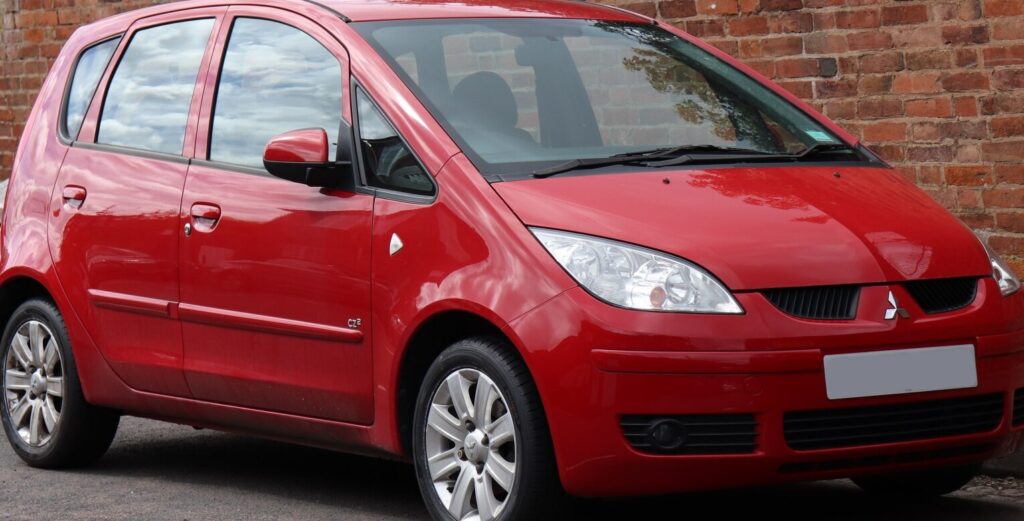
The Mitsubishi Colt VI (Z30) 1.5 DI-D HP, produced from 2005 to 2008, represented a key offering in Mitsubishi’s European small car lineup. Positioned as a fuel-efficient and practical option, this variant utilized a direct-injection diesel engine paired with a five-speed manual transmission. The Z30 Colt was a significant model for Mitsubishi, aiming to compete in the highly competitive supermini segment against rivals like the Ford Fiesta, Renault Clio, and Volkswagen Polo. This particular 1.5 DI-D trim aimed to balance economy with acceptable performance, appealing to buyers prioritizing low running costs.
Technical Specifications
| Brand | Mitsubishi |
| Model | Colt |
| Generation | Colt VI (Z30) |
| Type (Engine) | 1.5 DI-D HP (95 Hp) |
| Start of production | 2005 |
| End of production | 2008 |
| Powertrain Architecture | Internal Combustion engine |
| Body type | Hatchback |
| Seats | 5 |
| Doors | 3 |
| Fuel consumption (urban) | 6.3 l/100 km (37.3 US mpg, 44.8 UK mpg, 15.9 km/l) |
| Fuel consumption (extra urban) | 4.1 l/100 km (57.4 US mpg, 68.9 UK mpg, 24.4 km/l) |
| Fuel Type | Diesel |
| Acceleration 0 – 100 km/h | 9.9 sec |
| Acceleration 0 – 62 mph | 9.9 sec |
| Acceleration 0 – 60 mph | 9.4 sec |
| Maximum speed | 180 km/h (111.85 mph) |
| Weight-to-power ratio | 11 kg/Hp, 90.9 Hp/tonne |
| Weight-to-torque ratio | 5 kg/Nm, 201 Nm/tonne |
| Power | 95 Hp @ 4000 rpm |
| Power per litre | 63.6 Hp/l |
| Torque | 210 Nm @ 1800 rpm (154.89 lb.-ft. @ 1800 rpm) |
| Engine layout | Front, Transverse |
| Engine Model/Code | OM 639.939 |
| Engine displacement | 1493 cm3 (91.11 cu. in.) |
| Number of cylinders | 3 |
| Engine configuration | Inline |
| Cylinder Bore | 83 mm (3.27 in.) |
| Piston Stroke | 92 mm (3.62 in.) |
| Compression ratio | 18:1 |
| Number of valves per cylinder | 4 |
| Fuel injection system | Diesel Commonrail |
| Engine aspiration | Turbocharger, Intercooler |
| Valvetrain | DOHC |
| Engine oil capacity | 5.5 l (5.81 US qt | 4.84 UK qt) |
| Coolant | 6.6 l (6.97 US qt | 5.81 UK qt) |
| Kerb Weight | 1045 kg (2303.83 lbs.) |
| Max. weight | 1545 kg (3406.14 lbs.) |
| Max load | 500 kg (1102.31 lbs.) |
| Trunk (boot) space – minimum | 155 l (5.47 cu. ft.) |
| Trunk (boot) space – maximum | 760 l (26.84 cu. ft.) |
| Fuel tank capacity | 47 l (12.42 US gal | 10.34 UK gal) |
| Length | 3810 mm (150 in.) |
| Width | 1695 mm (66.73 in.) |
| Height | 1520 mm (59.84 in.) |
| Wheelbase | 2500 mm (98.43 in.) |
| Front track | 1450 mm (57.09 in.) |
| Rear (Back) track | 1445 mm (56.89 in.) |
| Drivetrain Architecture | The Internal combustion engine (ICE) drives the front wheels of the vehicle. |
| Drive wheel | Front wheel drive |
| Number of gears and type of gearbox | 5 gears, manual transmission |
| Front suspension | Spring Strut |
| Rear suspension | Torsion |
| Front brakes | Ventilated discs |
| Rear brakes | Disc |
| Assisting systems | ABS (Anti-lock braking system) |
| Steering type | Steering rack and pinion |
| Power steering | Electric Steering |
| Tires size | 195/50 R15 |
Introduction
The Mitsubishi Colt VI, launched in 2005, represented a departure from previous Colt generations, adopting a more contemporary and European-focused design. Built on the Mitsubishi’s GS platform, it shared components with the Smart Forfour and Renault Modus. The 1.5 DI-D HP variant, with its 95 horsepower diesel engine, was a crucial part of the lineup, targeting buyers seeking economical transportation. This model was primarily sold in Europe, where demand for small, fuel-efficient diesel cars was high. The “HP” designation signified a higher power output compared to the base 1.5 DI-D model.
Powertrain & Engine Architecture
The heart of the 1.5 DI-D HP is the OM639.939 engine, a 1.5-liter, three-cylinder diesel. This engine utilizes a common-rail direct injection system, delivering fuel directly into the cylinders at extremely high pressure for improved combustion efficiency and reduced emissions. The engine features a turbocharger with an intercooler, boosting power output and providing a broader torque curve. The DOHC (Double Overhead Camshaft) valvetrain ensures efficient valve operation. The engine’s compact size and lightweight construction contribute to the Colt’s overall agility. The five-speed manual transmission was the standard offering for this variant, providing precise gear changes and contributing to the car’s fuel efficiency. The engine’s design prioritized low-end torque, making it suitable for everyday driving conditions.
Driving Characteristics
The 1.5 DI-D HP offered a practical and economical driving experience. While not a performance-oriented model, the 95 horsepower and 210 Nm (155 lb-ft) of torque provided adequate acceleration for urban and highway driving. The five-speed manual transmission allowed drivers to effectively manage the engine’s power band. Acceleration from 0 to 60 mph took approximately 9.4 seconds, and the top speed was around 112 mph. The gear ratios were tuned for fuel efficiency, with taller gearing in higher gears to reduce engine RPM at cruising speeds. Compared to the base 1.5 DI-D, the HP version offered a noticeable improvement in responsiveness, particularly during overtaking maneuvers. However, it didn’t match the performance of the more powerful gasoline-powered Colt variants.
Equipment & Trim Levels
The 1.5 DI-D HP typically came with a reasonable level of standard equipment. This included power steering, central locking, electric front windows, and an ABS anti-lock braking system. Interior upholstery was typically cloth, with a functional and durable design. Depending on the market and optional packages, features like air conditioning, alloy wheels, a CD player, and even basic navigation systems were available. The dashboard layout was straightforward and user-friendly, prioritizing practicality over luxury. Higher trim levels offered upgrades such as upgraded audio systems, leather steering wheels, and more premium interior materials.
Chassis & Braking
The Colt VI utilized a front-wheel-drive layout with a MacPherson strut suspension at the front and a torsion beam suspension at the rear. This setup provided a good balance between ride comfort and handling. The front brakes were ventilated discs, offering good stopping power, while the rear brakes were solid discs. The electric power steering provided light and precise steering feel. The chassis was designed to be lightweight, contributing to the car’s agility and fuel efficiency. Stabilizer bars were fitted to both the front and rear axles to reduce body roll during cornering.
Market Reception & Comparison
The Mitsubishi Colt VI 1.5 DI-D HP was generally well-received by automotive critics as a practical and economical supermini. It was praised for its fuel efficiency, low running costs, and surprisingly spacious interior for its size. However, some critics noted that the engine could be somewhat noisy and that the interior materials were not as refined as those found in some of its competitors. Compared to other trims in the Colt lineup, the 1.5 DI-D HP offered a good compromise between performance and economy. It was more affordable than the higher-powered gasoline variants but offered better fuel economy and torque than the base diesel model. Against rivals like the Ford Fiesta and Renault Clio, the Colt offered a competitive package, particularly in terms of value for money.
Legacy
The Mitsubishi Colt VI 1.5 DI-D HP has proven to be a relatively reliable vehicle, with the 1.5-liter diesel engine generally regarded as durable and long-lasting. However, like any diesel engine, it’s important to ensure regular maintenance, including oil changes and filter replacements. On the used car market, these Colts are often sought after by buyers looking for an affordable and fuel-efficient runabout. While not a collector’s item, well-maintained examples continue to provide reliable transportation. The Colt VI, and particularly the 1.5 DI-D variants, played a significant role in establishing Mitsubishi’s presence in the European small car market.