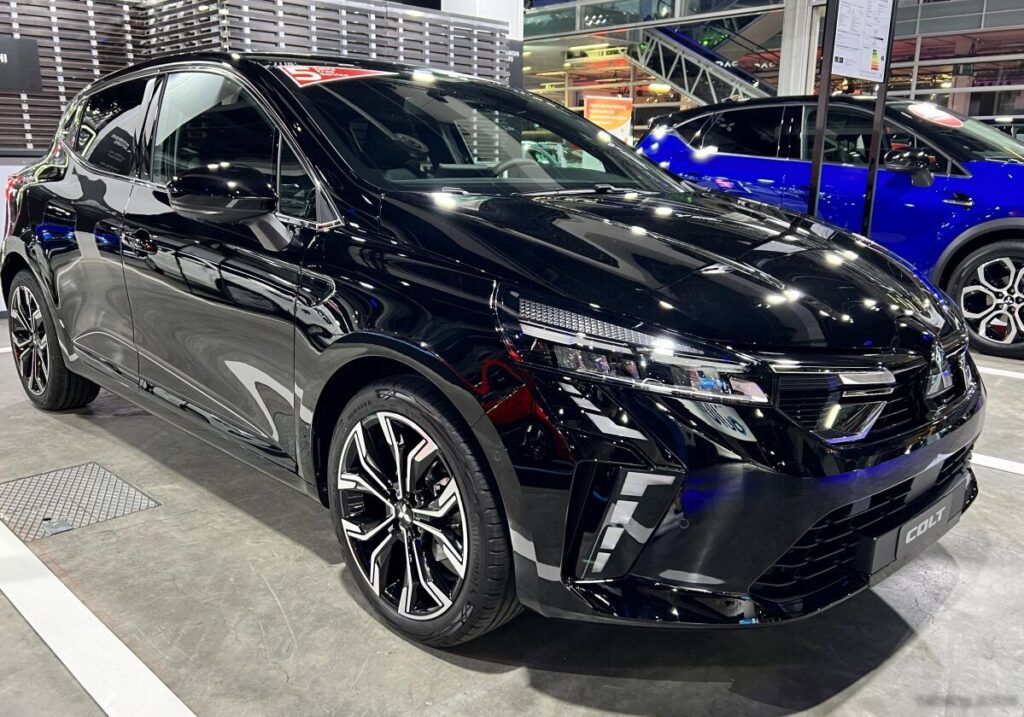
The Mitsubishi Colt VII 1.0 Turbo (91 hp) represents a significant entry point into the seventh generation of Mitsubishi’s Colt hatchback, launched in October 2023. This variant is positioned as an efficient and accessible option within the Colt VII lineup, designed primarily for the European market. It’s built on the shared platform with the Renault Clio V and the Renault Captur, marking a collaborative effort between the Renault-Nissan-Mitsubishi Alliance. The 1.0 Turbo model aims to balance fuel economy with a reasonable level of performance, appealing to buyers seeking a practical and modern supermini. This generation represents a substantial redesign for the Colt, moving away from the previous, smaller platform and adopting a more contemporary aesthetic and technology package.
Technical Specifications
| Brand | Mitsubishi |
| Model | Colt |
| Generation | Colt VII |
| Type (Engine) | 1.0 Turbo (91 Hp) |
| Start of production | October, 2023 |
| Powertrain Architecture | Internal Combustion engine |
| Body type | Hatchback |
| Seats | 5 |
| Doors | 5 |
| Fuel consumption at Low speed (WLTP) | 6.7 l/100 km (35.1 US mpg, 42.2 UK mpg, 14.9 km/l) |
| Fuel consumption at Medium speed (WLTP) | 4.8 l/100 km (49 US mpg, 58.9 UK mpg, 20.8 km/l) |
| Fuel consumption at high speed (WLTP) | 4.4 l/100 km (53.5 US mpg, 64.2 UK mpg, 22.7 km/l) |
| Fuel consumption at very high speed (WLTP) | 5.4 l/100 km (43.6 US mpg, 52.3 UK mpg, 18.5 km/l) |
| Combined fuel consumption (WLTP) | 5.2 l/100 km (45.2 US mpg, 54.3 UK mpg, 19.2 km/l) |
| CO2 emissions (WLTP) | 117 g/km |
| Fuel Type | Petrol (Gasoline) |
| Acceleration 0 – 100 km/h | 12.2 sec |
| Acceleration 0 – 62 mph | 12.2 sec |
| Acceleration 0 – 60 mph | 11.6 sec |
| Maximum speed | 180 km/h (111.85 mph) |
| Emission standard | Euro 6d |
| Weight-to-power ratio | 12.1 kg/Hp, 83 Hp/tonne |
| Weight-to-torque ratio | 6.9 kg/Nm, 145.9 Nm/tonne |
| Power | 91 Hp @ 4500-5000 rpm |
| Power per litre | 91.1 Hp/l |
| Torque | 160 Nm @ 2000-3750 rpm (118.01 lb.-ft. @ 2000-3750 rpm) |
| Engine layout | Front, Transverse |
| Engine displacement | 999 cm3 (60.96 cu. in.) |
| Number of cylinders | 3 |
| Engine configuration | Inline |
| Cylinder Bore | 72.2 mm (2.84 in.) |
| Piston Stroke | 81.3 mm (3.2 in.) |
| Compression ratio | 9.5:1 |
| Number of valves per cylinder | 4 |
| Fuel injection system | Multi-port manifold injection |
| Engine aspiration | Turbocharger, Intercooler |
| Valvetrain | DOHC |
| Engine systems | Start & Stop System, Particulate filter |
| Kerb Weight | 1097-1120 kg (2418.47 – 2469.18 lbs.) |
| Max. weight | 1570-1600 kg (3461.26 – 3527.4 lbs.) |
| Max load | 473-480 kg (1042.79 – 1058.22 lbs.) |
| Trunk (boot) space – minimum | 391 l (13.81 cu. ft.) |
| Trunk (boot) space – maximum | 1069 l (37.75 cu. ft.) |
| Fuel tank capacity | 42 l (11.1 US gal | 9.24 UK gal) |
| Max. roof load | 80 kg (176.37 lbs.) |
| Permitted trailer load with brakes (12%) | 900 kg (1984.16 lbs.) |
| Permitted trailer load without brakes | 575 kg (1267.66 lbs.) |
| Permitted towbar download | 63 kg (138.89 lbs.) |
| Length | 4053 mm (159.57 in.) |
| Width | 1798 mm (70.79 in.) |
| Width including mirrors | 1988 mm (78.27 in.) |
| Height | 1439 mm (56.65 in.) |
| Wheelbase | 2583 mm (101.69 in.) |
| Front track | 1518 mm (59.76 in.) |
| Rear (Back) track | 1506 mm (59.29 in.) |
| Front overhang | 833 mm (32.8 in.) |
| Rear overhang | 637 mm (25.08 in.) |
| Ride height (ground clearance) | 142 mm (5.59 in.) |
| Minimum turning circle (turning diameter) | 10.4 m (34.12 ft.) |
| Drivetrain Architecture | The Internal combustion engine (ICE) drives the front wheels of the vehicle. |
| Drive wheel | Front wheel drive |
| Number of gears and type of gearbox | 6 gears, manual transmission |
| Front suspension | Independent type McPherson |
| Rear suspension | Torsion |
| Front brakes | Ventilated discs |
| Rear brakes | Drum |
| Assisting systems | ABS (Anti-lock braking system) |
| Steering type | Steering rack and pinion |
| Power steering | Electric Steering |
| Tires size | 195/55 R16; 205/45 R17 |
| Wheel rims size | 6.5J x 16; 7J x 17 |
Powertrain & Engine Architecture
The heart of the Colt VII 1.0 Turbo is the HRA0 1.0-liter turbocharged three-cylinder engine. This engine, developed as part of the Renault-Nissan-Mitsubishi Alliance, utilizes a single-scroll turbocharger and direct injection to deliver 91 horsepower and 160 Nm (118 lb-ft) of torque. The engine features a DOHC (Double Overhead Camshaft) valvetrain and a compression ratio of 9.5:1. A particulate filter is included to meet stringent Euro 6d emission standards. The engine is transversely mounted at the front of the vehicle. The standard transmission for this variant is a 6-speed manual gearbox, optimized for fuel efficiency and responsive driving. While an automatic transmission is available on other Colt VII trims, it is not offered with the 1.0 Turbo engine.
Driving Characteristics
The 1.0 Turbo engine provides adequate performance for urban and suburban driving. Acceleration from 0 to 100 km/h (0-62 mph) takes approximately 12.2 seconds, and the top speed is 180 km/h (112 mph). The turbocharger provides a noticeable boost in power, particularly in the mid-range, making overtaking maneuvers manageable. However, compared to higher-powered Colt VII variants, such as those with larger engines, the 1.0 Turbo feels less spirited. The 6-speed manual transmission is well-matched to the engine’s characteristics, offering precise shifts and helping to keep the engine in its optimal power band. The gear ratios are tuned for fuel economy, which means the engine can feel slightly strained when climbing hills or carrying a full load.
Equipment & Trim Levels
The 1.0 Turbo trim typically serves as the entry-level offering in the Colt VII range. Standard equipment generally includes air conditioning, a touchscreen infotainment system with smartphone integration (Apple CarPlay and Android Auto), Bluetooth connectivity, and a suite of safety features such as automatic emergency braking, lane departure warning, and traffic sign recognition. Interior upholstery is typically cloth, and the dashboard features a functional, modern design. Optional extras may include alloy wheels, a rear-view camera, and parking sensors. The focus of this trim level is on providing essential features at an affordable price point.
Chassis & Braking
The Colt VII utilizes a McPherson strut front suspension and a torsion beam rear suspension. This setup provides a comfortable ride quality, well-suited for everyday driving. The front brakes are ventilated discs, while the rear brakes are drums. This configuration is typical for vehicles in this weight class and price range. The electric power steering provides light and precise steering feel. The chassis is designed to prioritize stability and handling, offering a secure driving experience.
Market Reception & Comparison
The Mitsubishi Colt VII 1.0 Turbo has been generally well-received as a practical and economical supermini. Critics have praised its fuel efficiency, modern design, and comprehensive safety features. However, some reviewers have noted that the 1.0-liter engine can feel underpowered, particularly when fully loaded or driving on challenging terrain. Compared to other trims in the Colt VII lineup, the 1.0 Turbo offers the lowest price of entry but sacrifices some performance. Compared to competitors like the Renault Clio, Peugeot 208, and Volkswagen Polo, the Colt VII 1.0 Turbo offers a competitive package in terms of price, features, and fuel economy.
Legacy
As a relatively new model, the long-term reliability of the Colt VII 1.0 Turbo powertrain is still being established. However, the engine itself has been used in other Renault-Nissan-Mitsubishi vehicles and has generally proven to be reliable. The simplicity of the three-cylinder engine and the use of proven technology suggest that it should be relatively easy and affordable to maintain. In the used car market, the 1.0 Turbo variant is likely to appeal to buyers seeking an economical and practical city car with low running costs.