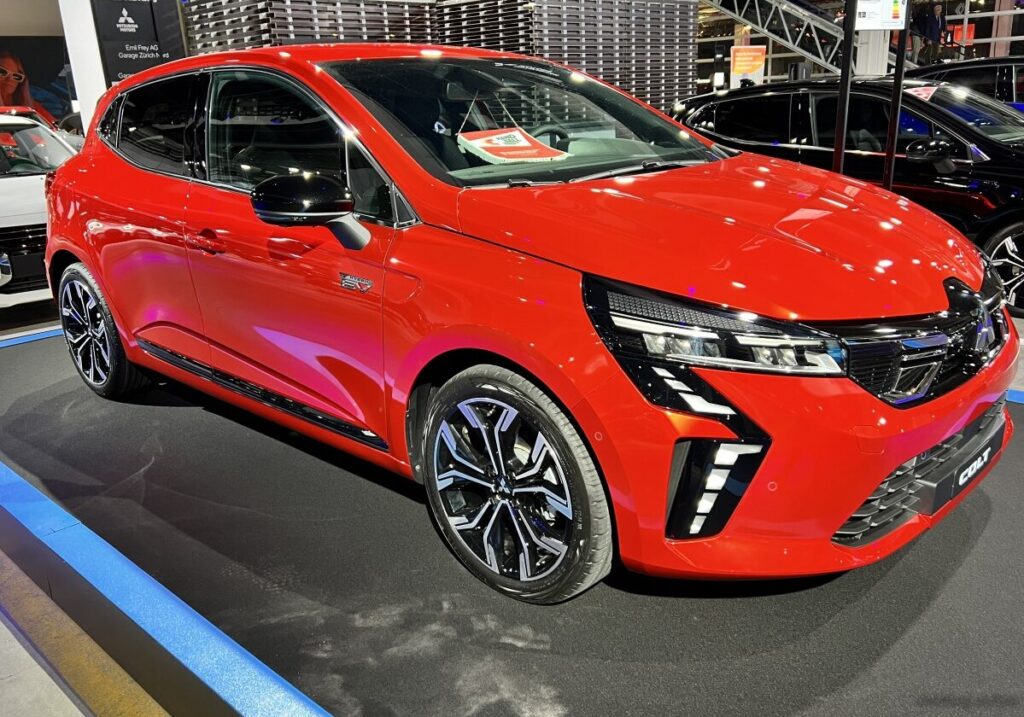
The Mitsubishi Colt VII 1.0 Turbo (91/101 hp) LPG is a subcompact hatchback produced by Mitsubishi Motors, entering production in September 2025. This variant represents a unique offering within the seventh generation Colt (introduced as a rebadged Renault Clio V), combining a turbocharged three-cylinder gasoline engine with the option of Liquefied Petroleum Gas (LPG) conversion. Positioned as an entry-level to mid-range trim, it aimed to provide a balance of fuel efficiency, affordability, and reasonable performance within the Colt VII lineup. The vehicle is primarily targeted towards European markets, where smaller, fuel-efficient vehicles are highly sought after.
Technical Specifications
| Brand | Mitsubishi |
| Model | Colt |
| Generation | Colt VII |
| Type (Engine) | 1.0 Turbo (91/101 Hp) LPG |
| Start of production | September, 2025 |
| Powertrain Architecture | Internal Combustion engine |
| Body type | Hatchback |
| Seats | 5 |
| Doors | 5 |
| Fuel consumption at Low speed (WLTP) | 7.0-7.1 l/100 km (33.6 – 33.1 US mpg, 40.4 – 39.8 UK mpg, 14.3 – 14.1 km/l) |
| Fuel consumption at Low speed (WLTP) (LPG) | 8.9-9.1 l/100 km |
| Fuel consumption at Medium speed (WLTP) | 5.2 l/100 km (45.2 US mpg, 54.3 UK mpg, 19.2 km/l) |
| Fuel consumption at Medium speed (WLTP) (LPG) | 6.7-6.8 l/100 km |
| Fuel consumption at high speed (WLTP) | 4.7 l/100 km (50 US mpg, 60.1 UK mpg, 21.3 km/l) |
| Fuel consumption at high speed (WLTP) (LPG) | 6.1 l/100 km |
| Fuel consumption at very high speed (WLTP) | 5.5 l/100 km (42.8 US mpg, 51.4 UK mpg, 18.2 km/l) |
| Fuel consumption at very high speed (WLTP) (LPG) | 7.2 l/100 km |
| Combined fuel consumption (WLTP) | 5.4 l/100 km (43.6 US mpg, 52.3 UK mpg, 18.5 km/l) |
| Combined fuel consumption (WLTP) (LPG) | 7.0 l/100 km |
| CO2 emissions (WLTP) | 122 g/km |
| CO2 emissions (LPG) (WLTP) | 109 g/km |
| Fuel Type | Petrol / LPG |
| Acceleration 0 – 100 km/h | 11.8 sec |
| Acceleration 0 – 62 mph | 11.8 sec |
| Acceleration 0 – 100 km/h (LPG) | 12.5 sec |
| Acceleration 0 – 60 mph (Calculated) | 11.2 sec |
| Maximum speed | 174 km/h (108.12 mph) |
| Emission standard | Euro 6e |
| Weight-to-power ratio | 12.6 kg/Hp, 79.1 Hp/tonne |
| Weight-to-torque ratio | 7.2 kg/Nm, 139 Nm/tonne |
| Power | 91 Hp @ 5000 rpm |
| Power per litre | 91.1 Hp/l |
| Power (LPG) | 101 Hp @ 4600-5000 rpm |
| Power per litre (LPG) | 101.1 Hp/l |
| Torque | 160 Nm @ 2000-3750 rpm (118.01 lb.-ft. @ 2000-3750 rpm) |
| Torque (LPG) | 170 Nm @ 2000-3500 rpm |
| Engine layout | Front, Transverse |
| Engine displacement | 999 cm3 (60.96 cu. in.) |
| Number of cylinders | 3 |
| Engine configuration | Inline |
| Number of valves per cylinder | 4 |
| Fuel injection system | Multi-port manifold injection |
| Engine aspiration | Turbocharger, Intercooler |
| Valvetrain | DOHC |
| Engine systems | Start & Stop System, Particulate filter |
| Kerb Weight | 1151-1175 kg (2537.52 – 2590.43 lbs.) |
| Max. weight | 1645 kg (3626.6 lbs.) |
| Max load | 470-494 kg (1036.17 – 1089.08 lbs.) |
| Trunk (boot) space – minimum | 301 l (10.63 cu. ft.) |
| Trunk (boot) space – maximum | 979 l (34.57 cu. ft.) |
| Fuel tank capacity | 39 l (10.3 US gal | 8.58 UK gal) |
| Fuel tank capacity (LPG) | 32 l |
| Permitted trailer load with brakes (12%) | 900 kg (1984.16 lbs.) |
| Permitted trailer load without brakes | 625 kg (1377.89 lbs.) |
| Length | 4047 mm (159.33 in.) |
| Width | 1728 mm (68.03 in.) |
| Height | 1457 mm (57.36 in.) |
| Wheelbase | 2583 mm (101.69 in.) |
| Front overhang | 830 mm (32.68 in.) |
| Rear overhang | 634 mm (24.96 in.) |
| Minimum turning circle | 10.42 m (34.19 ft.) |
| Drivetrain Architecture | ICE to Front Wheels |
| Drive wheel | Front wheel drive |
| Number of gears and type of gearbox | 6 gears, manual transmission |
| Front suspension | Independent type McPherson, Transverse stabilizer |
| Rear suspension | Transverse stabilizer, Torsion |
| Front brakes | Ventilated discs |
| Rear brakes | Drum |
| Assisting systems | ABS (Anti-lock braking system) |
| Steering type | Steering rack and pinion |
| Power steering | Electric Steering |
| Tires size | 195/55 R16; 205/45 R17 |
| Wheel rims size | 7.0J x 16; 7.0J x 17 |
INTRODUCTION
The Mitsubishi Colt VII 1.0 Turbo (91/101 hp) LPG represents a significant shift for the Colt nameplate. While previous generations were often developed independently by Mitsubishi, the VII is based on the Renault Clio V platform (1HX0/A3), a result of the Renault-Nissan-Mitsubishi Alliance. Introduced in 2025, this model aimed to revitalize the Colt in the European market, offering a modern, efficient, and affordable option in the competitive subcompact hatchback segment. The availability of an LPG conversion adds a further dimension to its appeal, catering to markets where alternative fuels are popular and incentivized. This particular variant, with its turbocharged engine and manual transmission, occupies a middle ground within the Colt VII range, offering more performance than the base naturally aspirated models but remaining more accessible than the higher-powered options.
Powertrain & Engine Architecture
At the heart of the Colt VII 1.0 Turbo LPG lies the H5Ft engine, a 999cc inline three-cylinder gasoline engine. This engine utilizes a single turbocharger with an intercooler to boost power output to 91 horsepower at 5000 rpm and 160 Nm of torque between 2000-3750 rpm. When converted to run on LPG, the engine management system adjusts to deliver 101 horsepower at 4600-5000 rpm and 170 Nm of torque between 2000-3500 rpm. The engine employs multi-point fuel injection and a double overhead camshaft (DOHC) valvetrain. A particulate filter is included to meet stringent Euro 6e emission standards. The engine is transversely mounted at the front of the vehicle. The standard transmission for this variant is a 6-speed manual gearbox, chosen for its efficiency and driver engagement. The LPG conversion is typically a factory-approved system, integrating seamlessly with the engine’s electronics and fuel delivery.
Driving Characteristics
The 1.0 Turbo engine, even in its 91 hp guise, provides adequate performance for everyday driving. Acceleration from 0-100 km/h takes approximately 11.8 seconds, while top speed is rated at 174 km/h. The turbocharger provides a noticeable boost in power, particularly in the mid-range, making overtaking maneuvers relatively effortless. The 6-speed manual transmission is well-matched to the engine’s characteristics, offering precise shifts and allowing the driver to keep the engine in its optimal power band. Switching to LPG slightly improves torque, resulting in a more responsive feel, although acceleration figures are marginally slower. Compared to the base 1.0-liter naturally aspirated engine, the turbo variant offers a significant improvement in performance. However, it doesn’t match the responsiveness of higher-output versions available in the Colt VII range.
Equipment & Trim Levels
The 1.0 Turbo LPG variant typically comes equipped with a reasonable level of standard features. These generally include air conditioning, a touchscreen infotainment system with smartphone integration (Apple CarPlay and Android Auto), Bluetooth connectivity, and basic safety features such as ABS, electronic stability control, and multiple airbags. Interior upholstery is typically cloth, with a functional and durable design. Optional extras could include alloy wheels, a rear parking camera, automatic climate control, and advanced driver-assistance systems (ADAS) like lane departure warning and automatic emergency braking. Trim levels above the base model often added features like upgraded interior materials, a larger touchscreen display, and more comprehensive ADAS packages.
Chassis & Braking
The Colt VII utilizes a McPherson strut front suspension with a transverse stabilizer bar, providing a comfortable and controlled ride. The rear suspension employs a torsion beam setup, which is a cost-effective and space-efficient solution. Front brakes are ventilated discs, offering good stopping power, while rear brakes are drums. This configuration is typical for vehicles in this weight class. The electric power steering provides light and precise steering feel. Tire sizes typically range from 195/55 R16 to 205/45 R17, depending on the trim level.
Market Reception & Comparison
The Mitsubishi Colt VII 1.0 Turbo LPG received generally positive reviews, with critics praising its fuel efficiency, affordability, and surprisingly engaging driving dynamics. The LPG conversion was seen as a valuable option for drivers seeking to reduce their fuel costs and environmental impact. Compared to other trims in the Colt VII lineup, the 1.0 Turbo LPG offered a good balance between performance and economy. The naturally aspirated 1.0-liter models were cheaper but lacked the turbo’s punch, while the higher-powered variants were more expensive and less fuel-efficient. Competitors in the subcompact hatchback segment, such as the Renault Clio, Peugeot 208, and Volkswagen Polo, offered similar levels of equipment and performance, but the Colt VII’s LPG option provided a unique selling point.
Legacy
The Mitsubishi Colt VII 1.0 Turbo LPG, while a relatively recent introduction, is expected to have good long-term reliability, benefiting from the robust design of the Renault Clio platform and the proven technology of the three-cylinder turbo engine. The LPG conversion, if properly maintained, can extend the engine’s lifespan and reduce running costs. As the model ages, it is likely to become a popular choice in the used car market, particularly among buyers seeking an affordable, fuel-efficient, and environmentally conscious vehicle. Its position as a rebadged Renault Clio may influence its resale value and parts availability, but the Colt’s unique styling and LPG option should maintain its appeal.