
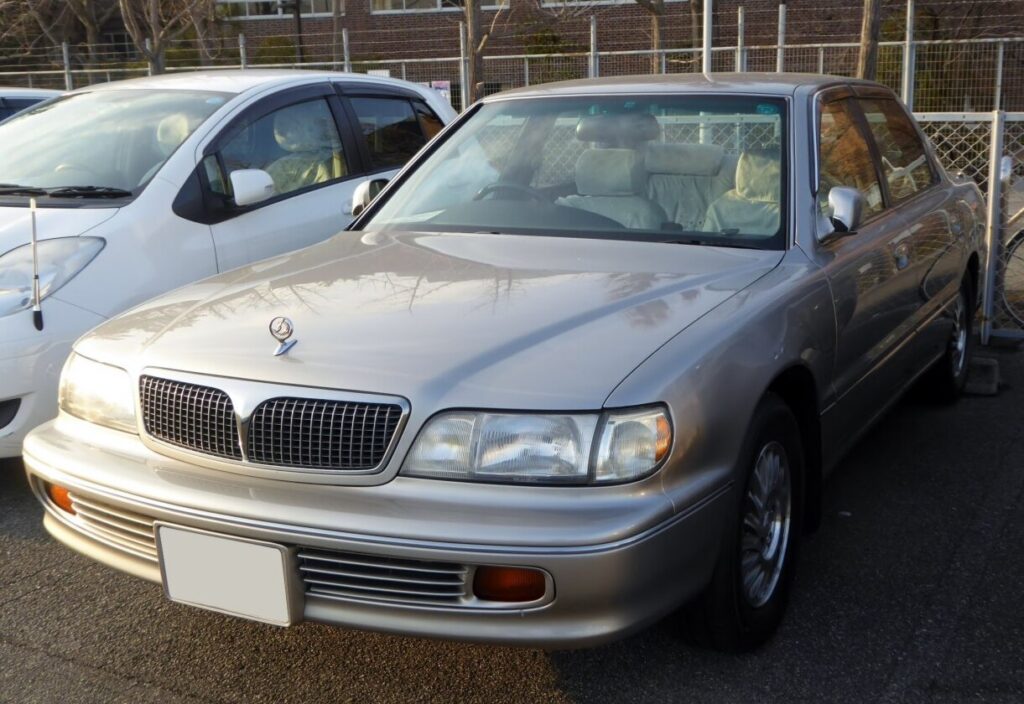
The Mitsubishi Debonair (S27) 3.0 i V6, produced between 1992 and 1999, represented the third generation of Mitsubishi’s flagship luxury sedan. Positioned as a direct competitor to Japanese rivals like the Toyota Crown and Nissan Cima, the Debonair aimed to offer a sophisticated and comfortable driving experience. The S27 generation, built on the Debonair platform, was characterized by its elegant styling, spacious interior, and advanced features for its time. This particular variant, equipped with the 3.0-liter V6 engine and a four-speed automatic transmission, occupied a mid-range position within the Debonair lineup, offering a balance between performance and refinement. It was primarily sold within the Japanese domestic market (JDM), catering to buyers seeking a premium, domestically-produced sedan.
Technical Specifications
| Brand | Mitsubishi |
| Model | Debonair |
| Generation | Debonair (S27) |
| Type (Engine) | 3.0 i V6 (150 Hp) |
| Start of production | 1992 |
| End of production | 1999 |
| Powertrain Architecture | Internal Combustion engine |
| Body type | Sedan |
| Seats | 5 |
| Doors | 4 |
| Fuel consumption (combined) | 8.8 l/100 km (26.7 US mpg, 32.1 UK mpg, 11.4 km/l) |
| Fuel Type | Petrol (Gasoline) |
| Power | 150 Hp @ 5000 rpm |
| Power per litre | 50.5 Hp/l |
| Torque | 226 Nm @ 4000 rpm (166.69 lb.-ft. @ 4000 rpm) |
| Engine layout | Front, Transverse |
| Engine displacement | 2972 cm3 (181.36 cu. in.) |
| Number of cylinders | 6 |
| Engine configuration | V-engine |
| Cylinder Bore | 91.1 mm (3.59 in.) |
| Piston Stroke | 76 mm (2.99 in.) |
| Compression ratio | 10:1 |
| Number of valves per cylinder | 2 |
| Fuel injection system | Multi-port manifold injection |
| Engine aspiration | Naturally aspirated engine |
| Valvetrain | OHC |
| Fuel tank capacity | 105 l (27.74 US gal | 23.1 UK gal) |
| Length | 4975 mm (195.87 in.) |
| Width | 1815 mm (71.46 in.) |
| Height | 1440 mm (56.69 in.) |
| Wheelbase | 2745 mm (108.07 in.) |
| Front track | 1545 mm (60.83 in.) |
| Rear track | 1550 mm (61.02 in.) |
| Drivetrain Architecture | The Internal combustion engine (ICE) drives the front wheels of the vehicle. |
| Drive wheel | Front wheel drive |
| Number of gears and type of gearbox | 4 gears, automatic transmission |
| Front suspension | Spring Strut |
| Rear suspension | Coil spring |
| Front brakes | Ventilated discs |
| Rear brakes | Ventilated discs |
| Assisting systems | ABS (Anti-lock braking system) |
| Steering type | Steering rack and pinion |
| Power steering | Hydraulic Steering |
| Tires size | 205/65 R15 H |
Powertrain & Engine Architecture
The heart of the Debonair 3.0 i V6 is the 6A12 engine, a 2.972-liter (181.36 cubic inches) naturally aspirated V6. This engine utilizes a 60-degree V-angle, contributing to a smoother power delivery and reduced vibrations. The engine employs a single overhead camshaft (OHC) valvetrain with two valves per cylinder. Fuel delivery is managed by a multi-port fuel injection system, optimizing combustion efficiency and responsiveness. The 6A12 engine was known for its relatively quiet operation and linear power curve. Paired with this engine is a four-speed automatic transmission, designed for smooth and comfortable gear changes. This transmission was a conventional hydraulic automatic, prioritizing ease of use over outright performance. The transmission’s gear ratios were tuned for relaxed cruising and adequate acceleration, rather than sporty driving.
Driving Characteristics
The Debonair 3.0 i V6 with the automatic transmission offered a comfortable and refined driving experience. While not a performance-oriented vehicle, the 150 horsepower and 226 Nm (166.69 lb-ft) of torque provided sufficient power for everyday driving and highway cruising. Acceleration was adequate, but noticeably slower than the manual transmission variants or higher-output engine options. The automatic transmission’s shift points were programmed for fuel efficiency and smoothness, sometimes resulting in a slight delay in response during overtaking maneuvers. The front-wheel-drive configuration contributed to predictable handling, but lacked the dynamic capabilities of rear-wheel-drive competitors. The suspension was tuned for comfort, absorbing bumps and imperfections in the road effectively, making it a pleasant long-distance cruiser.
Equipment & Trim Levels
The Debonair 3.0 i V6 typically came well-equipped, reflecting its position as a luxury sedan. Standard features included power windows, power locks, air conditioning, and a high-quality audio system. Interior upholstery was typically cloth or velour, with leather options available as upgrades. Dashboard design featured woodgrain accents and a straightforward layout, prioritizing functionality and ease of use. Optional extras included a sunroof, upgraded audio systems, and power-adjustable seats. The Debonair also offered advanced features for its time, such as an electronic multi-information display and automatic climate control on higher trim levels.
Chassis & Braking
The Debonair S27 utilized a conventional chassis design with a MacPherson strut suspension in the front and a coil spring suspension in the rear. The suspension was tuned for comfort, prioritizing ride quality over sporty handling. Braking duties were handled by ventilated disc brakes on all four wheels, providing adequate stopping power. An Anti-lock Braking System (ABS) was standard, enhancing safety and stability during emergency braking situations. Steering was provided by a hydraulic power steering system, making maneuvering easy and effortless. The Debonair’s chassis was designed to provide a stable and comfortable platform, rather than aggressive cornering performance.
Market Reception & Comparison
The Mitsubishi Debonair 3.0 i V6 was generally well-received in the Japanese market. Critics praised its comfortable ride, spacious interior, and refined engine. However, some reviewers noted that the automatic transmission could feel sluggish at times, and the front-wheel-drive configuration limited its dynamic capabilities compared to rear-wheel-drive competitors. Compared to the manual transmission versions of the Debonair, the automatic offered less engaging driving experience but greater convenience. Compared to the higher-output engine options, the 3.0-liter V6 provided a good balance between performance and fuel economy. Fuel economy was rated at 8.8 l/100 km (26.7 US mpg), which was competitive for a vehicle of its size and class.
Legacy
The Mitsubishi Debonair S27, including the 3.0 i V6 automatic variant, has developed a following among enthusiasts of Japanese classic cars. The 6A12 engine is known for its reliability and durability, provided it receives regular maintenance. While not as sought-after as some of the more performance-oriented JDM models, the Debonair offers a unique blend of luxury, comfort, and reliability. In the used car market, well-maintained examples of the Debonair 3.0 i V6 can command reasonable prices, appealing to buyers seeking a distinctive and comfortable classic sedan. Parts availability can be a challenge, as the Debonair was primarily sold in Japan, but a dedicated community of enthusiasts helps to keep these vehicles on the road.
