
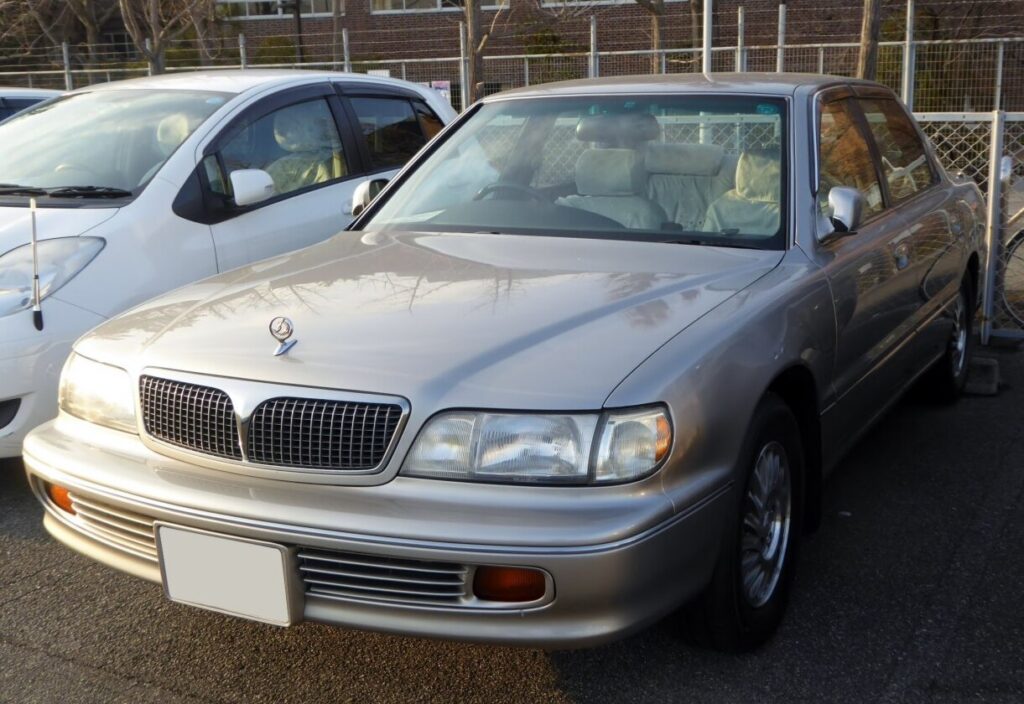
The Mitsubishi Debonair (S27) 3.5 i V6 24V, produced between 1992 and 1999, represented the third generation of Mitsubishi’s flagship luxury sedan. Positioned as a direct competitor to Japanese rivals like the Toyota Crown and Nissan Cima, the Debonair aimed to offer a sophisticated and comfortable driving experience. The S27 generation, built on a dedicated platform, was a significant departure from previous iterations, emphasizing refinement and advanced features for its time. This particular 3.5-liter V6 variant, producing 260 horsepower, sat at the top of the Debonair range, offering the highest level of performance and luxury within the model line.
Technical Specifications
| Brand | Mitsubishi |
| Model | Debonair |
| Generation | Debonair (S27) |
| Type (Engine) | 3.5 i V6 24V (260 Hp) |
| Start of production | 1992 |
| End of production | 1999 |
| Powertrain Architecture | Internal Combustion engine |
| Body type | Sedan |
| Seats | 5 |
| Doors | 4 |
| Fuel consumption (combined) | 9.6 l/100 km |
| Fuel consumption (US mpg) | 24.5 US mpg |
| Fuel consumption (UK mpg) | 29.4 UK mpg |
| Fuel consumption (km/l) | 10.4 km/l |
| Fuel Type | Petrol (Gasoline) |
| Weight-to-power ratio | 6.8 kg/Hp |
| Power | 260 Hp @ 6000 rpm |
| Power per litre | 74.4 Hp/l |
| Torque | 324 Nm @ 4500 rpm |
| Torque (lb.-ft.) | 238.97 lb.-ft. @ 4500 rpm |
| Engine layout | Front, Transverse |
| Engine displacement | 3496 cm3 |
| Engine displacement (cu. in.) | 213.34 cu. in. |
| Number of cylinders | 6 |
| Engine configuration | V-engine |
| Cylinder Bore | 93 mm |
| Cylinder Bore (in.) | 3.66 in. |
| Piston Stroke | 85.8 mm |
| Piston Stroke (in.) | 3.38 in. |
| Compression ratio | 10:1 |
| Number of valves per cylinder | 4 |
| Fuel injection system | Multi-port manifold injection |
| Engine aspiration | Naturally aspirated engine |
| Valvetrain | DOHC |
| Kerb Weight | 1780 kg |
| Kerb Weight (lbs.) | 3924.23 lbs. |
| Fuel tank capacity | 72 l |
| Fuel tank capacity (US gal) | 19.02 US gal |
| Fuel tank capacity (UK gal) | 15.84 UK gal |
| Length | 4975 mm |
| Length (in.) | 195.87 in. |
| Width | 1815 mm |
| Width (in.) | 71.46 in. |
| Height | 1440 mm |
| Height (in.) | 56.69 in. |
| Wheelbase | 2745 mm |
| Wheelbase (in.) | 108.07 in. |
| Front track | 1545 mm |
| Front track (in.) | 60.83 in. |
| Rear track | 1550 mm |
| Rear track (in.) | 61.02 in. |
| Drivetrain Architecture | Front wheel drive |
| Drive wheel | Front wheel drive |
| Number of gears | 4 |
| Gearbox type | automatic transmission |
| Front suspension | Spring Strut |
| Rear suspension | Coil spring |
| Front brakes | Ventilated discs |
| Rear brakes | Ventilated discs |
| Assisting systems | ABS (Anti-lock braking system) |
| Steering type | Steering rack and pinion |
| Power steering | Hydraulic Steering |
| Tires size | 215/65 R15 H |
Powertrain & Engine Architecture
The heart of the Debonair 3.5 i was the 6A13 twin-cam, 24-valve V6 engine. Displacing 3.5 liters (3496 cc), this engine featured multi-port fuel injection and a 10:1 compression ratio. The engine’s design prioritized smooth power delivery and quiet operation, befitting its luxury car status. Mitsubishi’s engineers focused on reducing noise, vibration, and harshness (NVH) through careful balancing and the use of advanced materials. The 4-speed automatic transmission, while not the most modern by today’s standards, was chosen for its smoothness and reliability. It was designed to complement the engine’s torque curve, providing comfortable acceleration without excessive gear hunting. The transmission featured electronically controlled torque converter lock-up for improved fuel efficiency at highway speeds.
Driving Characteristics
The 3.5-liter V6 and automatic transmission combination delivered a refined and comfortable driving experience. While not overtly sporty, the Debonair offered ample power for effortless cruising and overtaking. The automatic transmission, with its relatively conservative gear ratios, prioritized smooth shifts over outright acceleration. Compared to the manual transmission versions, the automatic offered a more relaxed driving experience, particularly in city traffic. However, it did result in slightly slower acceleration times and marginally lower fuel economy. The front-wheel-drive layout provided predictable handling, although it lacked the dynamic sharpness of rear-wheel-drive competitors.
Equipment & Trim Levels
The 3.5 i V6 24V Debonair was typically equipped with a comprehensive list of standard features. These included power-adjustable seats, climate control, a high-quality audio system, and woodgrain interior trim. Leather upholstery was standard, and options such as a sunroof, navigation system (a rarity for the time), and upgraded sound systems were available. The interior design emphasized spaciousness and comfort, with ample legroom for both front and rear passengers. The dashboard layout was functional and elegant, with a focus on ease of use.
Chassis & Braking
The Debonair S27 utilized a front-engine, front-wheel-drive layout. Suspension consisted of MacPherson struts at the front and a multi-link coil spring setup at the rear, tuned for a comfortable ride. Braking duties were handled by ventilated disc brakes on all four wheels, supplemented by an Anti-lock Braking System (ABS) as standard equipment. The steering system employed a rack-and-pinion setup with hydraulic power assistance, providing light and precise steering feel. The Debonair’s chassis was designed to minimize body roll and provide a stable platform for comfortable long-distance driving.
Market Reception & Comparison
The Debonair 3.5 i V6 24V was generally well-received by Japanese automotive critics. It was praised for its refined engine, comfortable ride, and luxurious interior. However, some critics noted that its styling was somewhat conservative compared to its European and American rivals. Compared to other trims in the Debonair lineup, the 3.5-liter V6 offered a significant performance advantage over the smaller 2.5-liter engine. Fuel economy was comparable to other large sedans of the era, but the V6 naturally consumed more fuel than the smaller-displacement options. Reliability was generally good, although maintenance costs could be higher due to the complexity of the V6 engine and its associated systems.
Legacy
The Mitsubishi Debonair S27, particularly the 3.5 i V6 24V variant, remains a sought-after classic car in Japan. Its combination of luxury, performance, and reliability has ensured its continued appeal to collectors and enthusiasts. While finding parts can be challenging outside of Japan, the 6A13 engine is known for its durability when properly maintained. Today, well-preserved examples command a premium in the used car market, representing a unique and refined piece of Japanese automotive history. The Debonair, in its various iterations, demonstrated Mitsubishi’s ambition to compete with the world’s leading luxury car manufacturers, and the S27 generation remains a testament to that effort.
