
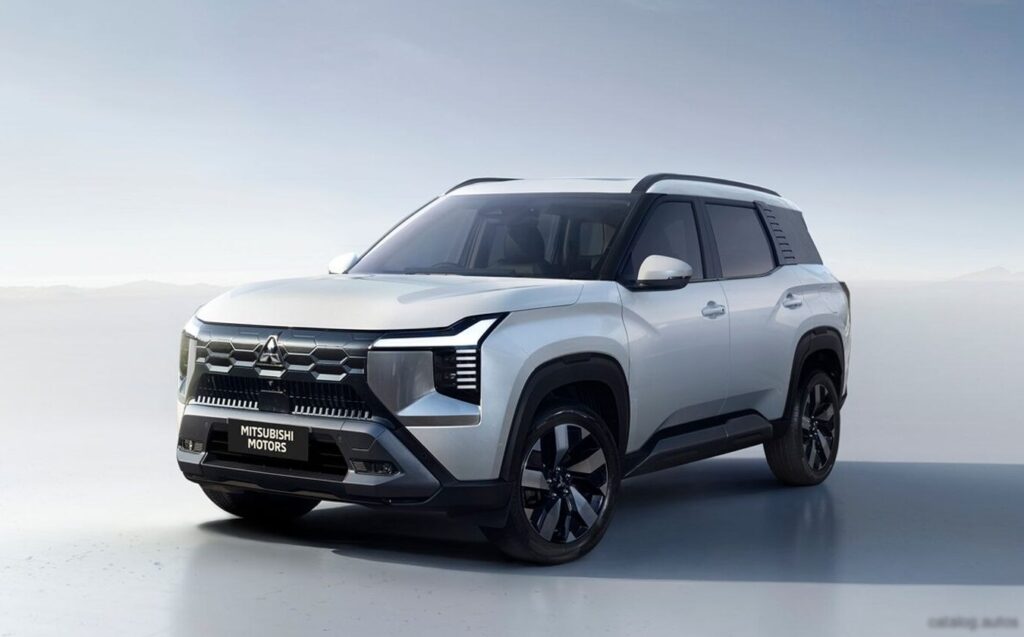
The Mitsubishi Destinator 1.5L (163 Hp) CVT, launched in July 2025, represents Mitsubishi’s entry into the increasingly competitive compact crossover SUV segment. Positioned as a family-oriented vehicle, the Destinator aims to offer a blend of practicality, fuel efficiency, and modern technology. It’s built upon a new platform designed to accommodate both internal combustion engines and, potentially, future electrified powertrains. The Destinator is primarily targeted at the North American and Asian markets, where seven-seat SUVs are in high demand. This specific 1.5L turbocharged variant with a continuously variable transmission (CVT) serves as the mainstream offering within the Destinator lineup, slotting below potential higher-performance or hybrid models.
Technical Specifications
| Brand | Mitsubishi |
| Model | Destinator |
| Generation | Destinator |
| Type (Engine) | 1.5L (163 Hp) CVT |
| Start of production | July, 2025 |
| Powertrain Architecture | Internal Combustion engine |
| Body type | SUV, Crossover |
| Seats | 7 |
| Doors | 5 |
| Fuel Type | Petrol (Gasoline) |
| Weight-to-power ratio | 9.2 kg/Hp, 109 Hp/tonne |
| Weight-to-torque ratio | 6 kg/Nm, 167.2 Nm/tonne |
| Power | 163 Hp @ 5000 rpm |
| Power per litre | 108.7 Hp/l |
| Torque | 250 Nm @ 2000-4000 rpm, 184.39 lb.-ft. @ 2000-4000 rpm |
| Engine layout | Front, Transverse |
| Engine Model/Code | MIVEC/4B40 |
| Engine displacement | 1499 cm3, 91.47 cu. in. |
| Number of cylinders | 4 |
| Engine configuration | Inline |
| Cylinder Bore | 75 mm, 2.95 in. |
| Piston Stroke | 84.8 mm, 3.34 in. |
| Compression ratio | 11:1 |
| Number of valves per cylinder | 4 |
| Fuel injection system | Direct injection and Multi-port manifold injection |
| Engine aspiration | Turbocharger, Intercooler |
| Valvetrain | DOHC |
| Engine systems | Start & Stop System |
| Kerb Weight | 1495 kg, 3295.91 lbs |
| Fuel tank capacity | 45 l, 11.89 US gal | 9.9 UK gal |
| Length | 4680 mm, 184.25 in |
| Width | 1840 mm, 72.44 in |
| Height | 1780 mm, 70.08 in |
| Wheelbase | 2815 mm, 110.83 in |
| Front track | 1580 mm, 62.2 in |
| Rear (Back) track | 1590 mm, 62.6 in |
| Ride height (ground clearance) | 214 mm, 8.43 in |
| Minimum turning circle (turning diameter) | 10.8 m, 35.43 ft |
| Approach angle | 21° |
| Departure angle | 25.5° |
| Ramp-over (brakeover) angle | 20.8° |
| Drivetrain Architecture | The Internal combustion engine (ICE) drives the front wheels of the vehicle. |
| Drive wheel | Front wheel drive |
| Number of gears and type of gearbox | automatic transmission CVT |
| Front suspension | Independent type McPherson |
| Rear suspension | Torsion |
| Front brakes | Disc |
| Rear brakes | Disc |
| Assisting systems | ABS (Anti-lock braking system) |
| Steering type | Steering rack and pinion |
| Power steering | Electric Steering |
| Tires size | 225/55 R18 |
| Wheel rims size | 18 |
Powertrain & Engine Architecture
The heart of the Destinator 1.5L is Mitsubishi’s 4B40 engine, a 1.5-liter inline-four cylinder powerplant. This engine utilizes Mitsubishi’s MIVEC (Mitsubishi Innovative Valve timing Electronic Control) technology, providing variable valve timing on both the intake and exhaust camshafts. This system optimizes engine performance across a wider RPM range, improving both fuel efficiency and power delivery. The engine employs a combination of direct injection and multi-port fuel injection, further enhancing combustion efficiency. A single turbocharger with an intercooler is used to boost power output. The engine is paired with a continuously variable transmission (CVT), chosen for its smooth operation and fuel-saving capabilities. While CVTs aren’t known for sporty driving dynamics, they are well-suited for the Destinator’s intended purpose as a comfortable and efficient family vehicle. The CVT is programmed with simulated shift points to provide a more natural driving feel.
Driving Characteristics
The Destinator 1.5L CVT delivers adequate performance for everyday driving. With 163 horsepower and 250 Nm (184 lb-ft) of torque, acceleration is reasonable, though not particularly brisk. The CVT effectively utilizes the engine’s torque band, providing smooth and linear acceleration. Compared to a potential manual transmission version (if offered), the CVT prioritizes fuel economy and ease of use over outright performance. The CVT’s gear ratios are optimized for fuel efficiency at cruising speeds, but may feel slightly less responsive during quick overtaking maneuvers. The steering is light and precise, making the Destinator easy to maneuver in urban environments. The suspension is tuned for comfort, absorbing bumps and imperfections in the road surface effectively.
Equipment & Trim Levels
The base Destinator 1.5L CVT comes standard with a respectable array of features, including automatic climate control, a touchscreen infotainment system with Apple CarPlay and Android Auto compatibility, and a suite of safety features such as ABS, stability control, and multiple airbags. Higher trim levels add features like leather upholstery, a panoramic sunroof, and advanced driver-assistance systems (ADAS) such as adaptive cruise control and lane departure warning. Interior materials are generally of good quality, with a focus on durability and practicality. The seven-seat configuration offers ample space for passengers, although the third-row seats are best suited for children or shorter adults.
Chassis & Braking
The Destinator utilizes a front-wheel-drive layout. The front suspension employs an independent McPherson strut design, while the rear suspension utilizes a torsion beam setup. This configuration provides a good balance between ride comfort and handling. The braking system consists of disc brakes on all four wheels, providing adequate stopping power. ABS (Anti-lock Braking System) is standard, enhancing safety during emergency braking situations. The electric power steering system provides light and precise steering feel.
Market Reception & Comparison
Initial reviews of the Destinator 1.5L CVT have been generally positive, with critics praising its spacious interior, comfortable ride, and fuel efficiency. However, some reviewers have noted that the CVT can feel somewhat sluggish during acceleration. Compared to competitors like the Toyota RAV4 or Honda CR-V, the Destinator offers a more affordable price point, but may not match their overall refinement or brand reputation. Fuel economy is competitive within its class, achieving an estimated combined fuel consumption of around 32 mpg. Reliability is still being assessed, as the Destinator is a relatively new model.
Legacy
It is still early to assess the long-term reliability of the Destinator 1.5L CVT powertrain. However, Mitsubishi has a generally good reputation for building durable and reliable vehicles. The 4B40 engine has been used in other Mitsubishi models for several years, and has proven to be a relatively robust unit. The CVT, while not known for its longevity in some applications, is expected to hold up well with proper maintenance. As the Destinator ages, its value in the used car market will likely depend on its maintenance history and overall condition. The combination of seven-seat practicality, fuel efficiency, and a reasonable price point could make it an attractive option for budget-conscious families.
