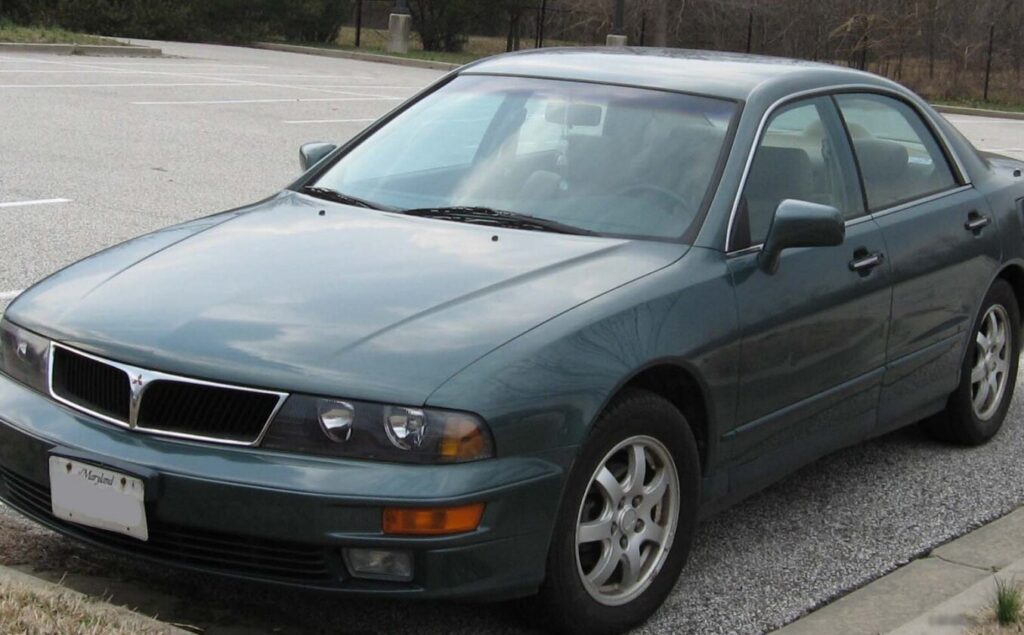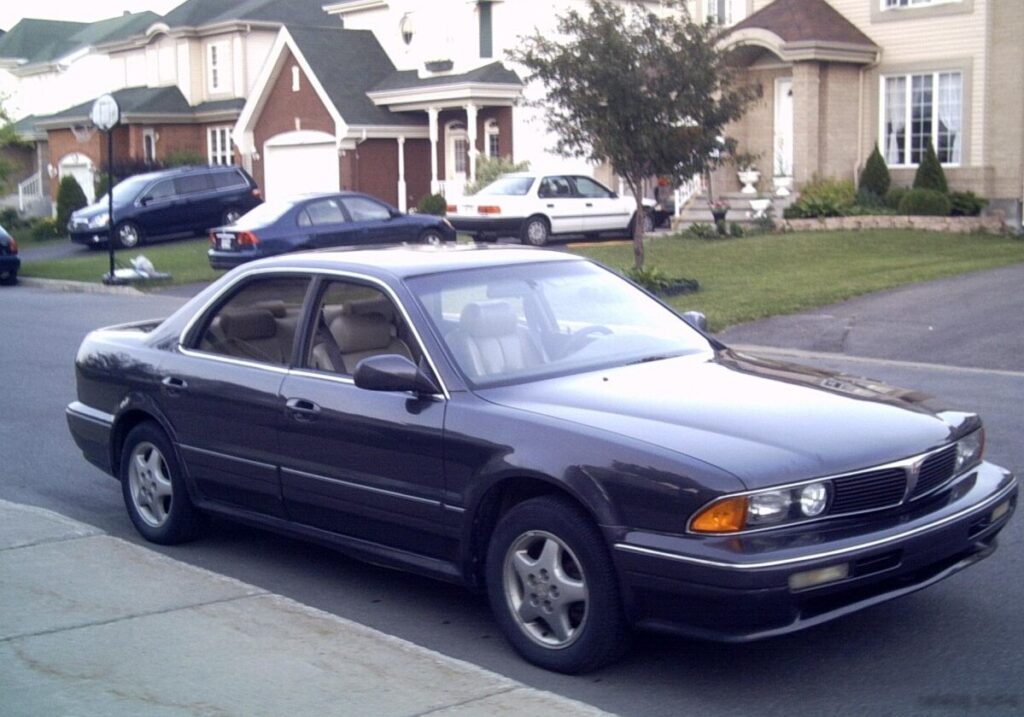
The Mitsubishi Diamante, known in Japan as the Mitsubishi Sigma, represented Mitsubishi’s foray into the mid-size luxury sedan segment. Introduced in 1991 and continuing through 1996 for the first generation (designated Diamante I, chassis code Y30/Y40), it aimed to compete with established players like the Toyota Crown, Nissan Cedric, and Honda Accord. The 2.0i V6 24V variant, producing 145 horsepower, was a significant offering within the Diamante lineup, positioned as a balance between performance and fuel efficiency. It was primarily marketed in Japan and select export markets, offering a more accessible entry point into the Diamante range compared to the higher-specification models.
Technical Specifications
| Brand | Mitsubishi |
| Model | Diamante |
| Generation | Diamante I |
| Type (Engine) | 2.0 i V6 24V (145 Hp) |
| Start of production | 1991 |
| End of production | 1996 |
| Powertrain Architecture | Internal Combustion engine |
| Body type | Sedan |
| Seats | 5 |
| Doors | 4 |
| Fuel consumption (combined) | 7.4 l/100 km (31.8 US mpg, 38.2 UK mpg, 13.5 km/l) |
| Fuel Type | Petrol (Gasoline) |
| Weight-to-power ratio | 9.7 kg/Hp, 103.6 Hp/tonne |
| Weight-to-torque ratio | 7.7 kg/Nm, 130 Nm/tonne |
| Power | 145 Hp @ 6000 rpm |
| Power per litre | 72.6 Hp/l |
| Torque | 182 Nm @ 4500 rpm (134.24 lb.-ft. @ 4500 rpm) |
| Engine layout | Front, Transverse |
| Engine displacement | 1998 cm3 (121.93 cu. in.) |
| Number of cylinders | 6 |
| Engine configuration | V-engine |
| Cylinder Bore | 78.4 mm (3.09 in.) |
| Piston Stroke | 69 mm (2.72 in.) |
| Compression ratio | 9.5:1 |
| Number of valves per cylinder | 4 |
| Fuel injection system | Multi-port manifold injection |
| Engine aspiration | Naturally aspirated engine |
| Valvetrain | OHC |
| Kerb Weight | 1400 kg (3086.47 lbs.) |
| Trunk (boot) space – minimum | 418 l (14.76 cu. ft.) |
| Fuel tank capacity | 72 l (19.02 US gal | 15.84 UK gal) |
| Length | 4740 mm (186.61 in.) |
| Width | 1775 mm (69.88 in.) |
| Height | 1410 mm (55.51 in.) |
| Wheelbase | 2720 mm (107.09 in.) |
| Front track | 1535 mm (60.43 in.) |
| Rear (Back) track | 1530 mm (60.24 in.) |
| Drivetrain Architecture | The Internal combustion engine (ICE) drives the front wheels of the vehicle. |
| Drive wheel | Front wheel drive |
| Number of gears and type of gearbox | 4 gears, automatic transmission |
| Front suspension | Spring Strut |
| Rear suspension | Double wishbone |
| Front brakes | Ventilated discs |
| Rear brakes | Disc |
| Assisting systems | ABS (Anti-lock braking system) |
| Steering type | Steering rack and pinion |
| Power steering | Hydraulic Steering |
| Tires size | 195/70 R14 S |
Powertrain & Engine Architecture
The heart of the Diamante 2.0i was the 6A12 engine, a 2.0-liter (1998cc) V6. This engine featured a 90-degree V-angle, contributing to a smoother power delivery. The 24-valve configuration (four valves per cylinder) and multi-port fuel injection helped optimize combustion efficiency and power output. The engine utilized an overhead camshaft (OHC) design, simplifying the valvetrain and reducing weight. The 6A12 engine was known for its relatively quiet operation and decent reliability. Paired with this engine was a four-speed automatic transmission, designed for smooth and comfortable shifts. This transmission wasn’t particularly sporty, prioritizing ease of use over aggressive performance. The transmission’s gear ratios were tuned for fuel economy and relaxed cruising, rather than rapid acceleration.
Driving Characteristics
The 145 horsepower and 134 lb-ft of torque offered by the 2.0-liter V6 and automatic transmission combination provided adequate, but not exhilarating, performance. Acceleration was respectable for its time, but noticeably slower than the more powerful V6 variants or those equipped with a manual transmission. The automatic transmission, while smooth, did contribute to some power loss. The Diamante 2.0i was best suited for comfortable highway cruising and city driving, where its relaxed power delivery and smooth ride quality were most appreciated. Compared to the manual transmission versions, the automatic felt less engaging, and the higher-output V6 models offered a significantly more dynamic driving experience.
Equipment & Trim Levels
The 2.0i trim level of the Diamante typically included features such as power windows, power locks, air conditioning, and a basic audio system. Interior upholstery was usually cloth, though leather options were available as upgrades. The dashboard layout was functional and straightforward, prioritizing ease of use. Optional extras included a sunroof, upgraded audio systems, and alloy wheels. The Diamante aimed to provide a comfortable and well-equipped interior, though it didn’t quite reach the luxury levels of some of its European competitors.
Chassis & Braking
The Diamante I utilized a front-engine, front-wheel-drive layout. Suspension consisted of a MacPherson strut setup at the front and a double wishbone configuration at the rear, providing a comfortable and controlled ride. Braking duties were handled by ventilated discs at the front and solid discs at the rear. Anti-lock braking system (ABS) was standard, enhancing safety. The chassis was designed to prioritize ride comfort over sporty handling, resulting in a relatively soft and forgiving driving experience. The steering was hydraulic power-assisted, making it easy to maneuver at low speeds.
Market Reception & Comparison
The Diamante 2.0i was generally well-received as a comfortable and reliable family sedan. Critics praised its smooth ride, quiet engine, and spacious interior. However, some noted that its performance was somewhat underwhelming compared to its competitors, particularly those with larger engines or manual transmissions. Fuel economy was considered average for its class. Compared to the higher-specification Diamante models, the 2.0i offered a more affordable entry point, but at the expense of performance and some luxury features. The 1.8L models, where available, were even more focused on fuel economy and affordability, while the larger V6 engines offered a more premium experience.
Legacy
The Mitsubishi Diamante, particularly the 2.0i variant, has developed a reputation for reliability, especially when properly maintained. The 6A12 engine is known to be durable, and the automatic transmission, while not particularly advanced, is generally dependable. In the used car market, Diamante 2.0i models are often sought after by those looking for an affordable and comfortable classic sedan. Parts availability can be a challenge, as the Diamante is no longer in production, but many components are still obtainable through online retailers and salvage yards. While not a performance icon, the Diamante 2.0i represents a solid and dependable offering from Mitsubishi’s early foray into the mid-size luxury segment.