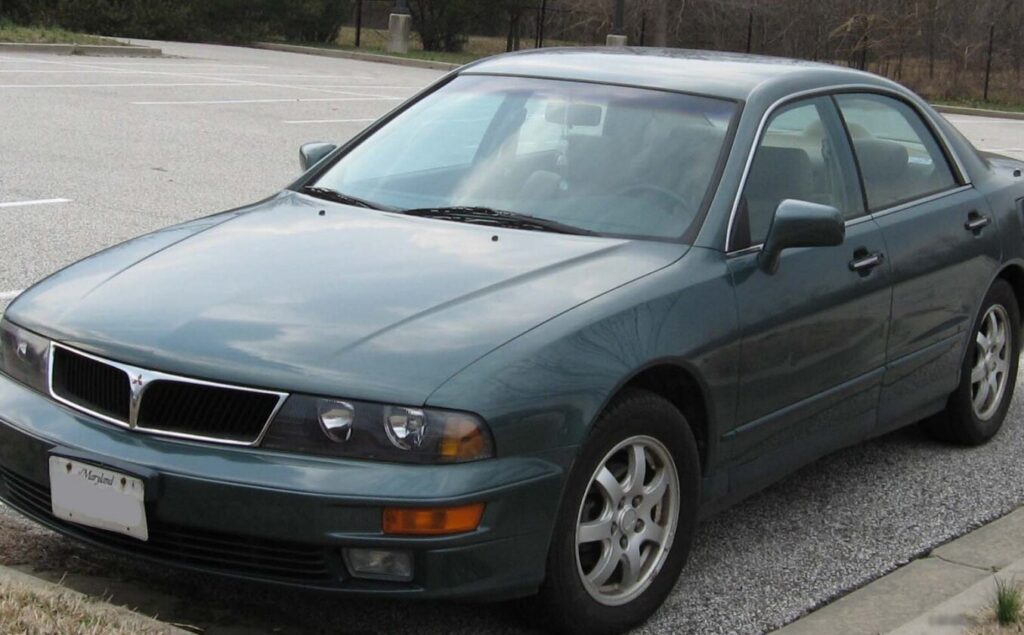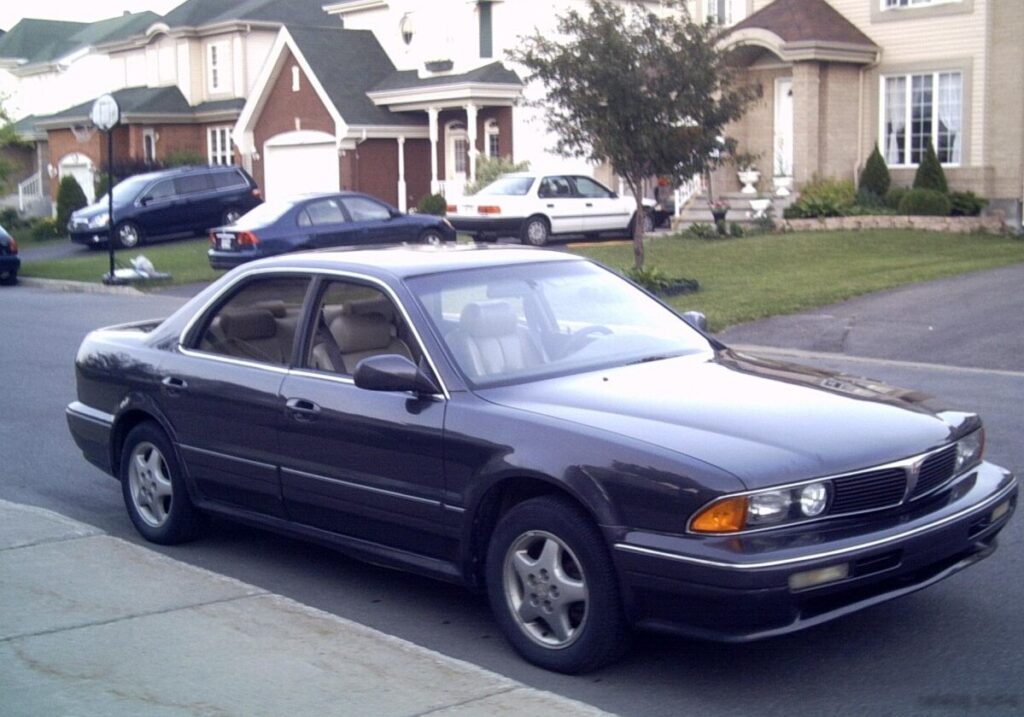
The Mitsubishi Diamante, known in Japan as the Mitsubishi Sigma, represented Mitsubishi’s foray into the mid-size luxury sedan segment. The first generation, produced from 1991 to 1996 (designated Diamante I), aimed to compete with established Japanese and European rivals. The 2.5 i V6 24V 4WD variant, producing 175 horsepower, was a significant offering within the lineup, positioned as a well-equipped, all-weather capable option for buyers seeking a comfortable and refined driving experience. This model year marked a shift for Mitsubishi, emphasizing more sophisticated engineering and design compared to their earlier offerings.
Technical Specifications
| Brand | Mitsubishi |
| Model | Diamante |
| Generation | Diamante I |
| Type (Engine) | 2.5 i V6 24V 4WD (175 Hp) |
| Start of production | 1991 |
| End of production | 1996 |
| Powertrain Architecture | Internal Combustion engine |
| Body type | Sedan |
| Seats | 5 |
| Doors | 4 |
| Fuel consumption (combined) | 8.9 l/100 km (26.4 US mpg, 31.7 UK mpg, 11.2 km/l) |
| Fuel Type | Petrol (Gasoline) |
| Weight-to-power ratio | 9.5 kg/Hp, 105.4 Hp/tonne |
| Weight-to-torque ratio | 7.5 kg/Nm, 133.7 Nm/tonne |
| Power | 175 Hp @ 6000 rpm |
| Power per litre | 70.1 Hp/l |
| Torque | 222 Nm @ 4500 rpm (163.74 lb.-ft. @ 4500 rpm) |
| Engine layout | Front, Transverse |
| Engine displacement | 2497 cm3 (152.38 cu. in.) |
| Number of cylinders | 6 |
| Engine configuration | V-engine |
| Cylinder Bore | 83.5 mm (3.29 in.) |
| Piston Stroke | 76 mm (2.99 in.) |
| Compression ratio | 10:1 |
| Number of valves per cylinder | 4 |
| Fuel injection system | Multi-port manifold injection |
| Engine aspiration | Naturally aspirated engine |
| Valvetrain | DOHC |
| Kerb Weight | 1660 kg (3659.67 lbs.) |
| Trunk (boot) space – minimum | 418 l (14.76 cu. ft.) |
| Fuel tank capacity | 70 l (18.49 US gal | 15.4 UK gal) |
| Length | 4740 mm (186.61 in.) |
| Width | 1775 mm (69.88 in.) |
| Height | 1420 mm (55.91 in.) |
| Wheelbase | 2720 mm (107.09 in.) |
| Front track | 1535 mm (60.43 in.) |
| Rear (Back) track | 1530 mm (60.24 in.) |
| Drive wheel | All wheel drive (4×4) |
| Number of gears and type of gearbox | 4 gears, automatic transmission |
| Front suspension | Spring Strut |
| Rear suspension | Double wishbone |
| Front brakes | Ventilated discs |
| Rear brakes | Ventilated discs |
| Assisting systems | ABS (Anti-lock braking system) |
| Steering type | Steering rack and pinion |
| Power steering | Hydraulic Steering |
| Tires size | 205/65 R15 H |
Powertrain & Engine Architecture
The heart of the Diamante 2.5 i V6 was the 6A13 engine, a 2.5-liter, 24-valve V6. This engine utilized a dual overhead camshaft (DOHC) design and multi-port fuel injection, contributing to its relatively smooth power delivery. The 6A13 was known for its refinement and quiet operation, characteristics Mitsubishi prioritized for this model. The 4-speed automatic transmission, while not the most modern by contemporary standards, was chosen for its comfort and ease of use, aligning with the Diamante’s luxury aspirations. The transmission was electronically controlled, offering adaptive shifting based on driving conditions. The all-wheel-drive system employed a viscous coupling, automatically distributing torque between the front and rear axles as needed, enhancing traction in inclement weather.
Driving Characteristics
The 175 horsepower and 222 Nm (163.74 lb-ft) of torque provided by the 2.5L V6 and automatic transmission resulted in adequate, but not exhilarating, performance. Acceleration was smooth and linear, but the automatic transmission’s gear ratios were geared more towards comfort and fuel economy than outright speed. Compared to the manual transmission versions, or potential future turbocharged variants, this setup felt less responsive. The all-wheel-drive system provided confident handling in various conditions, particularly on slippery surfaces. The Diamante wasn’t designed to be a sports sedan; instead, it prioritized a comfortable and composed ride, making it well-suited for long highway journeys.
Equipment & Trim Levels
The 2.5 i V6 4WD trim typically included features such as power windows, power locks, air conditioning, and a decent audio system. Higher trim levels added features like leather upholstery, a sunroof, and upgraded sound systems. The interior design focused on providing a comfortable and spacious environment for both driver and passengers. The dashboard layout was relatively straightforward, with easy-to-read gauges and logically placed controls. Optional extras included automatic climate control and a premium audio system with a CD changer.
Chassis & Braking
The Diamante I utilized a front strut and rear double wishbone suspension system, designed to provide a comfortable ride while maintaining reasonable handling characteristics. The suspension was tuned for comfort, absorbing bumps and irregularities in the road surface effectively. Braking duties were handled by ventilated disc brakes on all four wheels, providing adequate stopping power. The inclusion of ABS (Anti-lock Braking System) was a significant safety feature for the time, enhancing braking performance and stability, especially in emergency situations. Steering was rack and pinion, with hydraulic power assistance for ease of maneuvering.
Market Reception & Comparison
The Diamante was generally well-received by critics for its comfortable ride, refined engine, and spacious interior. However, it wasn’t considered a standout performer in terms of handling or acceleration compared to some of its European competitors. Fuel economy was average for a V6-powered sedan of its size. Compared to other Mitsubishi models, such as the Galant, the Diamante offered a more luxurious and refined experience, but at a higher price point. The 1.8L and 2.0L four-cylinder versions of the Diamante offered better fuel economy but lacked the smoothness and power of the V6. The V6 was the preferred choice for buyers prioritizing comfort and refinement.
Legacy
The Mitsubishi Diamante I, particularly the 2.5 i V6 4WD variant, has developed a modest following among enthusiasts. The 6A13 engine is generally considered reliable, although regular maintenance is crucial to prevent issues. The automatic transmission, while durable, can be prone to wear and tear over time. Finding parts for these vehicles can be challenging as they are no longer in production. Today, well-maintained examples are becoming increasingly rare and are sought after by collectors and enthusiasts who appreciate the Diamante’s unique blend of comfort, refinement, and all-weather capability. The Diamante represents a pivotal moment in Mitsubishi’s history, showcasing their ambition to compete in the luxury sedan market.