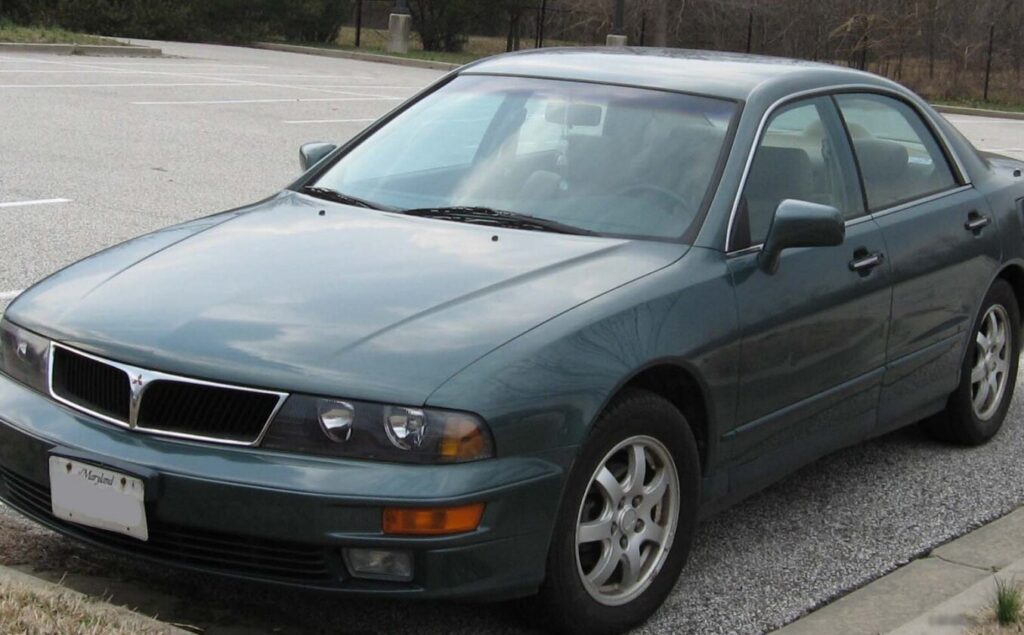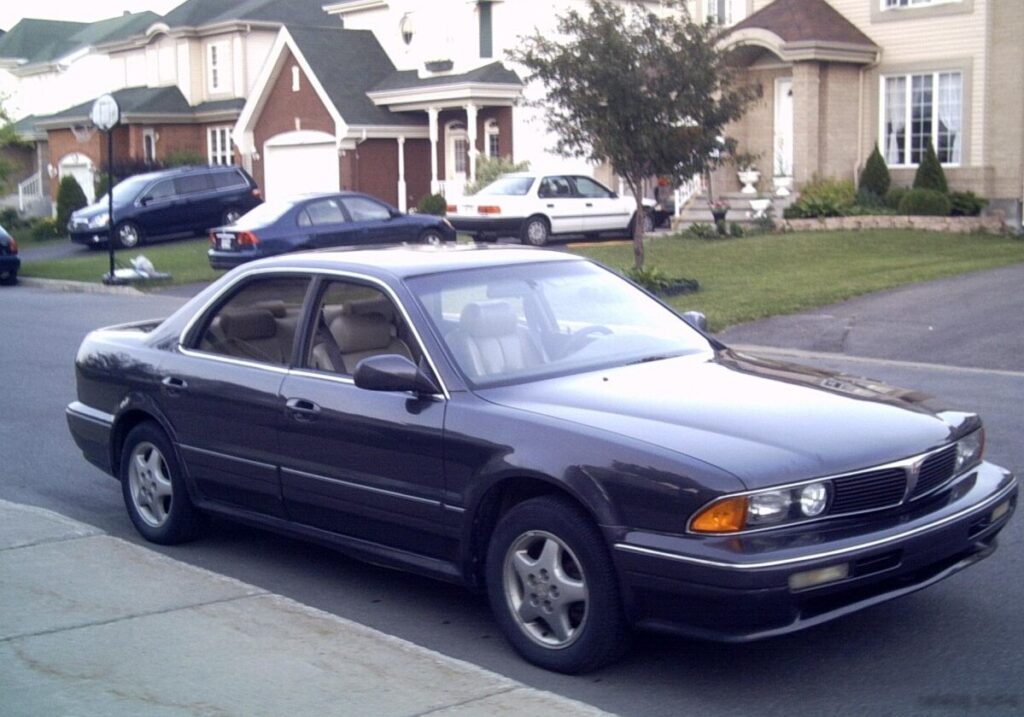
The Mitsubishi Diamante, known in Japan as the Mitsubishi Sigma, represented Mitsubishi’s foray into the mid-size luxury sedan segment. The first generation, produced from 1991 to 1996 (designated as the Diamante I), aimed to compete with established Japanese and American luxury cars. The 3.0 i V6 24V variant, equipped with a 3.0-liter V6 engine producing 210 horsepower, was positioned as the top-of-the-line offering, emphasizing performance and refinement. This model was primarily sold in Japan, North America, and select European markets, offering a blend of comfort, technology, and a relatively sporty driving experience for its time.
Technical Specifications
| Brand | Mitsubishi |
| Model | Diamante |
| Generation | Diamante I |
| Type (Engine) | 3.0 i V6 24V (210 Hp) |
| Start of production | 1991 |
| End of production | 1996 |
| Powertrain Architecture | Internal Combustion engine |
| Body type | Sedan |
| Seats | 5 |
| Doors | 4 |
| Fuel consumption (combined) | 8.7 l/100 km (27 US mpg, 32.5 UK mpg, 11.5 km/l) |
| Fuel Type | Petrol (Gasoline) |
| Weight-to-power ratio | 7.5 kg/Hp, 132.9 Hp/tonne |
| Weight-to-torque ratio | 5.9 kg/Nm, 170.9 Nm/tonne |
| Power | 210 Hp @ 6000 rpm |
| Power per litre | 70.7 Hp/l |
| Torque | 270 Nm @ 3000 rpm (199.14 lb.-ft. @ 3000 rpm) |
| Engine layout | Front, Transverse |
| Engine displacement | 2972 cm3 (181.36 cu. in.) |
| Number of cylinders | 6 |
| Engine configuration | V-engine |
| Cylinder Bore | 91.1 mm (3.59 in.) |
| Piston Stroke | 76 mm (2.99 in.) |
| Compression ratio | 10:1 |
| Number of valves per cylinder | 4 |
| Fuel injection system | Multi-port manifold injection |
| Engine aspiration | Naturally aspirated engine |
| Valvetrain | DOHC |
| Kerb Weight | 1580 kg (3483.3 lbs.) |
| Trunk (boot) space – minimum | 418 l (14.76 cu. ft.) |
| Fuel tank capacity | 72 l (19.02 US gal | 15.84 UK gal) |
| Length | 4740 mm (186.61 in.) |
| Width | 1775 mm (69.88 in.) |
| Height | 1410 mm (55.51 in.) |
| Wheelbase | 2720 mm (107.09 in.) |
| Front track | 1535 mm (60.43 in.) |
| Rear (Back) track | 1530 mm (60.24 in.) |
| Drivetrain Architecture | The Internal combustion engine (ICE) drives the front wheels of the vehicle. |
| Drive wheel | Front wheel drive |
| Number of gears and type of gearbox | 4 gears, automatic transmission |
| Front suspension | Spring Strut |
| Rear suspension | Coil spring |
| Front brakes | Ventilated discs |
| Rear brakes | Ventilated discs |
| Assisting systems | ABS (Anti-lock braking system) |
| Steering type | Steering rack and pinion |
| Power steering | Hydraulic Steering |
| Tires size | 205/65 R15 H |
Powertrain & Engine Architecture
The heart of the Diamante 3.0 i V6 was the 6A13 engine, a 2.97-liter (181.36 cubic inches) naturally aspirated V6. This engine featured a 60-degree V-angle, contributing to a smoother power delivery. It employed a multi-port fuel injection system, delivering fuel directly to each cylinder for optimized combustion. The engine utilized a double overhead camshaft (DOHC) valvetrain with four valves per cylinder, enhancing volumetric efficiency and high-rpm performance. The 4-speed automatic transmission, while not the most modern by today’s standards, was chosen for its smoothness and ease of use, aligning with the Diamante’s luxury positioning. The transmission was electronically controlled, offering adaptive shifting based on driving conditions.
Driving Characteristics
The 210 horsepower and 199 lb-ft of torque provided by the 3.0-liter V6 delivered respectable acceleration for the early 1990s. While not a sports car, the Diamante offered a comfortable and confident driving experience. The automatic transmission, while smooth, did result in some power loss compared to the available 5-speed manual transmission. Gear ratios were tuned for relaxed cruising, prioritizing comfort over outright performance. Compared to the base 2.5-liter engine, the 3.0-liter offered a noticeable improvement in both acceleration and passing power. It felt more refined and capable on the highway, making it suitable for long-distance travel.
Equipment & Trim Levels
The 3.0 i V6 trim was the most luxurious offering in the Diamante lineup. Standard features typically included power windows, power locks, power mirrors, a premium sound system, air conditioning, and cruise control. Leather upholstery was standard, along with woodgrain interior trim. Optional extras could include a sunroof, upgraded audio systems, and automatic climate control. The interior design focused on providing a comfortable and upscale environment, with attention paid to material quality and ergonomics.
Chassis & Braking
The Diamante I utilized a front-engine, front-wheel-drive layout. The suspension consisted of a MacPherson strut setup in the front and a multi-link coil spring suspension in the rear. This configuration aimed to balance ride comfort with handling stability. Braking duties were handled by ventilated disc brakes on all four wheels, providing adequate stopping power. An Anti-lock Braking System (ABS) was standard, enhancing safety and control during emergency braking situations. The steering system employed a rack-and-pinion setup with hydraulic power assistance, offering precise and responsive steering feel.
Market Reception & Comparison
The Diamante 3.0 i V6 was generally well-received by automotive critics. It was praised for its smooth engine, comfortable ride, and well-appointed interior. However, some critics noted that its handling wasn’t as sharp as some of its European competitors. Fuel economy, at 27 mpg combined, was considered average for its class. Compared to other trims in the Diamante lineup, the 3.0 i V6 offered a significant performance advantage, but at a higher price point. It competed directly with vehicles like the Toyota Camry, Honda Accord, and Mazda 626, offering a more luxurious alternative.
Legacy
The Mitsubishi Diamante, particularly the 3.0 i V6 variant, has developed a modest following among enthusiasts. The 6A13 engine is known for its reliability, although regular maintenance is crucial. Parts availability can be a challenge, as the Diamante is now a relatively rare vehicle. The automatic transmission, while generally dependable, can experience issues with age and high mileage. Today, well-maintained examples of the Diamante 3.0 i V6 are sought after by collectors and those looking for a comfortable and stylish classic sedan. Its blend of luxury, performance, and relative rarity makes it a unique and appealing vehicle in the used car market.