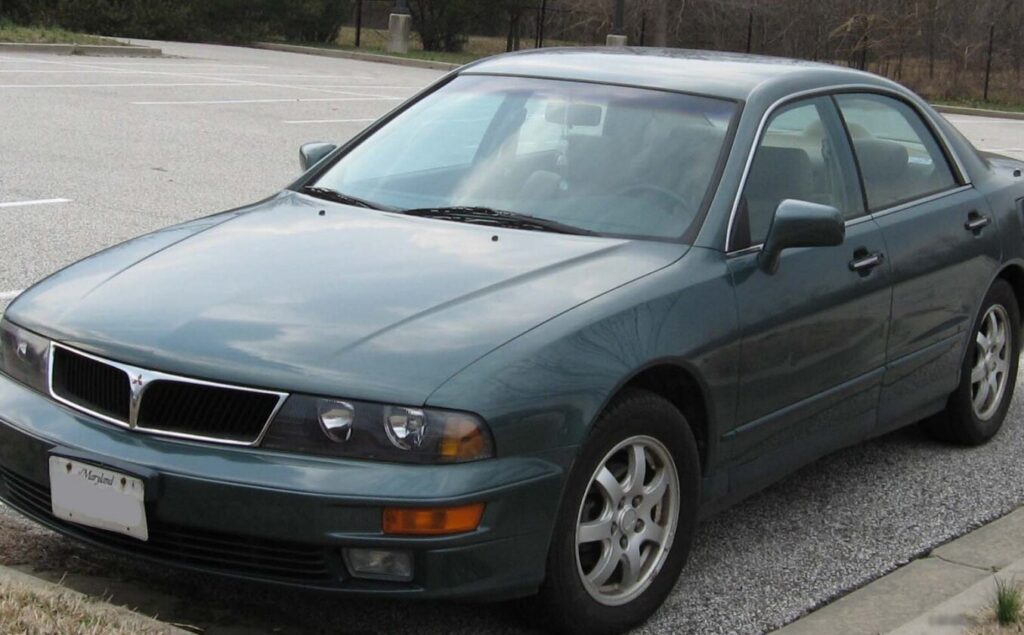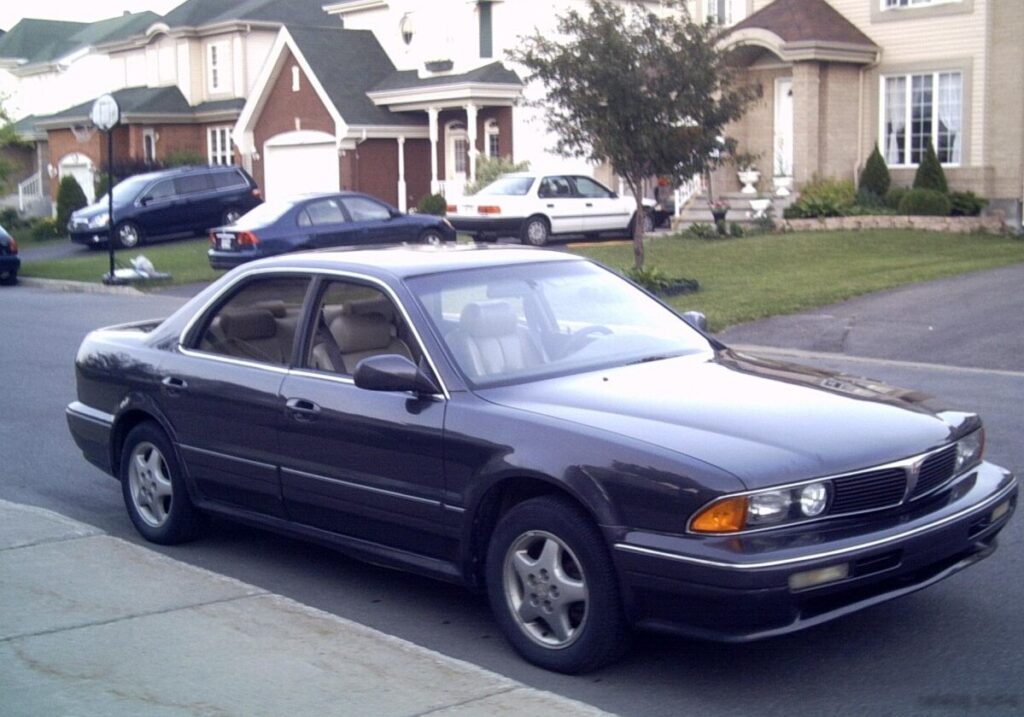
The Mitsubishi Diamante, known in Japan as the Mitsubishi Sigma, represented Mitsubishi’s foray into the full-size, premium sedan segment. The first generation, produced from 1991 to 1996 (designated as the Diamante I), aimed to compete with established Japanese and American luxury cars. This particular variant, the 3.0 i V6 24V 4WD, was a top-of-the-line offering, featuring a potent V6 engine paired with a four-speed automatic transmission and Mitsubishi’s Super Select 4WD system. It was positioned as the flagship model, offering a blend of performance, comfort, and all-weather capability. The Diamante I was built on the DS platform, shared with other Mitsubishi models like the Debonair.
Technical Specifications
| Brand | Mitsubishi |
| Model | Diamante |
| Generation | Diamante I |
| Type (Engine) | 3.0 i V6 24V 4WD (210 Hp) |
| Start of production | 1991 |
| End of production | 1996 |
| Powertrain Architecture | Internal Combustion engine |
| Body type | Sedan |
| Seats | 5 |
| Doors | 4 |
| Fuel consumption (combined) | 9.3 l/100 km (25.3 US mpg, 30.4 UK mpg, 10.8 km/l) |
| Fuel Type | Petrol (Gasoline) |
| Weight-to-power ratio | 8 kg/Hp, 125 Hp/tonne |
| Weight-to-torque ratio | 6.2 kg/Nm, 160.7 Nm/tonne |
| Power | 210 Hp @ 6000 rpm |
| Power per litre | 70.7 Hp/l |
| Torque | 270 Nm @ 3000 rpm (199.14 lb.-ft. @ 3000 rpm) |
| Engine layout | Front, Transverse |
| Engine displacement | 2972 cm3 (181.36 cu. in.) |
| Number of cylinders | 6 |
| Engine configuration | V-engine |
| Cylinder Bore | 91.1 mm (3.59 in.) |
| Piston Stroke | 76 mm (2.99 in.) |
| Compression ratio | 10:1 |
| Number of valves per cylinder | 4 |
| Fuel injection system | Multi-port manifold injection |
| Engine aspiration | Naturally aspirated engine |
| Valvetrain | DOHC |
| Kerb Weight | 1680 kg (3703.77 lbs.) |
| Trunk (boot) space – minimum | 418 l (14.76 cu. ft.) |
| Fuel tank capacity | 70 l (18.49 US gal | 15.4 UK gal) |
| Length | 4740 mm (186.61 in.) |
| Width | 1775 mm (69.88 in.) |
| Height | 1420 mm (55.91 in.) |
| Wheelbase | 2720 mm (107.09 in.) |
| Front track | 1535 mm (60.43 in.) |
| Rear (Back) track | 1530 mm (60.24 in.) |
| Drive wheel | All wheel drive (4×4) |
| Number of gears and type of gearbox | 4 gears, automatic transmission |
| Front suspension | Spring Strut |
| Rear suspension | Coil spring |
| Front brakes | Ventilated discs |
| Rear brakes | Ventilated discs |
| Assisting systems | ABS (Anti-lock braking system) |
| Steering type | Steering rack and pinion |
| Power steering | Hydraulic Steering |
| Tires size | 215/60 R15 H |
Powertrain & Engine Architecture
The heart of the Diamante 3.0 i V6 was the 6A12 engine, a 2.97-liter (181.36 cubic inches) naturally aspirated V6. This engine featured a 60-degree V-angle, dual overhead camshafts (DOHC), and four valves per cylinder (24V). The multi-port fuel injection system delivered fuel directly to each cylinder, optimizing combustion efficiency. The engine produced 210 horsepower at 6000 rpm and 270 Nm (199.14 lb-ft) of torque at 3000 rpm. The 4-speed automatic transmission, while providing smooth shifts, wasn’t known for its sportiness. It was geared more towards comfortable cruising than aggressive acceleration. The transmission was electronically controlled, adapting shift points based on throttle input and vehicle speed.
Driving Characteristics
The Diamante 3.0 i V6 4WD offered a refined driving experience. The V6 engine provided ample power for everyday driving and confident highway passing. However, the automatic transmission, while smooth, did detract somewhat from the engine’s potential. Compared to the manual transmission options available in other Diamante trims, the automatic felt less responsive. The 4WD system, Mitsubishi’s Super Select, allowed the driver to switch between two-wheel drive, four-wheel drive, and a 4WD lock mode, enhancing traction in various conditions. The car’s weight (1680 kg / 3703.77 lbs) was noticeable, but the suspension did a good job of absorbing bumps and providing a comfortable ride.
Equipment & Trim Levels
The 3.0 i V6 4WD trim was the most luxurious offering in the Diamante I lineup. Standard features typically included power windows, power locks, power mirrors, air conditioning, a premium sound system, and velour upholstery. Leather upholstery was often an optional extra. Higher-end models could be equipped with features like a sunroof, automatic climate control, and upgraded audio systems. The interior design was focused on comfort and spaciousness, with a woodgrain trim accenting the dashboard and door panels. The Diamante aimed to provide a similar level of luxury as its competitors, but at a slightly more accessible price point.
Chassis & Braking
The Diamante I utilized a front strut and rear coil spring suspension setup. The suspension was tuned for comfort, prioritizing a smooth ride over sporty handling. The 4WD system added to the vehicle’s stability, particularly in inclement weather. Braking duties were handled by ventilated disc brakes on all four wheels, providing adequate stopping power. An Anti-lock Braking System (ABS) was standard, enhancing safety and control during emergency braking situations. The steering was rack and pinion, with hydraulic power assistance, offering a reasonably responsive feel.
Market Reception & Comparison
The Mitsubishi Diamante was generally well-received by automotive critics, who praised its spacious interior, comfortable ride, and powerful V6 engine. However, some reviewers noted that the automatic transmission could feel sluggish and that the car’s handling wasn’t as sharp as some of its European competitors. Compared to other trims in the Diamante lineup, the 3.0 i V6 4WD offered the most performance and luxury, but it also came with a higher price tag and slightly lower fuel economy (9.3 l/100 km). The 2.0-liter four-cylinder models were more fuel-efficient and affordable, while the V6 models with front-wheel drive offered a balance between performance and economy.
Legacy
The Mitsubishi Diamante I, particularly the 3.0 i V6 4WD variant, remains a relatively uncommon sight on today’s roads. While not known for any widespread mechanical issues, the age of these vehicles means that maintenance and repair can be challenging due to parts availability. The 6A12 V6 engine is generally considered reliable, but like any older engine, it can be prone to oil leaks and other age-related problems. The automatic transmission, while durable, may require rebuilding after many years of use. In the used car market, well-maintained Diamante I models are sought after by enthusiasts who appreciate their unique blend of Japanese engineering, luxury features, and all-wheel-drive capability. They represent a unique chapter in Mitsubishi’s history, showcasing the company’s ambition to compete in the premium sedan segment.