
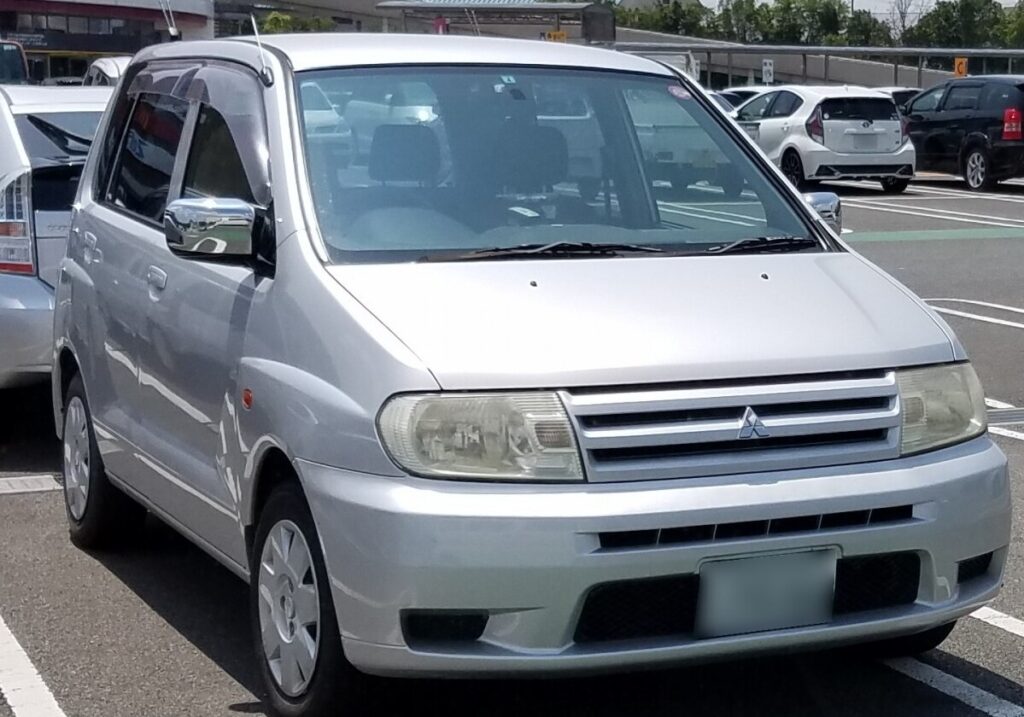
The Mitsubishi Dingo (CJ) 1.5 i 16V GDI 4WD, produced between 2000 and 2002, was a compact hatchback marketed primarily in Japan. It represented Mitsubishi’s entry into the increasingly popular “mini-SUV” or “kei-car inspired” segment, offering a blend of practicality, affordability, and available all-wheel drive. The Dingo was based on the Mitsubishi Mirage platform, sharing many components with its more conventional sibling, but distinguished itself through its taller body, rugged styling cues, and optional four-wheel drive system. This particular 1.5L GDI 4WD variant occupied a mid-range position within the Dingo lineup, offering a balance between performance, fuel efficiency, and cost.
Technical Specifications
| Brand | Mitsubishi |
| Model | Dingo |
| Generation | Dingo (CJ) |
| Type (Engine) | 1.5 i 16V GDI 4WD (105 Hp) |
| Start of production | 2000 year |
| End of production | 2002 year |
| Powertrain Architecture | Internal Combustion engine |
| Body type | Hatchback |
| Seats | 5 |
| Doors | 5 |
| Fuel Type | Petrol (Gasoline) |
| Weight-to-power ratio | 12.2 kg/Hp, 82 Hp/tonne |
| Weight-to-torque ratio | 9.1 kg/Nm, 109.4 Nm/tonne |
| Power | 105 Hp @ 6000 rpm |
| Power per litre | 71.5 Hp/l |
| Torque | 140 Nm @ 3500 rpm (103.26 lb.-ft. @ 3500 rpm) |
| Engine layout | Front, Transverse |
| Engine displacement | 1468 cm3 (89.58 cu. in.) |
| Number of cylinders | 4 |
| Engine configuration | Inline |
| Cylinder Bore | 75.5 mm (2.97 in.) |
| Piston Stroke | 82 mm (3.23 in.) |
| Number of valves per cylinder | 4 |
| Fuel injection system | Direct injection |
| Engine aspiration | Naturally aspirated engine |
| Valvetrain | DOHC |
| Kerb Weight | 1280 kg (2821.92 lbs.) |
| Max. weight | 1555 kg (3428.19 lbs.) |
| Max load | 275 kg (606.27 lbs.) |
| Fuel tank capacity | 50 l (13.21 US gal | 11 UK gal) |
| Length | 3905 mm (153.74 in.) |
| Width | 1695 mm (66.73 in.) |
| Height | 1640 mm (64.57 in.) |
| Wheelbase | 2440 mm (96.06 in.) |
| Front track | 1470 mm (57.87 in.) |
| Rear (Back) track | 1470 mm (57.87 in.) |
| Minimum turning circle | 9.4 m (30.84 ft.) |
| Drive wheel | All wheel drive (4×4) |
| Number of gears | 4 |
| Gearbox type | automatic transmission |
| Front suspension | Coil spring |
| Rear suspension | Coil spring |
| Front brakes | Disc |
| Rear brakes | Drum |
| Assisting systems | ABS (Anti-lock braking system) |
| Steering type | Steering rack and pinion |
| Power steering | Hydraulic Steering |
| Tires size | 185/65 R14 |
Powertrain & Engine Architecture
The heart of the Dingo 1.5 i GDI 4WD is the 4G93 engine, a 1.5-liter inline-four cylinder powerplant. This engine is notable for its use of Mitsubishi’s GDI (Gasoline Direct Injection) technology. GDI systems inject fuel directly into the combustion chamber, rather than into the intake port, allowing for more precise fuel control, improved fuel economy, and increased power output. The 4G93 features a double overhead camshaft (DOHC) valvetrain with four valves per cylinder, contributing to its relatively high specific output for its displacement. The engine produces 105 horsepower at 6000 rpm and 140 Nm (103.26 lb-ft) of torque at 3500 rpm. The engine is transversely mounted in the front of the vehicle. The automatic transmission is a conventional four-speed unit, chosen for its ease of use and suitability for the target market. While not particularly sophisticated, it provided smooth shifts and adequate performance for everyday driving.
Driving Characteristics
The Dingo 1.5 i GDI 4WD, with its 105 hp and four-speed automatic, wasn’t designed for outright speed. Acceleration was adequate for merging onto highways and navigating city streets, but it wasn’t particularly brisk. The automatic transmission, while smooth, did contribute to a slight loss of responsiveness compared to the available five-speed manual. The gear ratios were tuned for fuel efficiency and drivability rather than performance. The all-wheel drive system provided enhanced traction in slippery conditions, making it a capable vehicle for inclement weather or light off-road use. However, it wasn’t a dedicated off-roader; its capabilities were more suited to gravel roads and snowy conditions. Compared to the higher-output 1.8L versions of the Dingo, this 1.5L automatic offered a more relaxed and economical driving experience.
Equipment & Trim Levels
The 1.5 i GDI 4WD trim level typically included features such as air conditioning, power windows, power door locks, and a basic audio system. Interior upholstery was typically cloth, with a relatively simple dashboard layout. Optional extras included alloy wheels, a sunroof, and upgraded audio systems. The Dingo aimed for a balance between affordability and comfort, offering a reasonable level of equipment for its price point. The interior design was functional and practical, prioritizing space and usability over luxury.
Chassis & Braking
The Dingo utilized a relatively simple chassis design, featuring coil spring suspension at all four corners. The front suspension employed MacPherson struts, while the rear used a torsion beam setup. This configuration provided a comfortable ride quality, although it wasn’t particularly sporty. The braking system consisted of disc brakes at the front and drum brakes at the rear. Anti-lock braking system (ABS) was standard, enhancing safety by preventing wheel lockup during hard braking. The steering was rack and pinion with hydraulic power assistance, providing light and easy steering feel.
Market Reception & Comparison
The Mitsubishi Dingo was generally well-received in the Japanese market as a practical and affordable compact hatchback with available all-wheel drive. Critics praised its fuel efficiency, ease of driving, and spacious interior for its size. However, some reviewers noted that the 1.5L engine felt underpowered, especially when paired with the automatic transmission. Compared to other trims, the 1.5L GDI 4WD offered the best fuel economy, making it an attractive option for budget-conscious buyers. The 1.8L versions provided more power but at the expense of fuel efficiency. The Dingo competed with other small hatchbacks and mini-SUVs, such as the Honda Fit and the Suzuki Jimny.
Legacy
The Mitsubishi Dingo, while not a long-lived model, remains a fondly remembered vehicle in Japan. The 4G93 GDI engine, when properly maintained, is known for its reliability and durability. However, GDI engines can be susceptible to carbon buildup on the intake valves, requiring periodic cleaning to maintain optimal performance. The four-speed automatic transmission is also generally reliable, but like any automatic, it requires regular fluid changes. Today, the Dingo 1.5 i GDI 4WD can be found on the used car market, often at very affordable prices. It represents a unique blend of practicality, affordability, and available all-wheel drive, making it a potentially appealing option for those seeking a small, economical, and capable hatchback.
