
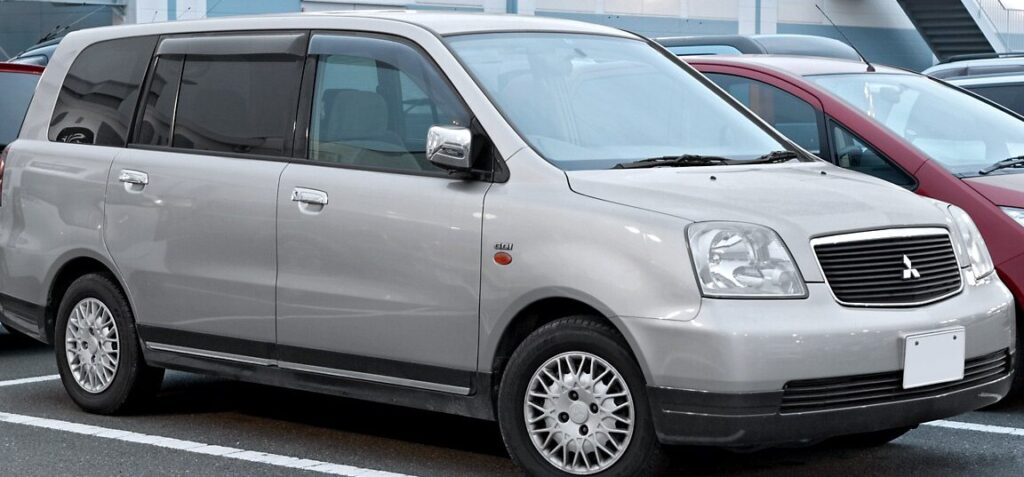
The Mitsubishi Dion 2.0 16V, produced between January 2000 and May 2002, was a compact minivan designed primarily for the Japanese domestic market (JDM) and select export markets in Southeast Asia and Australia. Representing Mitsubishi’s entry into the increasingly popular micro-MPV segment, the Dion aimed to provide affordable and practical transportation for families. This particular variant, equipped with the 4G63 2.0-liter 16-valve engine and a four-speed automatic transmission, occupied a mid-range position within the Dion lineup, offering a balance between performance and ease of use. It was positioned above the base 1.8-liter models and below any potential limited-edition or sportier trims.
Technical Specifications
| Brand | Mitsubishi |
| Model | Dion |
| Generation | Dion |
| Type (Engine) | 2.0 16V (135 Hp) |
| Start of production | January, 2000 |
| End of production | May, 2002 |
| Powertrain Architecture | Internal Combustion engine |
| Body type | Minivan |
| Seats | 7 |
| Doors | 5 |
| Fuel consumption (urban) | 13 l/100 km (18.1 US mpg, 21.7 UK mpg) |
| Fuel consumption (extra urban) | 8 l/100 km (29.4 US mpg, 35.3 UK mpg) |
| Fuel Type | Petrol (Gasoline) |
| Maximum speed | 180 km/h (111.85 mph) |
| Weight-to-power ratio | 10.2 kg/Hp |
| Weight-to-torque ratio | 7.5 kg/Nm |
| Power | 135 Hp @ 5800 rpm |
| Power per litre | 67.6 Hp/l |
| Torque | 183 Nm @ 3500 rpm (134.97 lb.-ft. @ 3500 rpm) |
| Engine layout | Front, Transverse |
| Engine Model/Code | 4G63 |
| Engine displacement | 1997 cm3 (121.86 cu. in.) |
| Number of cylinders | 4 |
| Engine configuration | Inline |
| Cylinder Bore | 85 mm (3.35 in.) |
| Piston Stroke | 88 mm (3.46 in.) |
| Compression ratio | 10.3:1 |
| Number of valves per cylinder | 4 |
| Fuel injection system | Direct injection |
| Engine aspiration | Naturally aspirated engine |
| Valvetrain | DOHC |
| Engine oil capacity | 4.3 l (4.54 US qt | 3.78 UK qt) |
| Coolant | 6 l (6.34 US qt | 5.28 UK qt) |
| Kerb Weight | 1380 kg (3042.38 lbs.) |
| Fuel tank capacity | 60 l (15.85 US gal | 13.2 UK gal) |
| Length | 4460 mm (175.59 in.) |
| Width | 1695 mm (66.73 in.) |
| Height | 1650 mm (64.96 in.) |
| Wheelbase | 2705 mm (106.5 in.) |
| Front track | 1470 mm (57.87 in.) |
| Rear track | 1470 mm (57.87 in.) |
| Drivetrain Architecture | Front wheel drive |
| Drive wheel | Front wheel drive |
| Number of gears | 4 |
| Gearbox type | automatic transmission |
| Front suspension | Spring Strut |
| Rear suspension | Double wishbone |
| Front brakes | Ventilated discs |
| Rear brakes | Drum |
| Assisting systems | ABS (Anti-lock braking system) |
| Steering type | Steering rack and pinion |
| Power steering | Hydraulic Steering |
| Tires size | 195/65 R14 |
Powertrain & Engine Architecture
The heart of the Dion 2.0 16V is the 4G63 engine, a 2.0-liter inline-four cylinder powerplant. This engine, a staple in many Mitsubishi vehicles of the era, features a double overhead camshaft (DOHC) valvetrain and four valves per cylinder, contributing to its relatively high output for its displacement. The 4G63 in the Dion utilizes a multi-point fuel injection system, delivering fuel directly to each cylinder for optimized combustion. The engine’s 135 horsepower at 5800 rpm and 183 Nm (135 lb-ft) of torque at 3500 rpm provided adequate power for the vehicle’s weight and intended purpose. Paired with the engine is a four-speed automatic transmission, chosen for its convenience and ease of use, appealing to a broader range of drivers. While not offering the sporty engagement of a manual gearbox, the automatic transmission provided smooth shifts and contributed to the Dion’s comfortable driving experience.
Driving Characteristics
The Dion 2.0 16V with the automatic transmission delivered a comfortable and predictable driving experience. Acceleration was adequate for everyday driving, though not particularly brisk. The automatic transmission’s gear ratios were tuned for fuel efficiency and smooth cruising rather than outright performance. Compared to the manual transmission versions of the Dion, the automatic offered less driver involvement and slightly reduced fuel economy. However, it provided a more relaxed driving experience, particularly in urban traffic. The weight of the vehicle, around 1380 kg (3042 lbs), was noticeable during acceleration and cornering, but the suspension did a reasonable job of managing body roll.
Equipment & Trim Levels
The 2.0 16V Dion typically came equipped with features such as power windows, power steering, and air conditioning as standard. Interior upholstery was generally cloth, with a functional and durable design. Depending on the specific market and optional packages, features like alloy wheels, a CD player, and upgraded interior trim were available. The dashboard layout was straightforward and user-friendly, prioritizing practicality over luxury. The seven-seat configuration, with its flexible seating arrangements, was a key selling point for families.
Chassis & Braking
The Dion utilized a front-engine, front-wheel-drive layout. The front suspension employed a MacPherson strut setup, while the rear featured a double wishbone configuration. This suspension design aimed to balance ride comfort with handling stability. Braking duties were handled by ventilated discs at the front and drum brakes at the rear. An Anti-lock Braking System (ABS) was included as a standard safety feature, enhancing braking performance and control, especially on slippery surfaces. The steering system was a rack and pinion setup with hydraulic power assistance, providing light and responsive steering feel.
Market Reception & Comparison
The Mitsubishi Dion, in general, was well-received in its target markets as an affordable and practical family vehicle. The 2.0 16V automatic variant offered a good balance of performance and convenience. Critics noted the vehicle’s spacious interior and flexible seating arrangements as key strengths. However, some reviewers pointed out the engine’s lack of refinement and the automatic transmission’s somewhat conservative tuning. Compared to other micro-MPVs available at the time, such as the Toyota Avanza or the Honda Mobilio, the Dion offered a competitive level of features and space for its price point. Fuel economy was generally considered average for its class.
Legacy
The Mitsubishi Dion, while not a groundbreaking vehicle, played a significant role in establishing Mitsubishi as a competitor in the compact minivan segment. The 4G63 engine, known for its durability and reliability, has proven to be a long-lasting powertrain. Today, used examples of the Dion 2.0 16V are relatively affordable and can be found in reasonable condition, particularly in regions where they were originally sold. While maintenance costs may be higher due to the vehicle’s age, the 4G63 engine’s robust design and readily available parts contribute to its continued usability. The Dion remains a practical and economical option for those seeking a spacious and reliable family vehicle.
