
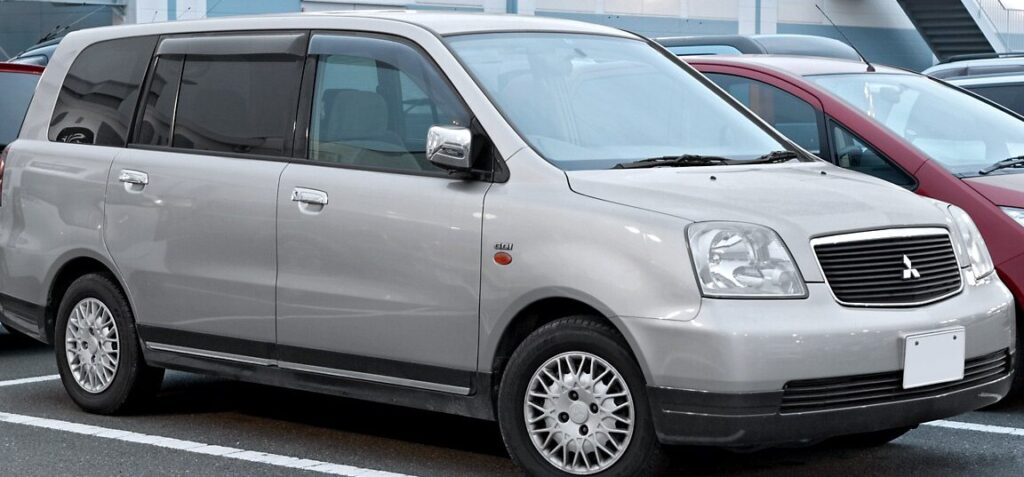
The Mitsubishi Dion 2.0 16V 4×4, produced between 2000 and May 2002, was a seven-seat minivan designed primarily for the Japanese domestic market (JDM) and select export regions, including Australia and parts of Asia. Positioned as a practical and versatile family vehicle, the Dion aimed to offer a compact footprint with ample interior space and available all-wheel drive. This particular variant, equipped with the 4G94 2.0-liter engine and a four-speed automatic transmission, represented a mid-range offering within the Dion lineup, balancing performance with ease of use and fuel efficiency. It competed with other compact MPVs like the Toyota Avanza and Honda Mobilio, offering a unique blend of features and a distinctive styling approach.
Technical Specifications
| Brand | Mitsubishi |
| Model | Dion |
| Generation | Dion |
| Type (Engine) | 2.0 16V 4×4 (135 Hp) |
| Start of production | 2000 |
| End of production | May, 2002 |
| Powertrain Architecture | Internal Combustion engine |
| Body type | Minivan |
| Seats | 7 |
| Doors | 5 |
| Fuel Type | Petrol (Gasoline) |
| Maximum speed | 180 km/h (111.85 mph) |
| Weight-to-power ratio | 10.5 kg/Hp, 95.1 Hp/tonne |
| Weight-to-torque ratio | 7.8 kg/Nm, 128.9 Nm/tonne |
| Power | 135 Hp @ 5700 rpm |
| Power per litre | 67.6 Hp/l |
| Torque | 183 Nm @ 3500 rpm (134.97 lb.-ft. @ 3500 rpm) |
| Engine layout | Front, Transverse |
| Engine Model/Code | 4G94 |
| Engine displacement | 1997 cm3 (121.86 cu. in.) |
| Number of cylinders | 4 |
| Engine configuration | Inline |
| Cylinder Bore | 81.5 mm (3.21 in.) |
| Piston Stroke | 95.8 mm (3.77 in.) |
| Compression ratio | 11:1 |
| Number of valves per cylinder | 4 |
| Fuel injection system | Direct injection |
| Engine aspiration | Naturally aspirated engine |
| Valvetrain | DOHC |
| Engine oil capacity | 3.8 l (4.02 US qt | 3.34 UK qt) |
| Kerb Weight | 1420 kg (3130.56 lbs) |
| Fuel tank capacity | 60 l (15.85 US gal | 13.2 UK gal) |
| Length | 4460 mm (175.59 in.) |
| Width | 1695 mm (66.73 in.) |
| Height | 1695 mm (66.73 in.) |
| Wheelbase | 2705 mm (106.5 in.) |
| Front track | 1470 mm (57.87 in.) |
| Rear (Back) track | 1470 mm (57.87 in.) |
| Drive wheel | All wheel drive (4×4) |
| Number of gears and type of gearbox | 4 gears, automatic transmission |
| Front suspension | Spring Strut |
| Rear suspension | Double wishbone |
| Front brakes | Ventilated discs |
| Rear brakes | Drum |
| Assisting systems | ABS (Anti-lock braking system) |
| Steering type | Steering rack and pinion |
| Power steering | Hydraulic Steering |
| Tires size | 195/65 R14 |
Powertrain & Engine Architecture
The heart of the Dion 2.0 4×4 is the Mitsubishi 4G94 engine, a 1.997-liter (2.0L) inline-four cylinder gasoline engine. This engine utilizes a double overhead camshaft (DOHC) valvetrain with four valves per cylinder, contributing to its relatively high output for its displacement. The 4G94 featured multi-point fuel injection, a common setup for engines of this era, delivering fuel directly to the intake ports. The engine’s 11:1 compression ratio helped maximize efficiency and power. Paired with this engine was a four-speed automatic transmission, designed for smooth and convenient operation. This transmission, while not offering the most advanced gear ratios, was known for its reliability and suitability for everyday driving. The 4×4 system employed a viscous coupling to distribute power between the front and rear axles, providing enhanced traction in slippery conditions without requiring driver intervention.
Driving Characteristics
The Dion 2.0 4×4 with the automatic transmission offered a comfortable and predictable driving experience. With 135 horsepower and 183 Nm (135 lb-ft) of torque, acceleration was adequate for typical driving situations, but not particularly sporty. The automatic transmission’s gear ratios were geared towards fuel economy and smooth cruising rather than rapid acceleration. Compared to the five-speed manual transmission option available on some Dion models, the automatic version felt noticeably less responsive. The all-wheel drive system provided increased stability and confidence in adverse weather conditions, making it a practical choice for regions with frequent rain or snow. However, the added weight of the 4×4 system and automatic transmission did slightly impact fuel economy compared to the front-wheel drive, manual transmission variants.
Equipment & Trim Levels
The Dion 2.0 4×4 typically came equipped with a reasonable level of standard features. These included power windows, power steering, air conditioning, and an AM/FM radio. Higher trim levels offered options such as alloy wheels, a more sophisticated audio system, and upgraded interior upholstery. The interior was designed with practicality in mind, featuring durable materials and a flexible seating arrangement. The third-row seats could be folded flat or removed entirely to maximize cargo space. Dashboard design was functional, with clearly labeled controls and a straightforward instrument cluster.
Chassis & Braking
The Dion utilized a relatively simple chassis design, featuring a MacPherson strut suspension in the front and a double wishbone suspension in the rear. This setup provided a comfortable ride quality, although it wasn’t particularly sporty. The front brakes were ventilated discs, offering good stopping power, while the rear brakes were drums, a cost-saving measure common in vehicles of this class. Anti-lock braking system (ABS) was standard, enhancing safety by preventing wheel lockup during hard braking. The steering system was a rack and pinion setup with hydraulic power assistance, providing light and easy steering.
Market Reception & Comparison
The Mitsubishi Dion 2.0 4×4 was generally well-received as a practical and affordable family vehicle. Critics praised its spacious interior, versatile seating arrangement, and available all-wheel drive. However, some reviewers noted that the engine felt underpowered, especially when fully loaded with passengers and cargo. Compared to the front-wheel drive Dion variants, the 4×4 model offered superior traction but suffered from slightly lower fuel economy. Against competitors like the Toyota Avanza and Honda Mobilio, the Dion stood out with its unique styling and available all-wheel drive, but often lagged behind in terms of brand recognition and resale value.
Legacy
The Mitsubishi Dion, while not a mainstream success in many markets, has developed a following among enthusiasts who appreciate its practicality and unique character. The 4G94 engine is known for its durability and relatively simple maintenance requirements. However, like many vehicles of its age, the Dion is susceptible to rust and wear and tear on suspension components. In the used car market, the Dion 2.0 4×4 remains an affordable option for those seeking a spacious and versatile family vehicle, particularly in regions where all-wheel drive is desirable. Parts availability can be a challenge in some areas, but the 4G94 engine shares components with other Mitsubishi models, making it relatively easy to source replacements.
