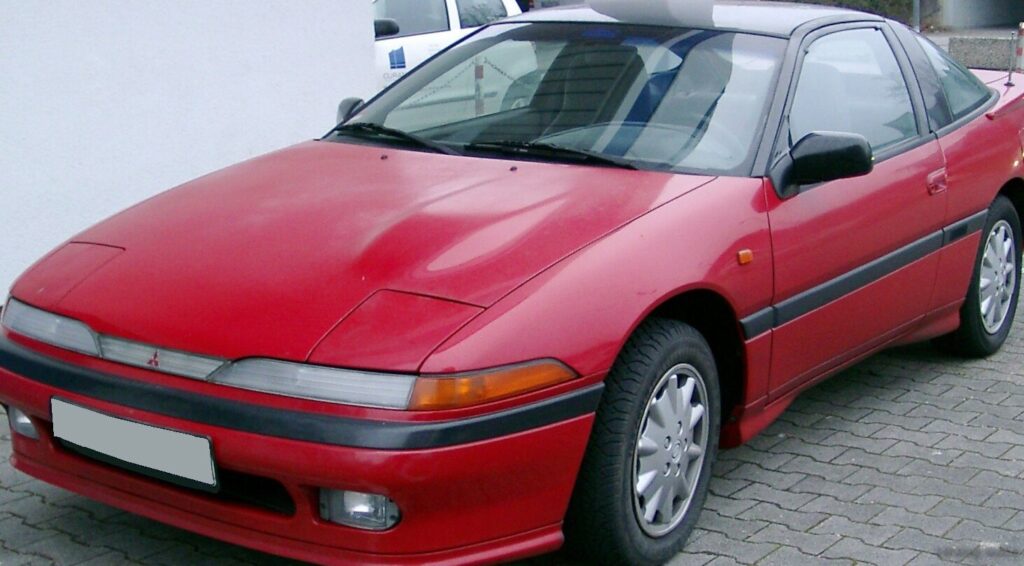
The Mitsubishi Eclipse first generation (1G), produced from 1989 to 1994, represented Mitsubishi’s entry into the competitive American compact coupe market. The 2.0i 16V variant, available with an automatic transmission from 1991-1992, occupied a middle ground in the Eclipse lineup, offering a balance between performance and affordability. Positioned above the base 1.5L models and below the turbocharged variants, it aimed to attract buyers seeking a sporty, yet practical, daily driver. This generation of Eclipse was significant for its distinctive styling and its role in popularizing the sport compact coupe segment in the United States.
Technical Specifications
| Brand | Mitsubishi |
| Model | Eclipse |
| Generation | Eclipse I (1G) |
| Type (Engine) | 2.0 i 16V (150 Hp) Automatic |
| Start of production | 1991 year |
| End of production | 1992 year |
| Powertrain Architecture | Internal Combustion engine |
| Body type | Coupe, Liftback |
| Seats | 4 |
| Doors | 2 |
| Fuel consumption (economy) – urban | 14 l/100 km (16.8 US mpg, 20.2 UK mpg, 7.1 km/l) |
| Fuel consumption (economy) – combined | 8 l/100 km (29.4 US mpg, 35.3 UK mpg, 12.5 km/l) |
| Fuel Type | Petrol (Gasoline) |
| Acceleration 0 – 100 km/h | 9.2 sec |
| Acceleration 0 – 62 mph | 9.2 sec |
| Acceleration 0 – 60 mph | 8.7 sec |
| Maximum speed | 220 km/h (136.7 mph) |
| Weight-to-power ratio | 8.7 kg/Hp, 114.5 Hp/tonne |
| Weight-to-torque ratio | 7.5 kg/Nm, 133.6 Nm/tonne |
| Power | 150 Hp @ 6750 rpm |
| Power per litre | 75.1 Hp/l |
| Torque | 175 Nm @ 5500 rpm (129.07 lb.-ft. @ 5500 rpm) |
| Engine layout | Front, Transverse |
| Engine Model/Code | 4G63 |
| Engine displacement | 1997 cm3 (121.86 cu. in.) |
| Number of cylinders | 4 |
| Engine configuration | Inline |
| Cylinder Bore | 85 mm (3.35 in.) |
| Piston Stroke | 88 mm (3.46 in.) |
| Compression ratio | 9.8:1 |
| Number of valves per cylinder | 4 |
| Fuel injection system | Multi-port manifold injection |
| Engine aspiration | Naturally aspirated engine |
| Valvetrain | DOHC |
| Kerb Weight | 1310 kg (2888.06 lbs.) |
| Max. weight | 1635 kg (3604.56 lbs.) |
| Max load | 325 kg (716.5 lbs.) |
| Trunk (boot) space – minimum | 290 l (10.24 cu. ft.) |
| Trunk (boot) space – maximum | 730 l (25.78 cu. ft.) |
| Fuel tank capacity | 60 l (15.85 US gal | 13.2 UK gal) |
| Length | 4340 mm (170.87 in.) |
| Width | 1690 mm (66.54 in.) |
| Height | 1305 mm (51.38 in.) |
| Wheelbase | 2470 mm (97.24 in.) |
| Front track | 1465 mm (57.68 in.) |
| Rear (Back) track | 1450 mm (57.09 in.) |
| Drivetrain Architecture | The Internal combustion engine (ICE) drives the front wheels of the vehicle. |
| Drive wheel | Front wheel drive |
| Number of gears and type of gearbox | 4 gears, automatic transmission |
| Front suspension | Coil spring |
| Rear suspension | Coil spring |
| Front brakes | Ventilated discs |
| Rear brakes | Disc |
| Assisting systems | ABS (Anti-lock braking system) |
| Steering type | Steering rack and pinion |
| Power steering | Hydraulic Steering |
| Tires size | 195/60 R15 |
| Wheel rims size | 6J x 15 |
Powertrain & Engine Architecture
The heart of the 2.0i 16V Eclipse was the 4G63 inline-four cylinder engine. This 2.0-liter (1997 cc) powerplant featured a cast iron block and an aluminum cylinder head, incorporating a double overhead camshaft (DOHC) valvetrain with four valves per cylinder. This configuration allowed for improved breathing and higher revving capability compared to engines with two valves per cylinder. Fuel delivery was handled by a multi-port fuel injection system, providing precise fuel metering for optimal combustion. The 4G63 engine in this configuration produced 150 horsepower at 6750 rpm and 175 Nm (129 lb-ft) of torque at 5500 rpm. The automatic transmission was a four-speed unit, designed to provide smooth shifts and ease of driving. While not as sporty as the available five-speed manual, it catered to buyers prioritizing convenience.
Driving Characteristics
The 2.0i 16V automatic Eclipse offered a comfortable and relatively refined driving experience. Acceleration from 0-60 mph took approximately 8.7 seconds, which was respectable for its time, but noticeably slower than the manual transmission versions or the turbocharged models. The automatic transmission’s gear ratios were tuned for fuel efficiency and smooth cruising, rather than outright performance. Power delivery was linear, but the engine felt somewhat strained at higher RPMs. The front-wheel-drive configuration provided predictable handling, but lacked the agility of rear-wheel-drive competitors. Compared to the more powerful turbocharged Eclipse RS, the 2.0i automatic felt less engaging, but it offered a more accessible and user-friendly driving experience.
Equipment & Trim Levels
The 2.0i 16V automatic Eclipse typically came standard with features such as air conditioning, power windows, power locks, and an AM/FM stereo. Interior upholstery was typically cloth, with a relatively simple dashboard layout. Optional extras included a sunroof, upgraded sound system, and cruise control. The trim level often dictated the color of the interior and exterior, as well as the availability of certain features. The automatic transmission was often paired with a slightly more luxurious trim package than the base manual transmission models, reflecting its appeal to buyers seeking a more comfortable driving experience.
Chassis & Braking
The Eclipse 1G utilized a front-engine, front-wheel-drive layout. Suspension consisted of coil springs all around, providing a comfortable ride. The front suspension featured independent struts, while the rear utilized a semi-independent twist beam setup. Braking duties were handled by ventilated discs at the front and solid discs at the rear. An anti-lock braking system (ABS) was available, enhancing safety and control during hard braking. The chassis was relatively lightweight, contributing to the car’s nimble handling characteristics. Stabilizer bars were included to reduce body roll during cornering.
Market Reception & Comparison
The 2.0i 16V automatic Eclipse received mixed reviews. Critics praised its stylish design and comfortable interior, but noted that its performance was not as exciting as some of its competitors, particularly the turbocharged models. Fuel economy was considered average for the time, with combined figures around 29.4 US mpg. Reliability was generally good, although some owners reported issues with the automatic transmission over the long term. Compared to the 1.5L base models, the 2.0i offered a significant performance upgrade. However, the turbocharged RS models provided a much more substantial boost in power and handling, albeit at a higher price point.
Legacy
The Mitsubishi Eclipse 1G, including the 2.0i 16V automatic variant, holds a nostalgic place in the hearts of many car enthusiasts. The 4G63 engine, in particular, gained a reputation for its durability and tunability, becoming a popular choice for aftermarket modifications. Today, well-maintained examples of the 2.0i 16V automatic Eclipse are becoming increasingly collectible. While not the most powerful or sporty version of the Eclipse, it represents a solid and reliable entry point into the world of sport compact coupes. The automatic transmission, while not favored by performance enthusiasts, makes these models more accessible to a wider range of drivers in the used car market.