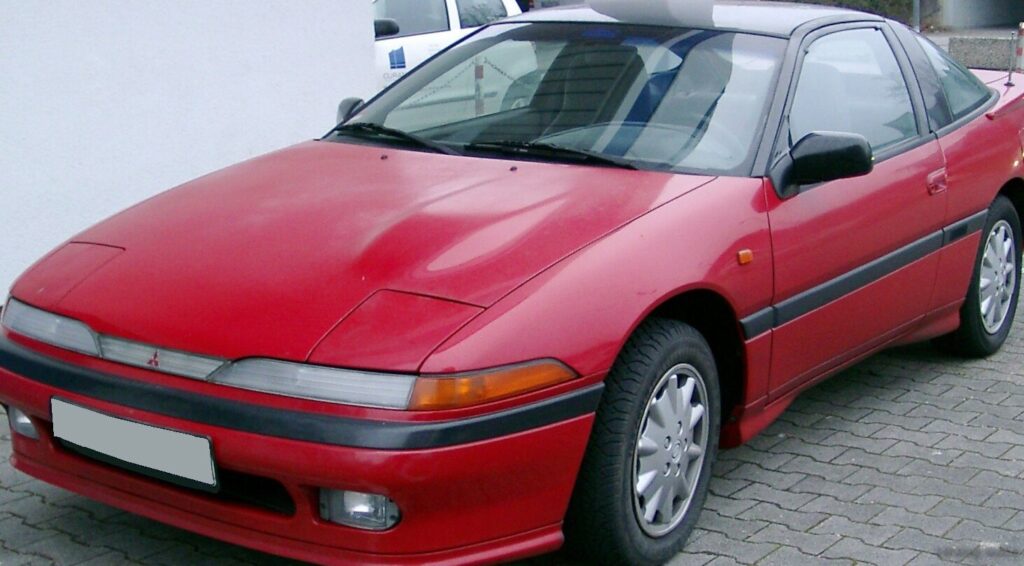
The Mitsubishi Eclipse first generation (1G), produced from 1989 to 1994, represented a significant departure for Mitsubishi, moving away from rear-wheel drive sports cars like the Starion and towards a more modern, front-wheel drive or all-wheel drive platform. The 2.0i 16V 4WD Turbo variant, available from 1990 to 1992, was the performance flagship of the initial Eclipse lineup, offering a compelling blend of turbocharged power and all-weather capability. It was positioned as a direct competitor to vehicles like the Toyota Celica GT-Four and Nissan 240SX, aiming for enthusiasts seeking a sporty and capable coupe.
Technical Specifications
| Brand | Mitsubishi |
| Model | Eclipse |
| Generation | Eclipse I (1G) |
| Type | 2.0 i 16V 4WD Turbo (195 Hp) |
| Start of production | 1990 |
| End of production | 1992 |
| Powertrain Architecture | Internal Combustion engine |
| Body type | Coupe, Liftback |
| Seats | 4 |
| Doors | 2 |
| Fuel consumption (combined) | 10.7 l/100 km (22 US mpg, 26.4 UK mpg, 9.3 km/l) |
| Fuel Type | Petrol (Gasoline) |
| Maximum speed | 220 km/h (136.7 mph) |
| Weight-to-power ratio | 7.2 kg/Hp, 139 Hp/tonne |
| Weight-to-torque ratio | 5.1 kg/Nm, 196 Nm/tonne |
| Power | 195 Hp @ 5000 rpm |
| Power per litre | 97.6 Hp/l |
| Torque | 275 Nm @ 3000 rpm (202.83 lb.-ft. @ 3000 rpm) |
| Engine layout | Front, Transverse |
| Engine displacement | 1997 cm3 (121.86 cu. in.) |
| Number of cylinders | 4 |
| Engine configuration | Inline |
| Cylinder Bore | 85 mm (3.35 in.) |
| Piston Stroke | 88 mm (3.46 in.) |
| Compression ratio | 7.8:1 |
| Number of valves per cylinder | 4 |
| Fuel injection system | Multi-port manifold injection |
| Engine aspiration | Turbocharger |
| Valvetrain | DOHC |
| Kerb Weight | 1403 kg (3093.09 lbs.) |
| Fuel tank capacity | 60 l (15.85 US gal | 13.2 UK gal) |
| Length | 4390 mm (172.83 in.) |
| Width | 1695 mm (66.73 in.) |
| Height | 1321 mm (52.01 in.) |
| Wheelbase | 2470 mm (97.24 in.) |
| Front track | 1465 mm (57.68 in.) |
| Rear track | 1455 mm (57.28 in.) |
| Drive wheel | All wheel drive (4×4) |
| Number of gears and type of gearbox | 5 gears, manual transmission |
| Front suspension | Coil spring |
| Rear suspension | Coil spring |
| Front brakes | Ventilated discs |
| Rear brakes | Disc |
| Assisting systems | ABS (Anti-lock braking system) |
| Steering type | Steering rack and pinion |
| Power steering | Hydraulic Steering |
| Tires size | 205/55 R16 V |
Powertrain & Engine Architecture
The heart of the 2.0i 16V 4WD Turbo was the 4G63T engine, a 1997cc inline-four cylinder powerplant. This engine featured a cast iron block and an aluminum cylinder head, equipped with dual overhead camshafts (DOHC) and four valves per cylinder. The turbocharger, a Garrett T25, provided significant boost, contributing to the engine’s 195 horsepower output at 5000 rpm and 275 Nm (202.83 lb-ft) of torque at 3000 rpm. Fuel delivery was handled by a multi-port fuel injection system. The 4G63 engine was known for its robustness and tunability, becoming a popular choice for aftermarket modifications. The transmission was a robust 5-speed manual, designed to handle the increased power and torque. The all-wheel drive system employed a viscous coupling to distribute power between the front and rear axles, providing enhanced traction.
Driving Characteristics
The 2.0i 16V 4WD Turbo offered a noticeably more engaging driving experience compared to the naturally aspirated Eclipse models. The turbocharger provided a surge of power in the mid-range, making for quick acceleration. While not as refined as some of its European competitors, the Eclipse Turbo delivered a raw and visceral feel. The all-wheel drive system significantly improved grip, particularly on loose surfaces, making it a capable performer in various weather conditions. The 5-speed manual transmission offered precise shifts, allowing drivers to fully exploit the engine’s powerband. Compared to the base model 1.8L Eclipse, the Turbo was in a different league, offering a substantial performance upgrade. The gear ratios were tuned for acceleration, prioritizing responsiveness over outright top-end speed.
Equipment & Trim Levels
The 2.0i 16V 4WD Turbo typically came well-equipped for its time. Standard features included power windows, power locks, and a decent sound system. The interior featured sport seats with patterned cloth upholstery. Air conditioning was often standard, though some base models might have required it as an option. Optional extras included a sunroof, upgraded audio systems, and alloy wheels. The dashboard layout was functional and driver-focused, with clearly marked gauges. The overall interior design was typical of early 1990s Japanese sports coupes – practical and durable, rather than luxurious.
Chassis & Braking
The Eclipse 1G utilized a MacPherson strut front suspension and a multi-link rear suspension, providing a good balance of ride comfort and handling. The 4WD Turbo models featured slightly stiffer springs and dampers compared to the front-wheel drive versions to manage the increased weight and power. Braking duties were handled by ventilated discs at the front and solid discs at the rear. An Anti-lock Braking System (ABS) was standard, enhancing safety and control during hard braking. The steering was a rack-and-pinion system with hydraulic power assistance, providing precise and responsive steering feel.
Market Reception & Comparison
The Mitsubishi Eclipse 2.0i 16V 4WD Turbo was generally well-received by automotive critics. It was praised for its strong performance, all-weather capability, and relatively affordable price. However, some reviewers noted that the interior was somewhat basic compared to its European rivals. Compared to the naturally aspirated Eclipse models, the Turbo offered a significant performance advantage, but at a higher price point. The 1.8L models were seen as more economical and practical, while the Turbo catered to enthusiasts seeking a more thrilling driving experience. Against competitors like the Toyota Celica GT-Four and Nissan 240SX, the Eclipse Turbo offered a compelling alternative, often undercutting them in price while delivering comparable performance.
Legacy
The 4G63 engine, found in the Eclipse 2.0i 16V 4WD Turbo, has earned a legendary reputation for its durability and tunability. Even today, well-maintained examples of this engine can be found delivering reliable performance. The Eclipse 1G, particularly the Turbo models, have become sought-after classics among enthusiasts. While finding pristine examples can be challenging, the 2.0i 16V 4WD Turbo remains a popular choice for restoration projects and performance modifications. The car’s robust mechanicals and relatively simple design make it a rewarding platform for those willing to invest the time and effort. In the used car market, prices for well-preserved examples have been steadily increasing, reflecting the growing appreciation for this iconic 1990s sports coupe.