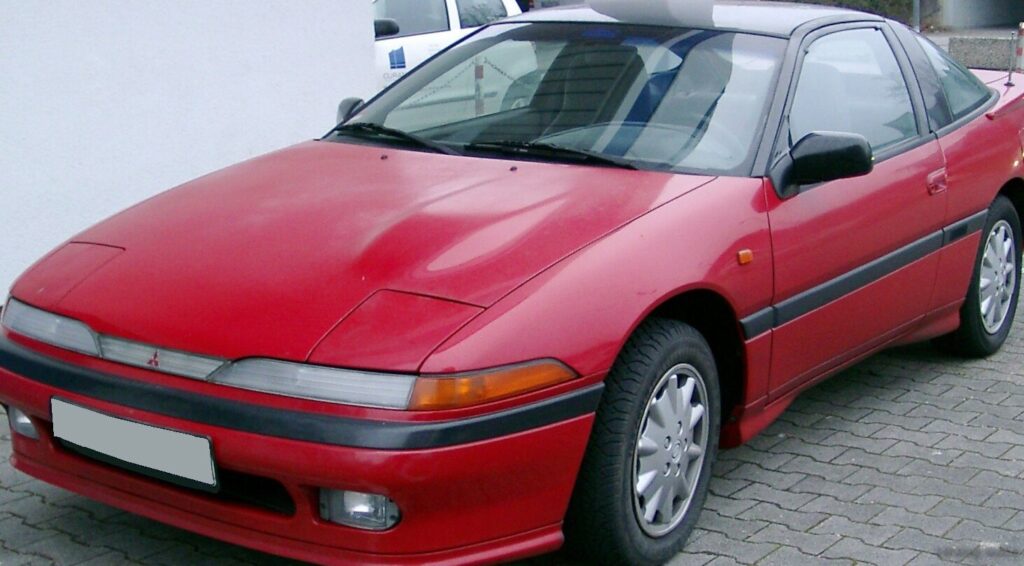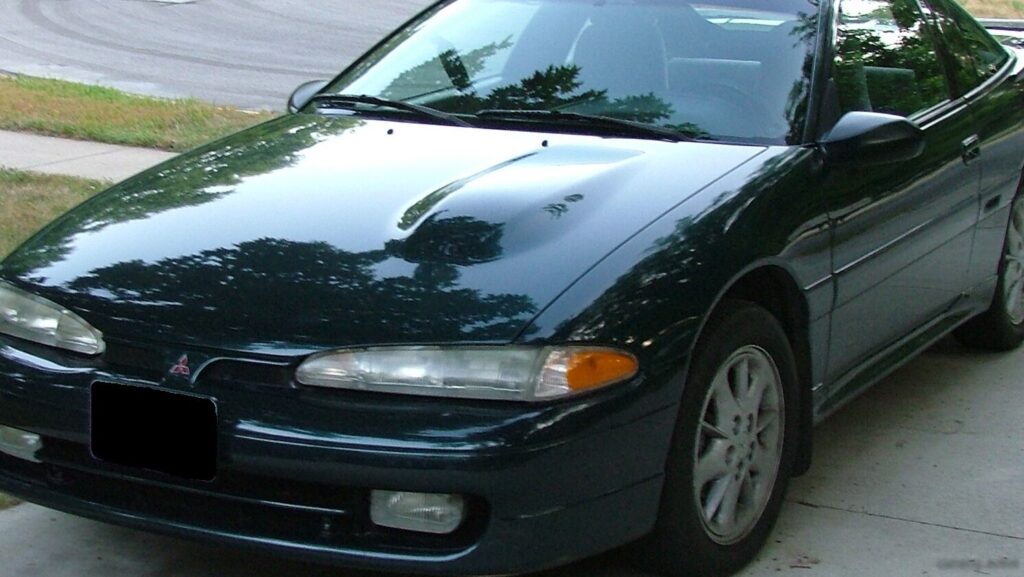
The Mitsubishi Eclipse GSX 2.0 Turbo, produced from 1992 to 1994, represents a significant iteration of the first-generation (1G) Eclipse. This facelifted model, often referred to as the 1HX0 series, was a key player in Mitsubishi’s attempt to capture a larger share of the North American sports coupe market. Positioned as the performance flagship of the Eclipse range, the GSX 2.0 Turbo distinguished itself with its turbocharged engine, all-wheel drive system, and sporty aesthetics. It was a direct response to the popularity of vehicles like the Toyota Turbo Celica and Nissan 240SX, offering a compelling blend of performance and affordability.
Technical Specifications
| Brand | Mitsubishi |
| Model | Eclipse |
| Generation | Eclipse I (1G, facelift 1992) |
| Type (Engine) | GSX 2.0 Turbo (195 Hp) AWD |
| Start of production | 1992 |
| End of production | 1994 |
| Powertrain Architecture | Internal Combustion engine |
| Body type | Coupe, Liftback |
| Seats | 4 |
| Doors | 3 |
| Fuel Type | Petrol (Gasoline) |
| Weight-to-power ratio | 7.2 kg/Hp, 139 Hp/tonne |
| Weight-to-torque ratio | 5.1 kg/Nm, 196 Nm/tonne |
| Power | 195 Hp @ 6000 rpm |
| Power per litre | 97.6 Hp/l |
| Torque | 275 Nm @ 3000 rpm, 202.83 lb.-ft. @ 3000 rpm |
| Engine layout | Front, Transverse |
| Engine Model/Code | 4G63T |
| Engine displacement | 1997 cm3, 121.86 cu. in. |
| Number of cylinders | 4 |
| Engine configuration | Inline |
| Cylinder Bore | 85 mm, 3.35 in. |
| Piston Stroke | 88 mm, 3.46 in. |
| Number of valves per cylinder | 4 |
| Fuel injection system | Multi-port manifold injection |
| Engine aspiration | Turbocharger, Intercooler |
| Valvetrain | DOHC |
| Engine oil capacity | 4.5 l, 4.76 US qt | 3.96 UK qt |
| Coolant | 7 l, 7.4 US qt | 6.16 UK qt |
| Kerb Weight | 1403 kg, 3093.09 lbs |
| Trunk (boot) space – minimum | 195 l, 6.89 cu. ft |
| Fuel tank capacity | 60 l, 15.85 US gal | 13.2 UK gal |
| Length | 4390 mm, 172.83 in |
| Width | 1695 mm, 66.73 in |
| Height | 1321 mm, 52.01 in |
| Wheelbase | 2470 mm, 97.24 in |
| Drag coefficient (Cd) | 0.33 |
| Drivetrain Architecture | The Internal combustion engine (ICE) drives permanently the four wheels of the vehicle. |
| Drive wheel | All wheel drive (4×4) |
| Number of gears and type of gearbox | 5 gears, manual transmission |
| Front suspension | Independent type McPherson, Transverse stabilizer |
| Rear suspension | Double wishbone, Transverse stabilizer |
| Front brakes | Ventilated discs |
| Rear brakes | Disc |
| Assisting systems | ABS (Anti-lock braking system) |
| Steering type | Steering rack and pinion |
| Power steering | Hydraulic Steering |
| Tires size | 205/55 R16 |
| Wheel rims size | 6J x 16 |
Powertrain & Engine Architecture
The heart of the Eclipse GSX was the 4G63T 2.0-liter inline-four cylinder engine. This engine was a derivative of the 4G63 non-turbocharged engine, but significantly upgraded with a Mitsubishi TD04H turbocharger and an intercooler. The turbocharger boosted power output to 195 horsepower at 6000 rpm and 275 Nm (202.83 lb-ft) of torque at 3000 rpm. The engine utilized multi-port fuel injection and a double overhead camshaft (DOHC) valvetrain, contributing to its responsive nature. The GSX exclusively came with a five-speed manual transmission, designed to handle the increased power and torque. This transmission featured robust internals to withstand the stresses of spirited driving and all-wheel drive operation.
Driving Characteristics
The 1992-1994 Eclipse GSX 2.0 Turbo offered a distinctly engaging driving experience. The all-wheel drive system provided excellent traction, particularly in inclement weather or during hard acceleration. While not a drag racer, the turbocharger provided a noticeable surge of power in the mid-range, making it fun to drive on winding roads. The five-speed manual transmission allowed for precise control, and the gear ratios were well-suited for both everyday driving and spirited performance. Compared to the naturally aspirated versions of the Eclipse, the GSX offered a substantial performance upgrade. However, the turbo lag was noticeable, requiring drivers to keep the engine revved to maintain optimal power delivery. The GSX was also heavier than its non-turbo counterparts, which slightly impacted its agility.
Equipment & Trim Levels
The GSX trim level was well-equipped for its time. Standard features included power windows, power locks, air conditioning, and a decent sound system. The interior typically featured sporty cloth upholstery with a dark color scheme. Optional extras included a sunroof, upgraded audio systems, and alloy wheels. The dashboard layout was functional and driver-focused, with easy-to-read gauges. The GSX also featured a unique body kit, including a rear spoiler and side skirts, to differentiate it from other Eclipse models.
Chassis & Braking
The Eclipse GSX utilized an independent McPherson strut suspension in the front and a double wishbone suspension in the rear. Both ends were equipped with transverse stabilizers to reduce body roll during cornering. The braking system consisted of ventilated discs in the front and solid discs in the rear. An Anti-lock Braking System (ABS) was standard, enhancing safety and control. The GSX’s suspension was tuned for a balance between comfort and handling, providing a reasonably compliant ride without sacrificing cornering stability. The all-wheel drive system added to the vehicle’s overall weight, requiring a slightly more robust suspension setup.
Market Reception & Comparison
The Eclipse GSX 2.0 Turbo was generally well-received by automotive critics. It was praised for its performance, handling, and all-wheel drive system. However, some reviewers noted the presence of turbo lag and the relatively basic interior compared to some of its European competitors. Compared to the base model Eclipse, the GSX offered a significant performance advantage. Against rivals like the Toyota Celica Turbo and Nissan 240SX, the GSX offered a unique combination of all-wheel drive and turbocharged power. Fuel economy was reasonable for a performance car of its era, averaging around 20-24 mpg in mixed driving. Reliability was generally good, although the turbocharger and associated components required regular maintenance.
Legacy
The Mitsubishi Eclipse GSX 2.0 Turbo has become a popular choice among enthusiasts and collectors. The 4G63T engine is renowned for its durability and tunability, making it a favorite for modifications and performance upgrades. While finding well-maintained examples can be challenging, the GSX remains a relatively affordable entry point into the world of turbocharged, all-wheel drive sports coupes. The car’s enduring appeal is a testament to its engaging driving dynamics and its place in the history of Japanese performance cars. Today, the GSX is often seen as a classic, representing a golden era of affordable and exciting sports coupes.