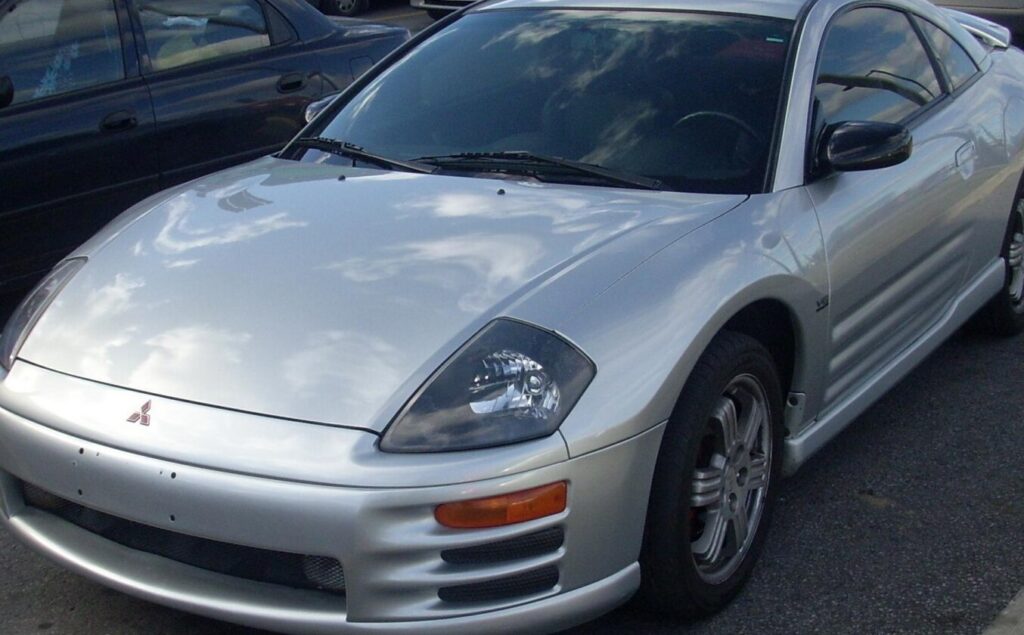
The Mitsubishi Eclipse III (3G), produced between 1999 and 2002, marked a significant departure in the Eclipse lineage. Positioned as a sporty coupe and liftback, it aimed for a wider audience than its predecessors. This generation, built on the DS platform shared with the Chrysler Sebring and Dodge Stratus, blended styling, performance, and technology. The 2.4-liter, 16-valve (147 hp) variant occupied a middle ground in the Eclipse III lineup, balancing affordability with respectable power. It was a step up from the base 2.0-liter engine, yet remained more accessible than the turbocharged GSX and GS-T models.
Technical Specifications
| Brand | Mitsubishi |
| Model | Eclipse |
| Generation | Eclipse III (3G) |
| Type (Engine) | 2.4 i 16V (147 Hp) |
| Start of production | 1999 |
| End of production | 2002 |
| Powertrain Architecture | Internal Combustion engine |
| Body type | Coupe, Liftback |
| Seats | 4 |
| Doors | 3 |
| Fuel consumption (urban) | 10.2 l/100 km (23.1 US mpg) |
| Fuel consumption (extra urban) | 7.6 l/100 km (30.9 US mpg) |
| Fuel Type | Petrol (Gasoline) |
| Weight-to-power ratio | 8.8 kg/Hp |
| Weight-to-torque ratio | 6.1 kg/Nm |
| Power | 147 Hp @ 5500 rpm |
| Power per litre | 62.5 Hp/l |
| Torque | 214 Nm @ 4000 rpm (157.84 lb.-ft. @ 4000 rpm) |
| Engine layout | Front, Transverse |
| Engine displacement | 2351 cm3 (143.47 cu. in.) |
| Number of cylinders | 4 |
| Engine configuration | Inline |
| Cylinder Bore | 86.5 mm (3.41 in.) |
| Piston Stroke | 100 mm (3.94 in.) |
| Compression ratio | 9:1 |
| Number of valves per cylinder | 4 |
| Fuel injection system | Multi-port manifold injection |
| Engine aspiration | Naturally aspirated engine |
| Valvetrain | SOHC |
| Kerb Weight | 1295-1335 kg (2854.99 – 2943.17 lbs.) |
| Max. weight | 1750 kg (3858.09 lbs.) |
| Max load | 415-455 kg (914.92 – 1003.1 lbs.) |
| Trunk (boot) space (minimum) | 480 l (16.95 cu. ft.) |
| Fuel tank capacity | 62 l (16.38 US gal | 13.64 UK gal) |
| Length | 4455 mm (175.39 in.) |
| Width | 1750 mm (68.9 in.) |
| Height | 1310 mm (51.57 in.) |
| Wheelbase | 2560 mm (100.79 in.) |
| Front track | 1510 mm (59.45 in.) |
| Rear track | 1510 mm (59.45 in.) |
| Front overhang | 975 mm (38.39 in.) |
| Rear overhang | 920 mm (36.22 in.) |
| Ride height (ground clearance) | 148 mm (5.83 in.) |
| Drivetrain Architecture | Front wheel drive |
| Number of gears and type of gearbox | 5 gears, manual transmission |
| Front suspension | Independent type McPherson |
| Rear suspension | Independent multi-link suspension |
| Front brakes | Ventilated discs |
| Rear brakes | Drum |
| Steering type | Steering rack and pinion |
| Power steering | Hydraulic Steering |
| Tires size | 195/65 R15 |
Powertrain & Engine Architecture
The core of this Eclipse variant is the 4G63 2.4-liter inline-four engine. This engine, part of Mitsubishi’s respected 4G6 family, featured a single overhead camshaft (SOHC) design and multi-port fuel injection. The 9:1 compression ratio represented a compromise between performance and compatibility with common gasoline grades. While less advanced than the dual overhead camshaft (DOHC) engines in the GSX and GS-T models, the 4G63 offered a robust and reliable powerplant. A five-speed manual transmission was standard, giving drivers direct control over the engine’s power. The transmission’s gear ratios were tuned for a balance of acceleration and fuel efficiency, though it wasn’t as sporty as the closer ratios in the turbocharged models.
Driving Characteristics
The 2.4-liter Eclipse delivered adequate, but not thrilling, performance. With 147 horsepower and 157.84 lb-ft of torque, acceleration was acceptable for daily driving, but lacked the punch of the turbocharged versions. The manual transmission allowed for reasonably quick shifts, but the engine’s powerband was relatively narrow. The car felt most comfortable at highway speeds, where the engine didn’t need to be strained. Compared to the GSX/GS-T, the 2.4L felt noticeably slower in acceleration and lacked the mid-range torque that made those models popular with enthusiasts. However, the simpler engine and transmission generally resulted in better fuel economy and lower maintenance costs.
Equipment & Trim Levels
The 2.4-liter Eclipse typically included standard features like air conditioning, power windows and locks, and an AM/FM stereo. Higher trim levels added features such as a CD player, upgraded upholstery, and alloy wheels. Interior materials were durable but not luxurious. Optional extras included a sunroof, leather seats, and a premium sound system. The interior design was functional and driver-focused, with easy-to-read gauges and well-placed controls. The liftback body style provided greater cargo versatility than the coupe.
Chassis & Braking
The Eclipse III used an independent McPherson strut suspension in the front and an independent multi-link suspension in the rear. This setup provided a comfortable ride and decent handling. The front brakes were ventilated discs, offering good stopping power, while the rear brakes were drums, a cost-saving measure common in this vehicle class. Steering was rack-and-pinion with hydraulic power assist, providing a responsive and precise feel. The standard tire size was 195/65 R15, balancing grip and ride comfort.
Market Reception & Comparison
The 2.4-liter Eclipse was generally well-received as an affordable and stylish coupe. Critics praised its comfortable ride and user-friendly features, but noted its performance wasn’t as exciting as the turbocharged models. Fuel economy was considered average for its class. Compared to competitors like the Honda Civic Coupe and Toyota Celica, the Eclipse offered more aggressive styling and a slightly more spacious interior. However, it lacked the refinement and reliability reputation of some Japanese rivals. The 2.4L model was often seen as a good choice for buyers prioritizing value and practicality over outright performance.
Legacy
The Mitsubishi Eclipse III 2.4-liter remains a relatively affordable and accessible sports coupe in the used car market. The 4G63 engine is known for its durability and simple maintenance. While not as desirable as the turbocharged GSX and GS-T models, the 2.4-liter variant offers a reliable and enjoyable driving experience. Common issues include minor oil leaks and wear on suspension components. Overall, the 2.4-liter Eclipse III is a solid and dependable choice for those seeking a sporty and affordable coupe from the early 2000s.