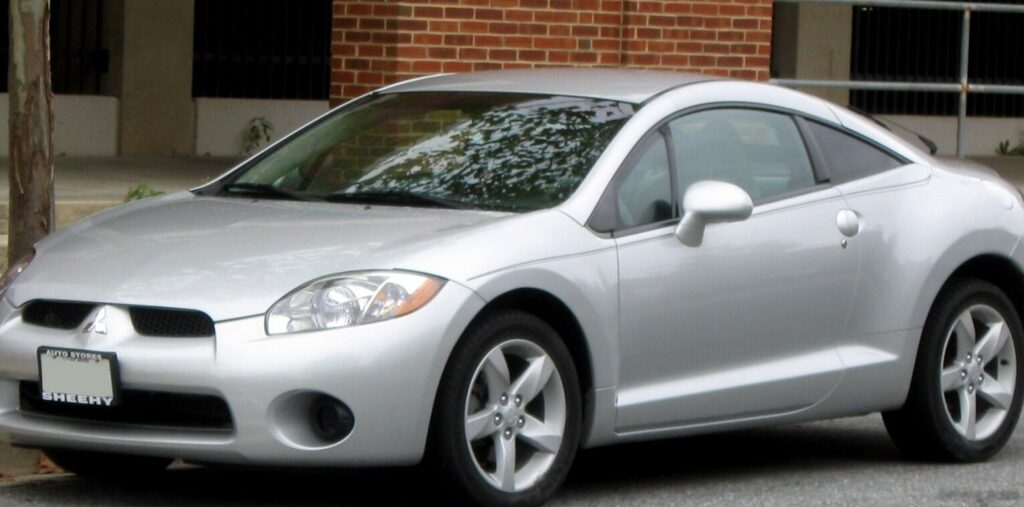
The Mitsubishi Eclipse IV (4G), produced between 2006 and 2009, represented the final generation of the iconic Eclipse sports coupe and liftback. Positioned as a competitor to the Honda Civic Coupe and Nissan Sentra SE-R, the 4G Eclipse aimed to deliver a blend of sporty styling, decent performance, and everyday practicality. This particular variant, equipped with the 2.4-liter 4G69 inline-four engine producing 162 horsepower, served as a mid-range offering within the Eclipse lineup, bridging the gap between the base 2.0-liter engine and the more potent turbocharged variants available in certain markets. The 4G Eclipse was primarily sold in North America, with limited distribution elsewhere.
Technical Specifications
| Brand | Mitsubishi |
| Model | Eclipse |
| Generation | Eclipse IV (4G) |
| Type (Engine) | 2.4L (162 Hp) |
| Start of production | 2006 |
| End of production | 2009 |
| Powertrain Architecture | Internal Combustion engine |
| Body type | Coupe, Liftback |
| Seats | 4 |
| Doors | 2 |
| Fuel Type | Petrol (Gasoline) |
| Acceleration 0 – 100 km/h | 9.4 sec |
| Acceleration 0 – 62 mph | 9.4 sec |
| Acceleration 0 – 60 mph | 8.9 sec |
| Weight-to-power ratio | 9.2 kg/Hp, 109.1 Hp/tonne |
| Weight-to-torque ratio | 6.8 kg/Nm, 148.1 Nm/tonne |
| Power | 162 Hp @ 6000 rpm |
| Power per litre | 68.1 Hp/l |
| Torque | 220 Nm @ 4000 rpm (162.26 lb.-ft. @ 4000 rpm) |
| Engine layout | Front, Transverse |
| Engine Model/Code | 4G69 |
| Engine displacement | 2378 cm3 (145.11 cu. in.) |
| Number of cylinders | 4 |
| Engine configuration | Inline |
| Cylinder Bore | 87 mm (3.43 in.) |
| Piston Stroke | 100 mm (3.94 in.) |
| Compression ratio | 9.5:1 |
| Number of valves per cylinder | 4 |
| Fuel injection system | Multi-port manifold injection |
| Engine aspiration | Naturally aspirated engine |
| Valvetrain | SOHC |
| Engine oil capacity | 4.3 l (4.54 US qt | 3.78 UK qt) |
| Coolant | 8.8 l (9.3 US qt | 7.74 UK qt) |
| Kerb Weight | 1485 kg (3273.86 lbs.) |
| Max. weight | 1845 kg (4067.53 lbs.) |
| Max load | 360 kg (793.66 lbs.) |
| Length | 4565 mm (179.72 in.) |
| Width | 1835 mm (72.24 in.) |
| Height | 1358 mm (53.46 in.) |
| Wheelbase | 2575 mm (101.38 in.) |
| Front track | 1570 mm (61.81 in.) |
| Rear (Back) track | 1570 mm (61.81 in.) |
| Front overhang | 1007 mm (39.65 in.) |
| Rear overhang | 983 mm (38.7 in.) |
| Ride height (ground clearance) | 148 mm (5.83 in.) |
| Drivetrain Architecture | The Internal combustion engine (ICE) drives the front wheels of the vehicle. |
| Drive wheel | Front wheel drive |
| Number of gears and type of gearbox | 5 gears, manual transmission |
| Front suspension | Independent type McPherson |
| Rear suspension | Independent multi-link suspension |
| Front brakes | Ventilated discs, 295 mm |
| Rear brakes | Disc, 262 mm |
| Assisting systems | ABS (Anti-lock braking system) |
| Steering type | Steering rack and pinion |
| Power steering | Hydraulic Steering |
Powertrain & Engine Architecture
The heart of this Eclipse variant is the 4G69 engine, a 2.4-liter inline-four cylinder powerplant. This engine utilizes a single overhead camshaft (SOHC) design, operating with four valves per cylinder. Fuel delivery is managed by a multi-port fuel injection system, providing a balance between efficiency and performance. The 4G69 is a non-interference engine, meaning that even if the timing belt breaks, the pistons will not collide with the valves, preventing catastrophic engine damage. The engine’s 9.5:1 compression ratio contributes to its respectable power output. The standard transmission for this trim was a five-speed manual, offering drivers a direct connection to the engine. The 4G69 engine is known for its relative simplicity and durability, making it a reasonably reliable unit when properly maintained.
Driving Characteristics
The 2.4-liter engine, paired with the five-speed manual transmission, provided adequate, though not exhilarating, performance. Acceleration from 0 to 60 mph took approximately 8.9 seconds. The engine delivered a usable amount of torque at lower RPMs, making it suitable for daily driving. However, compared to the turbocharged variants or even the base 2.0-liter engine with a manual transmission, the 2.4-liter felt somewhat less responsive. The five-speed manual transmission offered a decent spread of gear ratios, allowing drivers to keep the engine in its optimal power band. The front-wheel-drive configuration provided predictable handling, but lacked the all-weather capability of an all-wheel-drive system.
Equipment & Trim Levels
The 2.4-liter Eclipse typically came equipped with standard features such as air conditioning, power windows and locks, a CD player with MP3 compatibility, and basic cloth upholstery. Optional extras included a premium sound system, sunroof, leather upholstery, and alloy wheels. The trim level often dictated the availability of these options. The 2.4L trim generally sat in the middle of the lineup, offering a step up in performance and features compared to the base model, but falling short of the more luxurious and performance-oriented trims.
Chassis & Braking
The Eclipse 4G utilized an independent McPherson strut suspension in the front and an independent multi-link suspension in the rear, providing a comfortable ride and reasonably controlled handling. Front brakes were ventilated discs measuring 295mm, while the rear brakes were solid discs measuring 262mm. Anti-lock braking system (ABS) was standard, enhancing safety and control during hard braking. The suspension tuning was geared towards a balance between comfort and handling, making it suitable for both daily commuting and spirited driving.
Market Reception & Comparison
Critics generally viewed the 2.4-liter Eclipse as a competent, but unremarkable, offering. It was praised for its styling and comfortable interior, but criticized for its lack of outright performance compared to some of its competitors. Fuel economy was average for its class. Compared to the base 2.0-liter engine, the 2.4-liter offered a noticeable improvement in power and acceleration. However, the turbocharged variants, when available, provided a significantly more engaging driving experience. Reliability was generally good, with the 4G69 engine proving to be a durable unit.
Legacy
The 2.4-liter 4G69 engine in the Eclipse IV has a reputation for being a relatively reliable and long-lasting powertrain. Used examples are still relatively common today, and with proper maintenance, can provide years of service. While not a particularly sought-after variant by collectors, the 2.4-liter Eclipse represents a solid and affordable option for those seeking a stylish and practical coupe. The 4G Eclipse, as a whole, marked the end of an era for the Eclipse nameplate, and remains a fondly remembered vehicle for many enthusiasts.