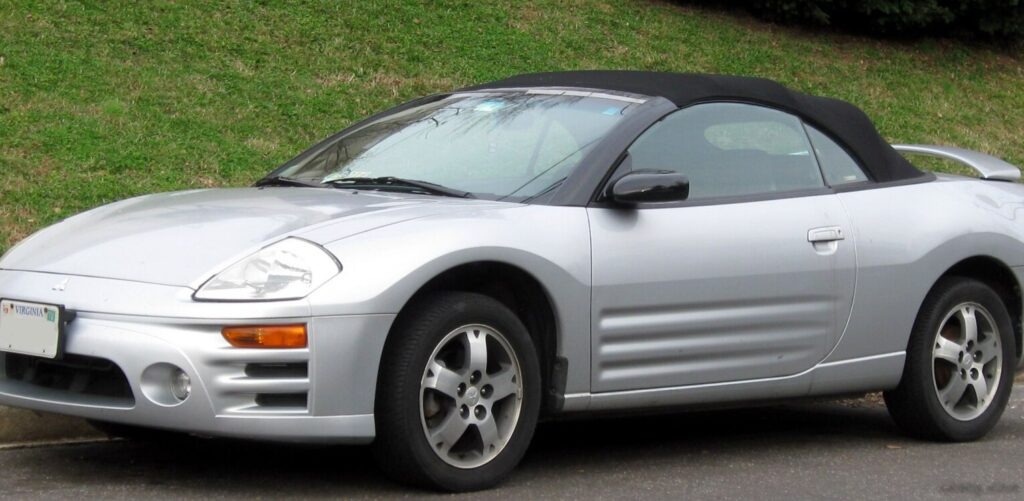
The Mitsubishi Eclipse Spyder GTS 3.0, produced from 2003 to 2005, represented the facelift of the third-generation (3G) Eclipse Spyder. This variant, designated internally as the 3G, sat at the top of the Spyder range, offering a more powerful V6 engine and automatic transmission. It was positioned as a sporty, open-top alternative within Mitsubishi’s lineup, aimed at buyers seeking a blend of performance and style. The 3G Eclipse Spyder was primarily marketed in North America, where the convertible market was particularly strong, and it competed with models like the Mazda MX-5 Miata and Honda S2000, though offering a more grand-touring focused experience.
Technical Specifications
| Brand | Mitsubishi |
| Model | Eclipse |
| Generation | Eclipse Spyder III (3G, facelift 2003) |
| Type | GTS 3.0 i V6 24V (210 Hp) Automatic |
| Start of production | 2003 |
| End of production | 2005 |
| Powertrain Architecture | Internal Combustion engine |
| Body type | Cabriolet |
| Seats | 4 |
| Doors | 2 |
| Fuel consumption (urban) | 11.8 l/100 km (19.9 US mpg) |
| Fuel consumption (extra urban) | 8.7 l/100 km (27 US mpg) |
| Fuel Type | Petrol (Gasoline) |
| Weight-to-power ratio | 7.3 kg/Hp |
| Weight-to-torque ratio | 5.5 kg/Nm |
| Power | 210 Hp @ 5750 rpm |
| Torque | 278 Nm @ 3750 rpm (205.04 lb.-ft. @ 3750 rpm) |
| Engine layout | Front, Transverse |
| Engine Model/Code | 6G72 |
| Engine displacement | 2972 cm3 (181.36 cu. in.) |
| Number of cylinders | 6 |
| Engine configuration | V-engine |
| Cylinder Bore | 91.1 mm (3.59 in.) |
| Piston Stroke | 76 mm (2.99 in.) |
| Compression ratio | 9:1 |
| Number of valves per cylinder | 4 |
| Fuel injection system | Multi-port manifold injection |
| Engine aspiration | Naturally aspirated engine |
| Engine oil capacity | 4.3 l (4.54 US qt | 3.78 UK qt) |
| Coolant capacity | 8 l (8.45 US qt | 7.04 UK qt) |
| Kerb Weight | 1540 kg (3395.12 lbs.) |
| Max. weight | 1865 kg (4111.62 lbs.) |
| Max load | 325 kg (716.5 lbs.) |
| Trunk (boot) space (minimum) | 170 l (6 cu. ft.) |
| Fuel tank capacity | 62 l (16.38 US gal | 13.64 UK gal) |
| Length | 4490 mm (176.77 in.) |
| Width | 1750 mm (68.9 in.) |
| Height | 1340 mm (52.76 in.) |
| Wheelbase | 2560 mm (100.79 in.) |
| Front track | 1510 mm (59.45 in.) |
| Rear track | 1510 mm (59.45 in.) |
| Front overhang | 1010 mm (39.76 in.) |
| Rear overhang | 920 mm (36.22 in.) |
| Ride height (ground clearance) | 165 mm (6.5 in.) |
| Drivetrain Architecture | Front wheel drive |
| Number of gears | 4 |
| Gearbox type | Automatic transmission |
| Front suspension | Independent type McPherson |
| Rear suspension | Independent multi-link suspension |
| Front brakes | Ventilated discs |
| Rear brakes | Disc |
| Assisting systems | ABS (Anti-lock braking system) |
| Steering type | Steering rack and pinion |
| Power steering | Hydraulic Steering |
| Tires size | 215/50 R17 |
| Wheel rims size | 17 |
INTRODUCTION
The 2003-2005 Mitsubishi Eclipse Spyder GTS 3.0 represented a significant upgrade within the third-generation Eclipse Spyder lineup. Built on the 3G platform, this facelifted model offered a more refined aesthetic and a more potent engine option. The GTS 3.0 was the premium trim level for the Spyder, distinguishing itself from the base RS model with its larger displacement V6 engine and automatic transmission. It aimed to provide a comfortable and enjoyable open-air driving experience with a focus on accessible performance.
Powertrain & Engine Architecture
At the heart of the Eclipse Spyder GTS 3.0 lies the 6G72 3.0-liter V6 engine. This naturally aspirated engine, a staple of Mitsubishi performance vehicles of the era, produced 210 horsepower at 5750 rpm and 278 Nm (205 lb-ft) of torque at 3750 rpm. The 6G72 featured a cast iron block, aluminum cylinder heads, and a single overhead camshaft (SOHC) design with four valves per cylinder. Fuel delivery was handled by a multi-port fuel injection system, ensuring efficient combustion. The engine’s 9:1 compression ratio was a compromise between performance and reliability. The engine was transversely mounted in the front of the vehicle.
The GTS 3.0 was exclusively offered with a four-speed automatic transmission. This transmission, while providing ease of use, wasn’t known for its sportiness or efficiency compared to the available five-speed manual. The automatic transmission featured electronically controlled shifts, but lacked the responsiveness of more modern gearboxes. Gear ratios were tuned for a balance of acceleration and highway cruising, prioritizing comfort over outright performance.
Driving Characteristics
The Eclipse Spyder GTS 3.0 with the automatic transmission delivered a smooth, but not particularly exhilarating, driving experience. Acceleration was adequate, with the V6 providing sufficient power for everyday driving and passing maneuvers. However, the four-speed automatic transmission limited the engine’s potential, resulting in slower acceleration times compared to the manual transmission equipped models. The automatic’s shift points were sometimes hesitant, and lacked the engagement of a manual gearbox. The front-wheel-drive configuration, while common for this class of vehicle, contributed to some torque steer under hard acceleration.
The suspension was tuned for comfort, providing a relatively compliant ride. However, this came at the expense of handling precision. Body roll was noticeable in corners, and the steering lacked the feedback desired by more enthusiastic drivers. Overall, the GTS 3.0 automatic was best suited for relaxed cruising and enjoying the open-air experience rather than aggressive driving.
Equipment & Trim Levels
The GTS 3.0 trim level came standard with a number of features designed to enhance comfort and convenience. These included air conditioning, power windows and locks, a premium sound system, and alloy wheels. Leather upholstery was standard, along with a leather-wrapped steering wheel and shift knob. Optional extras included a power-operated convertible top, heated seats, and a sunroof. The interior design was generally functional and aesthetically pleasing, though the materials used were not of the highest quality.
Chassis & Braking
The Eclipse Spyder GTS 3.0 utilized an independent McPherson strut suspension in the front and an independent multi-link suspension in the rear. This setup provided a reasonable level of ride comfort and handling. The front brakes were ventilated discs, while the rear brakes were solid discs. Anti-lock brakes (ABS) were standard, enhancing safety. The steering system was a rack-and-pinion setup with hydraulic power assist. The car rode on 215/50 R17 tires, providing adequate grip for most driving conditions.
Market Reception & Comparison
The Eclipse Spyder GTS 3.0 received mixed reviews from automotive critics. While the V6 engine was praised for its smooth power delivery, the four-speed automatic transmission was often criticized for its lack of responsiveness. Compared to the manual transmission version, the automatic GTS 3.0 offered less engaging driving experience. Fuel economy was also a concern, with the V6 engine consuming a significant amount of fuel, especially in urban driving. The GTS 3.0 was generally considered a good value for the money, offering a stylish and comfortable convertible experience at a competitive price point.
Legacy
The Mitsubishi Eclipse Spyder GTS 3.0, while not a groundbreaking vehicle, holds a place in automotive history as a representative of the early 2000s affordable sports car segment. The 6G72 V6 engine is known for its durability and reliability, and well-maintained examples can still provide years of enjoyable driving. However, the automatic transmission can be a potential source of issues as it ages. Today, the Eclipse Spyder GTS 3.0 is a relatively affordable used car, appealing to buyers seeking a stylish and comfortable convertible. Its value has remained relatively stable, making it a viable option for those looking for a classic open-top experience.