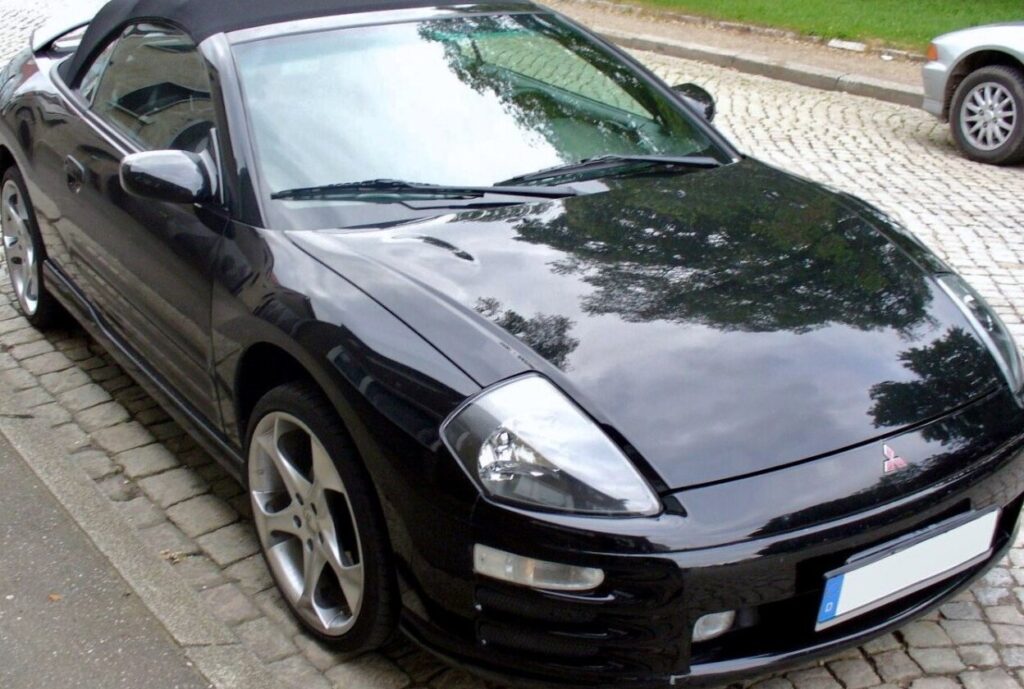
The Mitsubishi Eclipse Spyder GS 2.4 i 16V Automatic, produced between 1999 and 2002, represents the third generation (3G) of Mitsubishi’s popular Eclipse convertible. This variant occupied a middle ground within the 3G Spyder lineup, offering a balance between performance and affordability. Built on the 1HX0 platform, the Spyder aimed to provide an accessible open-air driving experience, competing with models like the Mazda MX-5 Miata and Honda Civic Sol. The GS trim, paired with the 2.4-liter engine and automatic transmission, was designed to appeal to buyers seeking a comfortable and stylish convertible without the higher price tag of the more performance-oriented GT models.
Technical Specifications
| Brand | Mitsubishi |
| Model | Eclipse |
| Generation | Eclipse Spyder III (3G) |
| Type | GS 2.4 i 16V (149 Hp) Automatic |
| Start of production | 1999 |
| End of production | 2002 |
| Powertrain Architecture | Internal Combustion engine |
| Body type | Cabriolet |
| Seats | 4 |
| Doors | 2 |
| Fuel consumption (urban) | 11.8 l/100 km (19.9 US mpg) |
| Fuel consumption (extra urban) | 9.1 l/100 km (25.8 US mpg) |
| Fuel Type | Petrol (Gasoline) |
| Weight-to-power ratio | 9.6 kg/Hp |
| Weight-to-torque ratio | 6.7 kg/Nm |
| Power | 149 Hp @ 5000 rpm |
| Power per litre | 63.4 Hp/l |
| Torque | 214 Nm @ 4000 rpm (157.84 lb.-ft. @ 4000 rpm) |
| Engine layout | Front, Transverse |
| Engine displacement | 2351 cm3 (143.47 cu. in.) |
| Number of cylinders | 4 |
| Engine configuration | Inline |
| Cylinder Bore | 86.5 mm (3.41 in.) |
| Piston Stroke | 100 mm (3.94 in.) |
| Compression ratio | 9:1 |
| Number of valves per cylinder | 4 |
| Fuel injection system | Multi-port manifold injection |
| Engine aspiration | Naturally aspirated engine |
| Valvetrain | SOHC |
| Kerb Weight | 1425 kg (3141.59 lbs.) |
| Max. weight | 1770 kg (3902.18 lbs.) |
| Max load | 345 kg (760.59 lbs.) |
| Trunk (boot) space (minimum) | 170 l (6 cu. ft.) |
| Fuel tank capacity | 62 l (16.38 US gal | 13.64 UK gal) |
| Length | 4455 mm (175.39 in.) |
| Width | 1750 mm (68.9 in.) |
| Height | 1340 mm (52.76 in.) |
| Wheelbase | 2560 mm (100.79 in.) |
| Front track | 1510 mm (59.45 in.) |
| Rear track | 1510 mm (59.45 in.) |
| Front overhang | 975 mm (38.39 in.) |
| Rear overhang | 920 mm (36.22 in.) |
| Ride height (ground clearance) | 163 mm (6.42 in.) |
| Drivetrain Architecture | Front wheel drive |
| Number of gears | 4 |
| Gearbox type | Automatic transmission |
| Front suspension | Independent type McPherson |
| Rear suspension | Independent multi-link suspension |
| Front brakes | Ventilated discs |
| Rear brakes | Disc |
| Assisting systems | ABS (Anti-lock braking system) |
| Steering type | Steering rack and pinion |
| Power steering | Hydraulic Steering |
| Tires size | 205/55 R16 |
| Wheel rims size | 16 |
Powertrain & Engine Architecture
The heart of the Eclipse Spyder GS Automatic is the 4G63 2.4-liter inline-four cylinder engine. This engine, a staple in Mitsubishi’s lineup, utilizes a single overhead camshaft (SOHC) valvetrain with four valves per cylinder. The 4G63 benefits from multi-port fuel injection, contributing to reasonable fuel efficiency and smooth power delivery. The engine produces 149 horsepower at 5000 rpm and 214 Nm (157.84 lb-ft) of torque at 4000 rpm. The engine’s 9:1 compression ratio represents a compromise between performance and the ability to run on regular unleaded gasoline. The engine is transversely mounted, driving the front wheels. The transmission is a four-speed automatic, chosen for its ease of use and suitability for the target market. While not offering the sporty engagement of a manual transmission, it provided a comfortable driving experience, particularly in city traffic.
Driving Characteristics
The 2.4-liter engine and four-speed automatic transmission combination in the GS Spyder delivers adequate, but not exhilarating, performance. Acceleration from 0 to 60 mph takes approximately 9-10 seconds. The automatic transmission is tuned for comfort, with relatively conservative gear ratios. This results in smooth shifts but can feel somewhat sluggish during quick acceleration or when attempting to pass on the highway. Compared to the available five-speed manual transmission, the automatic noticeably diminishes the driver’s control and responsiveness. The higher-output GT models, with their turbocharged engines, offered significantly more power and a sportier driving experience. However, the GS Automatic prioritizes ease of driving and fuel economy, making it a suitable choice for daily commuting and leisurely cruising.
Equipment & Trim Levels
The GS trim level of the Eclipse Spyder offered a good balance of features. Standard equipment typically included air conditioning, power windows and locks, a CD player, and a basic cloth interior. The convertible top was manually operated, a cost-saving measure compared to the power-operated top found on some higher trims. Optional extras included a premium sound system, leather upholstery, and alloy wheels. The interior design was functional and relatively simple, focusing on usability rather than luxury. The dashboard layout was straightforward, with easy-to-read gauges and logically placed controls.
Chassis & Braking
The Eclipse Spyder GS utilizes an independent McPherson strut suspension in the front and an independent multi-link suspension in the rear. This setup provides a comfortable ride quality, absorbing bumps and irregularities in the road surface effectively. The front brakes are ventilated discs, while the rear brakes are solid discs. Anti-lock braking system (ABS) was standard, enhancing safety by preventing wheel lockup during hard braking. The steering is rack and pinion with hydraulic power assist, providing responsive and precise steering feel. The suspension tuning is geared towards comfort rather than aggressive handling, reflecting the GS trim’s focus on everyday usability.
Market Reception & Comparison
The Eclipse Spyder GS 2.4 i Automatic was generally well-received by automotive critics as an affordable and stylish convertible. However, its performance was often criticized as being underwhelming compared to the more powerful GT models. Fuel economy was considered average for its class, with combined fuel consumption around 23 mpg. Reliability was generally good, although some owners reported issues with the automatic transmission over the long term. Compared to the Mazda MX-5 Miata, the Eclipse Spyder offered more interior space and a more comfortable ride, but lacked the Miata’s sharp handling and sporty character. The Honda Civic Sol, another competitor, was more affordable but offered less power and a less refined interior.
Legacy
The Mitsubishi Eclipse Spyder GS 2.4 i Automatic has become a relatively affordable and accessible entry point into the world of classic convertibles. The 4G63 engine is known for its durability and relatively simple maintenance requirements. While the automatic transmission can be a potential weak point, many examples remain on the road today. The Spyder’s styling has aged well, and it continues to appeal to enthusiasts seeking a stylish and enjoyable open-air driving experience. In the used car market, these models are often sought after for their affordability and potential for modification, with some owners upgrading the engine or suspension to enhance performance. The GS Automatic represents a practical and accessible version of the Eclipse Spyder, offering a blend of style, comfort, and affordability that continues to resonate with car enthusiasts today.