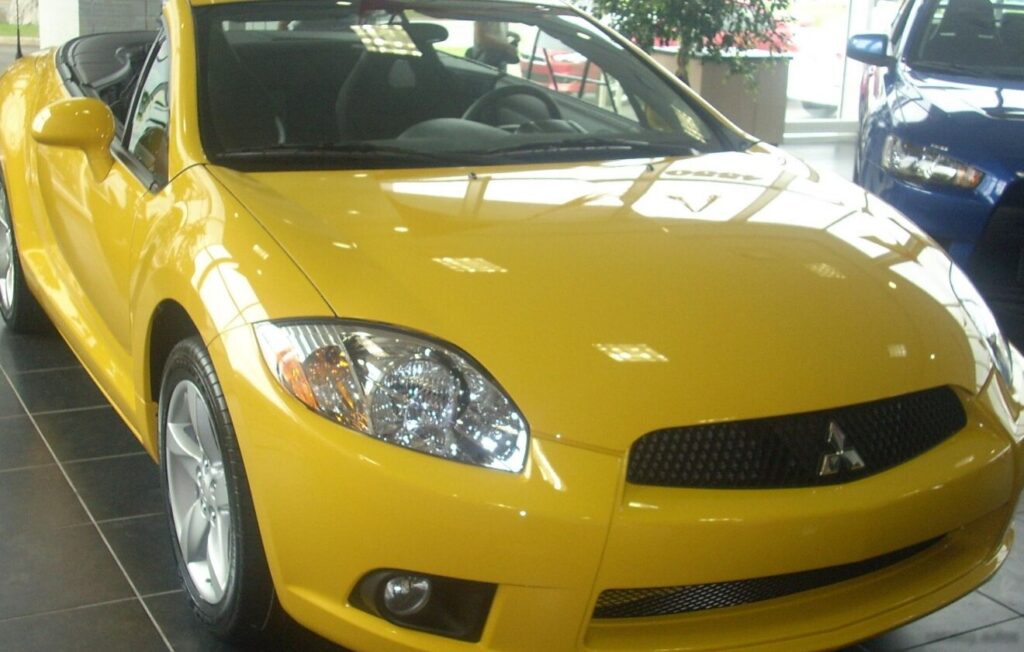
The Mitsubishi Eclipse Spyder IV (4G), specifically the facelifted version produced from 2009 to 2011, represented the final iteration of the popular Eclipse convertible. This generation, built on the GS platform, aimed to blend sporty styling with comfortable open-air driving. The 3.8L V6 MIVEC engine paired with an automatic transmission was the top-tier offering in the Spyder lineup, positioned as the premium choice for buyers seeking maximum performance and refinement. It was primarily marketed towards enthusiasts desiring a stylish and powerful convertible, though it faced competition from established players like the Mazda MX-5 Miata and BMW Z4.
Technical Specifications
| Brand | Mitsubishi |
| Model | Eclipse |
| Generation | Eclipse Spyder IV (4G, facelift 2009) |
| Type (Engine) | 3.8L V6 MIVEC (265 Hp) Automatic |
| Start of production | 2009 |
| End of production | 2011 |
| Powertrain Architecture | Internal Combustion engine |
| Body type | Cabriolet |
| Seats | 4 |
| Doors | 2 |
| Fuel consumption (urban) | 14.7 l/100 km (16 US mpg, 19.2 UK mpg, 6.8 km/l) |
| Fuel consumption (extra urban) | 9.8 l/100 km (24 US mpg, 28.8 UK mpg, 10.2 km/l) |
| Fuel Type | Petrol (Gasoline) |
| Weight-to-power ratio | 6.4 kg/Hp, 155.2 Hp/tonne |
| Weight-to-torque ratio | 4.8 kg/Nm, 208 Nm/tonne |
| Power | 265 Hp @ 5750 rpm |
| Power per litre | 69.2 Hp/l |
| Torque | 355 Nm @ 4500 rpm (261.83 lb.-ft. @ 4500 rpm) |
| Engine layout | Front, Transverse |
| Engine Model/Code | 6G75 |
| Engine displacement | 3828 cm3 (233.6 cu. in.) |
| Number of cylinders | 6 |
| Engine configuration | V-engine |
| Cylinder Bore | 95 mm (3.74 in.) |
| Piston Stroke | 90 mm (3.54 in.) |
| Compression ratio | 10.5:1 |
| Number of valves per cylinder | 4 |
| Fuel injection system | Multi-port manifold injection |
| Engine aspiration | Naturally aspirated engine |
| Valvetrain | SOHC |
| Engine oil capacity | 4.3 l (4.54 US qt | 3.78 UK qt) |
| Coolant | 8 l (8.45 US qt | 7.04 UK qt) |
| Kerb Weight | 1707 kg (3763.29 lbs.) |
| Trunk (boot) space – maximum | 147 l (5.19 cu. ft.) |
| Fuel tank capacity | 67 l (17.7 US gal | 14.74 UK gal) |
| Length | 4582 mm (180.39 in.) |
| Width | 1833 mm (72.17 in.) |
| Height | 1389 mm (54.69 in.) |
| Wheelbase | 2575 mm (101.38 in.) |
| Front track | 1570 mm (61.81 in.) |
| Rear (Back) track | 1570 mm (61.81 in.) |
| Minimum turning circle (turning diameter) | 12.2 m (40.03 ft.) |
| Drivetrain Architecture | The Internal combustion engine (ICE) drives the front wheels of the vehicle. |
| Drive wheel | Front wheel drive |
| Number of gears and type of gearbox | 5 gears, automatic transmission Sportronic |
| Front suspension | Independent type McPherson |
| Rear suspension | Independent multi-link suspension |
| Front brakes | Ventilated discs, 295 mm |
| Rear brakes | Disc, 284 mm |
| Assisting systems | ABS (Anti-lock braking system) |
| Steering type | Steering rack and pinion |
| Power steering | Hydraulic Steering |
| Tires size | 235/45 R18 |
| Wheel rims size | 18 |
INTRODUCTION
The 2009-2011 Mitsubishi Eclipse Spyder 3.8L V6 Automatic represented the pinnacle of performance for the fourth-generation Eclipse convertible. Following a mid-cycle refresh in 2009, the Spyder received updated styling and, crucially, the larger 3.8-liter 6G75 V6 engine previously found in the Eclipse GT coupe. This engine significantly boosted power output compared to the earlier 2.4-liter four-cylinder options. The “Sportronic” automatic transmission, a five-speed unit, offered a degree of driver control with manual shift capabilities. This variant aimed to provide a more engaging driving experience than the base models while maintaining the convenience of an automatic gearbox.
Powertrain & Engine Architecture
The heart of this Eclipse Spyder is the 6G75 3.8-liter V6 engine. This naturally aspirated engine utilizes a single overhead camshaft (SOHC) design with four valves per cylinder. Mitsubishi’s MIVEC (Mitsubishi Innovative Valve timing and lift Electronic Control) technology is employed to optimize valve timing for improved performance and fuel efficiency across the rev range. The engine features multi-port fuel injection, delivering fuel directly into the intake ports. The 6G75 is known for its robust construction and relatively simple design, contributing to its overall reliability. The five-speed Sportronic automatic transmission provides smooth shifts and allows the driver to select gears manually for more control. The transmission is electronically controlled, adapting shift points based on driving conditions and throttle input.
Driving Characteristics
The 3.8L V6 Automatic Spyder delivers a noticeable performance upgrade over the lower-trim models. With 265 horsepower and 261.83 lb-ft of torque, acceleration is brisk, and highway passing is effortless. While not a sports car in the purest sense, the combination of the V6 engine and the automatic transmission provides a satisfying driving experience. The Sportronic transmission allows for some driver engagement, but it doesn’t offer the responsiveness of a dual-clutch or manual gearbox. The automatic transmission’s gear ratios are tuned for a balance between acceleration and fuel economy. Compared to the manual transmission versions of the 3.8L engine, the automatic sacrifices some immediacy but gains in everyday usability. The front-wheel-drive configuration provides adequate traction in most conditions, but torque steer can be noticeable under hard acceleration.
Equipment & Trim Levels
The 3.8L V6 Automatic Spyder typically came well-equipped, representing the top trim level. Standard features generally included leather upholstery, automatic climate control, a premium sound system, power windows and locks, and alloy wheels. Optional extras often included a sunroof, upgraded audio systems, and various cosmetic enhancements. The interior design was focused on comfort and convenience, with a user-friendly layout and supportive seats. The Spyder’s convertible top was power-operated, providing easy open-air enjoyment. The dashboard featured a straightforward instrument cluster and a central infotainment screen.
Chassis & Braking
The Eclipse Spyder IV utilized an independent McPherson strut suspension in the front and an independent multi-link suspension in the rear. This setup provided a comfortable ride while maintaining reasonable handling characteristics. The suspension was tuned to balance ride comfort with body control. Braking duties were handled by ventilated discs in the front and solid discs in the rear. An Anti-lock Braking System (ABS) was standard, enhancing safety and control during emergency braking situations. The steering system employed a hydraulic rack-and-pinion setup, providing responsive and precise steering feel. The Spyder’s chassis was reinforced to compensate for the loss of structural rigidity associated with the convertible body style.
Market Reception & Comparison
The 2009-2011 Mitsubishi Eclipse Spyder 3.8L V6 Automatic received mixed reviews. Critics praised the engine’s power and refinement but noted that the front-wheel-drive configuration limited its overall handling potential. Fuel economy was also a concern, with the V6 engine consuming significantly more fuel than the four-cylinder options. Compared to the Mazda MX-5 Miata, the Eclipse Spyder offered more space and comfort but lacked the Miata’s pure sports car focus. Against competitors like the BMW Z4, the Eclipse Spyder offered a more affordable price point but didn’t match the BMW’s build quality or driving dynamics. Reliability reports generally indicated that the 6G75 engine was durable, but some owners reported issues with the automatic transmission.
Legacy
The Mitsubishi Eclipse Spyder IV, particularly the 3.8L V6 Automatic variant, holds a niche position in the used car market. While not as highly sought after as some other convertibles, it offers a compelling combination of power, style, and affordability. The 6G75 engine is known for its longevity, and parts availability remains reasonable. However, potential buyers should be aware of the possibility of transmission issues and the relatively poor fuel economy. The 2009-2011 facelifted models are generally considered the most desirable due to the updated styling and the more powerful engine. Today, these Eclipses are often appreciated by enthusiasts looking for a unique and relatively affordable convertible with a V6 engine.