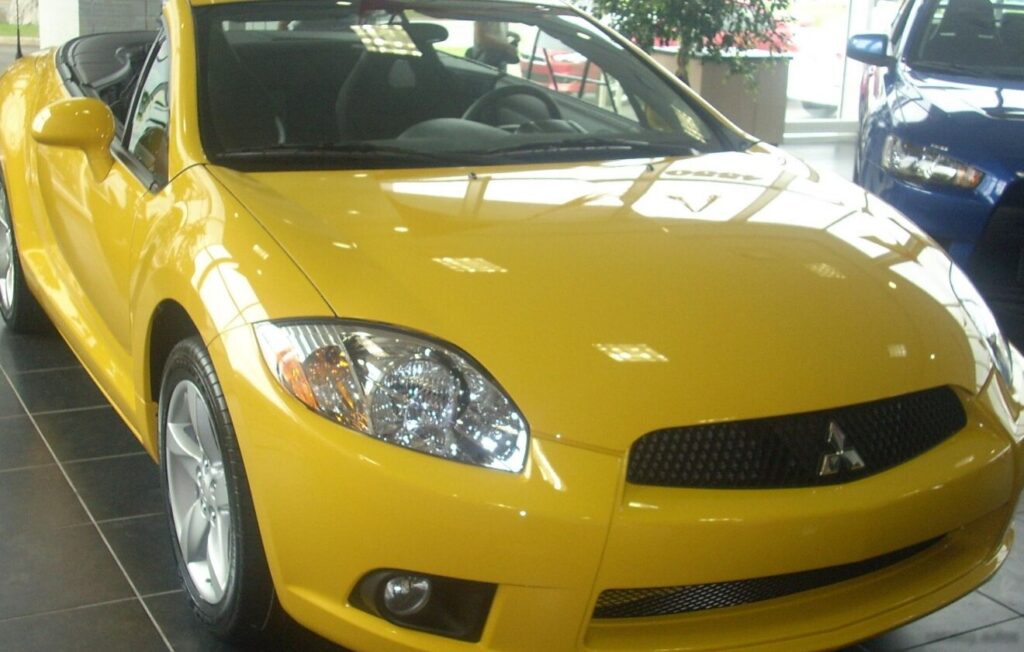
The Mitsubishi Eclipse Spyder IV (4G), specifically the GS 2.4L variant with an automatic transmission, represented a continuation of Mitsubishi’s foray into the affordable convertible market. Produced from 2009 to 2011 as part of the facelifted fourth generation (2006-2011), this model aimed to offer open-air motoring with a blend of style, convenience, and reasonable performance. It occupied a mid-range position within the Spyder lineup, slotting between the base model and potentially more performance-oriented trims, though a dedicated performance variant wasn’t widely offered in the US market. The Spyder IV was built on the PS12 platform, shared with the Galant and other Mitsubishi models, and was primarily targeted at the North American market where convertible sales remained relatively strong.
Technical Specifications
| Brand | Mitsubishi |
| Model | Eclipse |
| Generation | Eclipse Spyder IV (4G, facelift 2009) |
| Type | GS 2.4L (160 Hp) Automatic |
| Start of production | 2009 |
| End of production | 2011 |
| Powertrain Architecture | Internal Combustion engine |
| Body type | Cabriolet |
| Seats | 4 |
| Doors | 2 |
| Fuel consumption (urban) | 12.4 l/100 km (19 US mpg) |
| Fuel consumption (extra urban) | 9 l/100 km (26.1 US mpg) |
| Fuel Type | Petrol (Gasoline) |
| Weight-to-power ratio | 10 kg/Hp |
| Weight-to-torque ratio | 7.5 kg/Nm |
| Power | 160 Hp @ 5500 rpm |
| Power per litre | 67.3 Hp/l |
| Torque | 213 Nm @ 4000 rpm (157.1 lb.-ft. @ 4000 rpm) |
| Engine layout | Front, Transverse |
| Engine Model/Code | 4G69 |
| Engine displacement | 2378 cm3 (145.11 cu. in.) |
| Number of cylinders | 4 |
| Engine configuration | Inline |
| Cylinder Bore | 87 mm (3.43 in.) |
| Piston Stroke | 100 mm (3.94 in.) |
| Compression ratio | 9.5:1 |
| Number of valves per cylinder | 4 |
| Fuel injection system | Multi-port manifold injection |
| Engine aspiration | Naturally aspirated engine |
| Engine oil capacity | 4.3 l (4.54 US qt | 3.78 UK qt) |
| Coolant capacity | 8.7 l (9.19 US qt | 7.65 UK qt) |
| Kerb Weight | 1595 kg (3516.37 lbs.) |
| Trunk (boot) space – maximum | 147 l (5.19 cu. ft.) |
| Fuel tank capacity | 67 l (17.7 US gal | 14.74 UK gal) |
| Length | 4582 mm (180.39 in.) |
| Width | 1834 mm (72.2 in.) |
| Height | 1382 mm (54.41 in.) |
| Wheelbase | 2576 mm (101.42 in.) |
| Front track | 1570 mm (61.81 in.) |
| Rear track | 1570 mm (61.81 in.) |
| Minimum turning circle | 12.2 m (40.03 ft.) |
| Drivetrain Architecture | Front wheel drive |
| Number of gears | 4 |
| Gearbox type | Automatic transmission Sportronic |
| Front suspension | Independent type McPherson |
| Rear suspension | Independent multi-link suspension |
| Front brakes | Ventilated discs, 295 mm |
| Rear brakes | Disc, 262 mm |
| Assisting systems | ABS (Anti-lock braking system) |
| Steering type | Steering rack and pinion |
| Power steering | Hydraulic Steering |
| Tires size | 225/50 R17 |
| Wheel rims size | 17 |
Powertrain & Engine Architecture
The heart of the 2009-2011 Eclipse Spyder GS was the 4G69 2.4-liter inline-four cylinder engine. This engine, a staple in Mitsubishi’s lineup, featured a cast iron block and an aluminum cylinder head. It utilized multi-port fuel injection to deliver fuel to the cylinders, and a single overhead camshaft (SOHC) design operated four valves per cylinder. The 4G69 was known for its relative reliability and straightforward design. The automatic transmission paired with this engine was a four-speed Sportronic unit. This transmission offered a degree of driver control with a manual shift mode, allowing for some engagement beyond fully automatic operation. While not the most advanced transmission available at the time, it was chosen for its cost-effectiveness and suitability for the engine’s power output.
Driving Characteristics
The 160 horsepower and 157 lb-ft of torque produced by the 2.4L engine, when coupled with the four-speed automatic, resulted in adequate, but not exhilarating, performance. Acceleration from 0 to 60 mph was estimated to be around 8-9 seconds. The automatic transmission’s gear ratios were tuned for comfortable cruising rather than aggressive acceleration. Compared to a manual transmission equipped Eclipse Spyder, the automatic version felt noticeably slower, particularly during overtaking maneuvers. The Sportronic mode offered some improvement, allowing the driver to hold gears for longer, but it couldn’t fully compensate for the transmission’s limitations. The focus was on providing a smooth and relaxed driving experience, making it well-suited for everyday commuting and leisurely drives.
Equipment & Trim Levels
The GS trim level of the Eclipse Spyder IV offered a reasonable level of standard equipment. Typically, this included features such as air conditioning, power windows and locks, a CD player with MP3 compatibility, and cruise control. Upholstery was generally cloth, though leather options were available. The Spyder GS also featured a power-operated convertible top, a key selling point. Optional extras could include a premium sound system, alloy wheels, and a sunroof. The interior design was functional and relatively modern for its time, though it didn’t boast the premium materials found in more expensive convertibles.
Chassis & Braking
The Eclipse Spyder IV utilized an independent McPherson strut suspension in the front and an independent multi-link suspension in the rear. This setup provided a comfortable ride quality, absorbing bumps and imperfections in the road reasonably well. The front brakes were ventilated discs, providing adequate stopping power, while the rear brakes were solid discs. Anti-lock braking system (ABS) was standard, enhancing safety. The chassis was reinforced to compensate for the loss of structural rigidity inherent in a convertible design, but some body flex was still noticeable over uneven surfaces. Stabilizer bars were included both front and rear to reduce body roll during cornering.
Market Reception & Comparison
The 2009-2011 Mitsubishi Eclipse Spyder GS 2.4L Automatic received mixed reviews. Critics generally praised its styling and comfortable ride, but often criticized its lack of performance and the dated four-speed automatic transmission. Compared to other convertibles in its price range, such as the Mazda MX-5 Miata (which prioritized handling) or the Ford Mustang Convertible (which offered more power), the Eclipse Spyder occupied a middle ground. Fuel economy was average for the class, with EPA estimates around 19 mpg city and 26 mpg highway. Reliability was generally considered acceptable, though some owners reported issues with the convertible top mechanism and minor electrical glitches.
Legacy
The Mitsubishi Eclipse Spyder IV, including the GS 2.4L Automatic variant, has become a relatively affordable used car option. The 4G69 engine is known for its durability, and with proper maintenance, can provide many years of reliable service. However, potential buyers should be aware of the limitations of the four-speed automatic transmission and the possibility of issues with the convertible top. While it may not offer the performance or refinement of more expensive convertibles, the Eclipse Spyder IV remains a viable option for those seeking an affordable and stylish open-air driving experience. Its place in automotive history is as a representative of Mitsubishi’s attempt to capture a share of the North American convertible market during the late 2000s.