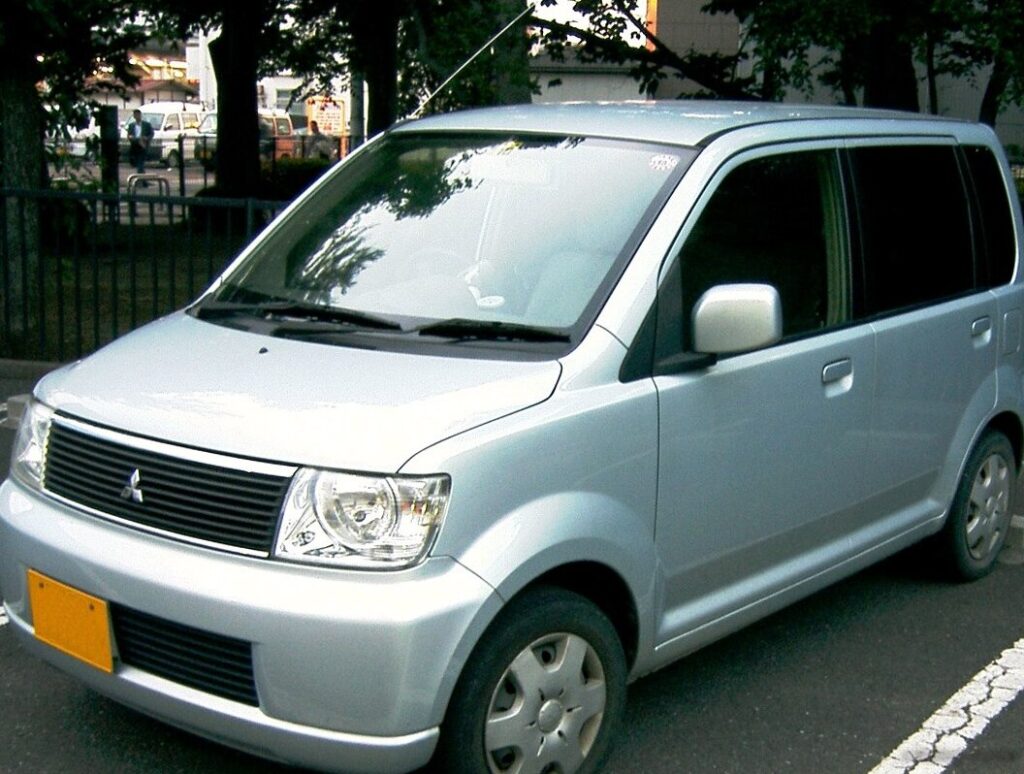
The Mitsubishi eK Wagon, specifically the 0.7 i 12V variant producing 50 horsepower, was a key model in Mitsubishi’s “kei car” lineup, manufactured from 2001 to 2006. This first generation (eK I Wagon) was designed to meet the stringent regulations of the Japanese kei car class, focusing on affordability, fuel efficiency, and compact dimensions. The eK Wagon aimed to provide practical transportation for urban dwellers, and this particular engine and transmission combination represented the entry point into the model range. It was primarily sold within the Japanese domestic market, where kei cars enjoy significant tax and insurance benefits.
Technical Specifications
| Brand | Mitsubishi |
| Model | eK |
| Generation | eK I Wagon |
| Type (Engine) | 0.7 i 12V (50 Hp) |
| Start of production | October, 2001 |
| End of production | 2006 |
| Powertrain Architecture | Internal Combustion engine |
| Body type | Minivan |
| Seats | 4 |
| Doors | 5 |
| Fuel consumption (urban) | 5.75 l/100 km (40.9 US mpg, 49.1 UK mpg, 17.4 km/l) |
| Fuel Type | Petrol (Gasoline) |
| Weight-to-power ratio | 15.8 kg/Hp, 63.3 Hp/tonne |
| Weight-to-torque ratio | 12.7 kg/Nm, 78.5 Nm/tonne |
| Power | 50 Hp @ 6500 rpm |
| Power per litre | 76.1 Hp/l |
| Torque | 62 Nm @ 4000 rpm (45.73 lb.-ft. @ 4000 rpm) |
| Engine layout | Front, Transverse |
| Engine displacement | 657 cm3 (40.09 cu. in.) |
| Number of cylinders | 3 |
| Engine configuration | Inline |
| Cylinder Bore | 65 mm (2.56 in.) |
| Piston Stroke | 66 mm (2.6 in.) |
| Compression ratio | 10.2:1 |
| Number of valves per cylinder | 4 |
| Fuel injection system | Multi-port manifold injection |
| Engine aspiration | Naturally aspirated engine |
| Kerb Weight | 790 kg (1741.65 lbs.) |
| Fuel tank capacity | 30 l (7.93 US gal | 6.6 UK gal) |
| Length | 3395 mm (133.66 in.) |
| Width | 1475 mm (58.07 in.) |
| Height | 1550 mm (61.02 in.) |
| Wheelbase | 2340 mm (92.13 in.) |
| Front track | 1300 mm (51.18 in.) |
| Rear track | 1295 mm (50.98 in.) |
| Minimum turning circle | 8.8 m (28.87 ft.) |
| Drivetrain Architecture | The Internal combustion engine (ICE) drives the front wheels of the vehicle. |
| Drive wheel | Front wheel drive |
| Number of gears and type of gearbox | 3 gears, automatic transmission |
| Front suspension | Coil spring |
| Rear suspension | Coil spring |
| Front brakes | Disc |
| Rear brakes | Drum |
| Assisting systems | ABS (Anti-lock braking system) |
| Steering type | Steering rack and pinion |
| Tires size | 155/65 R13 |
Powertrain & Engine Architecture
The heart of the eK Wagon 0.7 i 12V is a 657cc inline-three cylinder engine, designated as part of Mitsubishi’s engine family. This engine utilizes a multi-port fuel injection system, a relatively simple setup designed for reliability and cost-effectiveness. The 12-valve configuration (four valves per cylinder) helps to optimize breathing and improve efficiency. The engine’s modest output of 50 horsepower at 6500 rpm and 62 Nm (45.73 lb-ft) of torque at 4000 rpm is typical for a kei car engine of this era. It’s paired with a 3-speed automatic transmission, chosen for its ease of use and suitability for urban driving conditions. This transmission was not known for its sporty performance, but rather for its smooth, if somewhat slow, shifts.
Driving Characteristics
The 0.7L engine and 3-speed automatic combination resulted in leisurely acceleration. The eK Wagon was never intended to be a performance vehicle; instead, it prioritized fuel economy and ease of driving. The automatic transmission’s gear ratios were optimized for low-speed maneuverability and maximizing fuel efficiency. Compared to the available manual transmission, the automatic version offered less driver engagement but greater convenience, particularly in congested city traffic. The power delivery was linear, but the engine felt strained when climbing hills or carrying a full load of passengers. The overall driving experience was best described as adequate for its intended purpose – short commutes and errands around town.
Equipment & Trim Levels
The 0.7 i 12V Automatic trim typically represented the base model of the eK Wagon. Standard features included basic air conditioning, power steering, and a simple audio system. Interior upholstery was typically a durable, easy-to-clean cloth. Optional extras, depending on the year and specific package, could include power windows, central locking, and upgraded audio systems. The dashboard layout was functional and straightforward, prioritizing usability over aesthetics. Safety features were relatively basic, with ABS being a notable inclusion, but airbags were often optional or limited to higher trim levels.
Chassis & Braking
The eK Wagon’s chassis was designed to be lightweight and compact, contributing to its fuel efficiency. It utilized a coil spring suspension system at both the front and rear, providing a reasonably comfortable ride, although it wasn’t particularly sporty. The front brakes were discs, offering better stopping power than the drum brakes used on the rear wheels. The relatively light weight of the vehicle helped to compensate for the less powerful braking system. Stabilizer bars were typically absent on the base model, further emphasizing the focus on affordability over handling performance.
Market Reception & Comparison
The Mitsubishi eK Wagon 0.7 i 12V Automatic was generally well-received in the Japanese market as an affordable and practical kei car. Critics praised its fuel efficiency and ease of driving, but noted its lack of power and somewhat basic interior. Compared to other kei car options, such as the Suzuki Wagon R or the Daihatsu Move, the eK Wagon offered a competitive price point and a reputation for reliability. However, the higher-powered versions of the eK Wagon, with larger engines and manual transmissions, were often preferred by drivers who desired a more engaging driving experience.
Legacy
The Mitsubishi eK Wagon 0.7 i 12V, while not a particularly exciting vehicle, played a significant role in Mitsubishi’s kei car success. The powertrain, while simple, proved to be relatively reliable, and many examples are still on the road today. In the used car market, these early eK Wagons are valued for their affordability and low running costs. However, potential buyers should be aware of the age-related issues common to older vehicles, such as corrosion and wear and tear on suspension components. The eK Wagon laid the foundation for subsequent generations of the model, which have continued to evolve and improve upon the original’s strengths.