
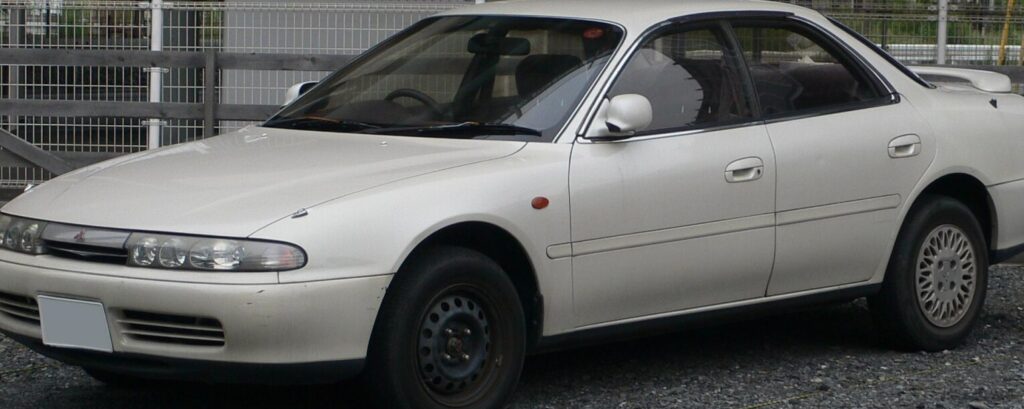
The Mitsubishi Emeraude (E54A) was a mid-size sedan produced by Mitsubishi Motors between 1992 and 1995. Positioned as a comfortable and relatively upscale offering, the Emeraude aimed to compete with established Japanese and European sedans. The 2.0 i V6 24V variant, producing 170 horsepower, represented a significant step up in performance within the Emeraude lineup, offering a more spirited driving experience than the base engine options. It was primarily sold in the Japanese domestic market (JDM), with limited exports to other regions.
Technical Specifications
| Brand | Mitsubishi |
| Model | Emeraude |
| Generation | Emeraude (E54A) |
| Type (Engine) | 2.0 i V6 24V (170 Hp) |
| Start of production | 1992 |
| End of production | 1995 |
| Powertrain Architecture | Internal Combustion engine |
| Body type | Sedan |
| Seats | 5 |
| Doors | 4 |
| Fuel consumption (combined) | 6.5 l/100 km (36.2 US mpg, 43.5 UK mpg, 15.4 km/l) |
| Fuel Type | Petrol (Gasoline) |
| Weight-to-power ratio | 7.6 kg/Hp, 131.8 Hp/tonne |
| Weight-to-torque ratio | 5.4 kg/Nm, 186 Nm/tonne |
| Power | 170 Hp @ 6000 rpm |
| Power per litre | 85.1 Hp/l |
| Torque | 240 Nm @ 5000 rpm (177.01 lb.-ft. @ 5000 rpm) |
| Engine layout | Front, Transverse |
| Engine displacement | 1998 cm3 (121.93 cu. in.) |
| Number of cylinders | 6 |
| Engine configuration | V-engine |
| Cylinder Bore | 78.4 mm (3.09 in.) |
| Piston Stroke | 69 mm (2.72 in.) |
| Compression ratio | 10:1 |
| Number of valves per cylinder | 4 |
| Fuel injection system | Multi-port manifold injection |
| Engine aspiration | Naturally aspirated engine |
| Valvetrain | DOHC |
| Kerb Weight | 1290 kg (2843.96 lbs.) |
| Fuel tank capacity | 64 l (16.91 US gal | 14.08 UK gal) |
| Length | 4610 mm (181.5 in.) |
| Width | 1730 mm (68.11 in.) |
| Height | 1370 mm (53.94 in.) |
| Wheelbase | 2635 mm (103.74 in.) |
| Front track | 1510 mm (59.45 in.) |
| Rear track | 1505 mm (59.25 in.) |
| Drivetrain Architecture | The Internal combustion engine (ICE) drives the front wheels of the vehicle. |
| Drive wheel | Front wheel drive |
| Number of gears and type of gearbox | 5 gears, manual transmission |
| Front suspension | Wishbone |
| Rear suspension | Coil spring |
| Front brakes | Ventilated discs |
| Rear brakes | Ventilated discs |
| Assisting systems | ABS (Anti-lock braking system) |
| Steering type | Steering rack and pinion |
| Power steering | Hydraulic Steering |
| Tires size | 215/60 R15 H |
Powertrain & Engine Architecture
The heart of the Emeraude 2.0 i V6 was the 6A12 engine, a 2.0-liter (1998 cc) naturally aspirated V6. This engine featured a double overhead camshaft (DOHC) valvetrain with four valves per cylinder, contributing to its relatively high output for its displacement. The 6A12 utilized multi-port fuel injection, ensuring precise fuel delivery for optimal combustion. The engine’s 60-degree V-angle provided a good balance between smoothness and compactness. The 5-speed manual transmission was the standard pairing for this engine, offering drivers full control over the power delivery. The transmission was designed for smooth shifts and durability, typical of Japanese engineering of the era.
Driving Characteristics
The 170 horsepower and 240 Nm (177 lb-ft) of torque provided by the 2.0L V6 offered a noticeable improvement in performance compared to the lower-displacement engines available in the Emeraude range. Acceleration was brisk, and the engine felt responsive throughout the rev range. The manual transmission allowed for engaging driving, and the gear ratios were well-suited for both city and highway driving. While not a sports sedan, the 2.0 i V6 Emeraude provided a comfortable and capable driving experience. Compared to the base 1.8L engine, the V6 offered significantly more power, but at the cost of slightly increased fuel consumption. The manual transmission, while engaging, required more driver involvement than the optional automatic transmission found in other Emeraude trims.
Equipment & Trim Levels
The 2.0 i V6 variant of the Emeraude typically came with a reasonably well-equipped interior. Standard features included power windows, power steering, central locking, and an AM/FM radio. Higher trim levels offered options such as air conditioning, a sunroof, upgraded upholstery (often cloth or velour), and a more sophisticated audio system. The dashboard layout was functional and straightforward, prioritizing ease of use. The interior materials were of decent quality, reflecting Mitsubishi’s commitment to providing a comfortable and refined driving environment. The V6 trim often included subtle exterior enhancements, such as alloy wheels and body-colored mirrors.
Chassis & Braking
The Emeraude utilized a front-engine, front-wheel-drive layout. The suspension consisted of a wishbone setup at the front and a coil spring arrangement at the rear. This configuration provided a comfortable ride quality while maintaining reasonable handling characteristics. The braking system featured ventilated discs on all four wheels, providing adequate stopping power. An Anti-lock Braking System (ABS) was included as standard equipment, enhancing safety and control during emergency braking situations. The steering was rack and pinion, offering precise and responsive steering feel. The tires were typically 215/60 R15, providing a good balance between grip and ride comfort.
Market Reception & Comparison
The Mitsubishi Emeraude 2.0 i V6 was generally well-received by Japanese automotive critics. It was praised for its smooth and powerful engine, comfortable ride, and relatively spacious interior. However, some critics noted that its styling was somewhat conservative compared to its rivals. Compared to other sedans in its class, such as the Toyota Corona and Nissan Sentra, the Emeraude offered a compelling combination of performance, comfort, and value. Fuel economy was respectable, averaging around 6.5 l/100 km (36.2 US mpg), but slightly lower than the base 1.8L models. Reliability was generally good, although some owners reported minor issues with the electrical system.
Legacy
The Mitsubishi Emeraude, while not a groundbreaking model, played an important role in establishing Mitsubishi’s reputation for building reliable and well-engineered vehicles. The 2.0 i V6 variant, in particular, is remembered for its smooth and responsive engine. Today, the Emeraude is a relatively rare sight on the roads, but it has gained a following among enthusiasts of classic Japanese cars. The 6A12 engine is known for its durability and relatively simple maintenance requirements. Well-maintained examples of the Emeraude 2.0 i V6 can still provide years of reliable service, and they represent a unique and interesting piece of automotive history. The car’s relative obscurity has also helped to keep parts prices reasonable, making it a potentially affordable classic for those interested in Japanese automotive heritage.
