
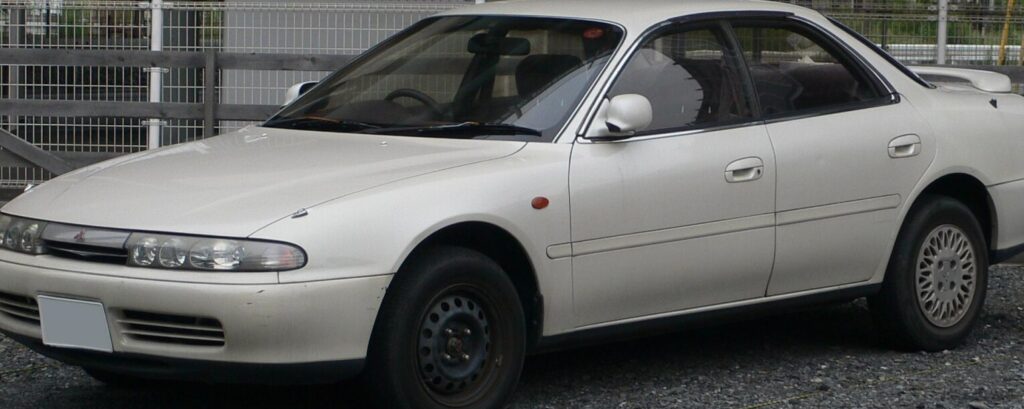
The Mitsubishi Emeraude (E54A) 2.0 i V6 24V Automatic, produced between 1992 and 1995, represented a significant offering in Mitsubishi’s lineup during that period. Positioned as a comfortable and relatively upscale sedan, the Emeraude aimed to compete with established Japanese and European models in the mid-size segment. This particular variant, equipped with the 6A12 2.0-liter V6 engine and a four-speed automatic transmission, was a popular choice for buyers prioritizing smooth operation and convenience over outright performance. The E54A chassis code designates this generation of the Emeraude, which was primarily sold in the Japanese domestic market (JDM) and select export markets.
Technical Specifications
| Brand | Mitsubishi |
| Model | Emeraude |
| Generation | Emeraude (E54A) |
| Type | 2.0 i V6 24V (200 Hp) Automatic |
| Start of production | 1992 |
| End of production | 1995 |
| Powertrain Architecture | Internal Combustion engine |
| Body type | Sedan |
| Seats | 5 |
| Doors | 4 |
| Fuel consumption (combined) | 6.3 l/100 km (37.3 US mpg, 44.8 UK mpg, 15.9 km/l) |
| Fuel Type | Petrol (Gasoline) |
| Weight-to-power ratio | 6.6 kg/Hp, 152.7 Hp/tonne |
| Weight-to-torque ratio | 6.6 kg/Nm, 152.7 Nm/tonne |
| Power | 200 Hp @ 7500 rpm |
| Power per litre | 100.1 Hp/l |
| Torque | 200 Nm @ 6000 rpm (147.51 lb.-ft. @ 6000 rpm) |
| Engine layout | Front, Transverse |
| Engine displacement | 1998 cm3 (121.93 cu. in.) |
| Number of cylinders | 6 |
| Engine configuration | V-engine |
| Cylinder Bore | 78.4 mm (3.09 in.) |
| Piston Stroke | 69 mm (2.72 in.) |
| Compression ratio | 10:1 |
| Number of valves per cylinder | 4 |
| Fuel injection system | Multi-port manifold injection |
| Engine aspiration | Naturally aspirated engine |
| Valvetrain | DOHC |
| Kerb Weight | 1310 kg (2888.06 lbs.) |
| Fuel tank capacity | 64 l (16.91 US gal | 14.08 UK gal) |
| Length | 4610 mm (181.5 in.) |
| Width | 1730 mm (68.11 in.) |
| Height | 1370 mm (53.94 in.) |
| Wheelbase | 2635 mm (103.74 in.) |
| Front track | 1510 mm (59.45 in.) |
| Rear track | 1505 mm (59.25 in.) |
| Drivetrain Architecture | Front wheel drive, Internal Combustion engine (ICE) |
| Drive wheel | Front wheel drive |
| Number of gears and type of gearbox | 4 gears, automatic transmission |
| Front suspension | Coil spring |
| Rear suspension | Coil spring |
| Front brakes | Ventilated discs |
| Rear brakes | Disc |
| Assisting systems | ABS (Anti-lock braking system) |
| Steering type | Steering rack and pinion |
| Power steering | Hydraulic Steering |
| Tires size | 205/60 R15 H |
| Wheel rims size | 15 |
Powertrain & Engine Architecture
The heart of the Emeraude 2.0 i V6 Automatic is Mitsubishi’s 6A12 engine. This 1998cc, 24-valve, double overhead camshaft (DOHC) V6 is a naturally aspirated powerplant known for its smooth operation and relatively high output for its displacement. The engine utilizes multi-port fuel injection, contributing to efficient combustion and responsive throttle control. The 6A12 engine was a mainstay in several Mitsubishi vehicles of the era, appreciated for its durability and refinement. Paired with this engine is a four-speed automatic transmission, designed to provide comfortable and effortless shifting. While not offering the sporty engagement of a manual gearbox, the automatic transmission was well-suited to the Emeraude’s intended role as a comfortable cruiser.
Driving Characteristics
The 200 horsepower and 200 Nm (147.51 lb-ft) of torque delivered by the 6A12 engine, when channeled through the four-speed automatic, resulted in a driving experience focused on smooth acceleration and relaxed cruising. Compared to the manual transmission versions of the Emeraude, or those equipped with the smaller 1.8-liter engine, the 2.0 V6 Automatic offered noticeably more power, particularly during highway merging and overtaking maneuvers. However, the automatic transmission did slightly diminish the engine’s responsiveness, and fuel economy was somewhat lower than the manual variants. The gear ratios were tuned for comfort rather than outright performance, prioritizing smooth transitions between gears.
Equipment & Trim Levels
The Emeraude 2.0 i V6 Automatic typically came well-equipped, reflecting its position as a higher-end trim level. Standard features often included power windows, power locks, air conditioning, and a quality audio system. Interior upholstery was typically cloth, though leather options were available. Dashboard design was functional and aesthetically pleasing for the early 1990s, with a focus on ease of use. Optional extras could include a sunroof, upgraded audio systems, and alloy wheels. The level of equipment varied slightly depending on the specific market and package selected.
Chassis & Braking
The Emeraude E54A utilized a front-engine, front-wheel-drive layout. Suspension consisted of coil springs all around, providing a comfortable ride quality. The front suspension featured MacPherson struts, while the rear employed a multi-link setup. Braking duties were handled by ventilated discs at the front and solid discs at the rear. An Anti-lock Braking System (ABS) was standard, enhancing safety and control during hard braking situations. Steering was rack and pinion, assisted by hydraulic power steering for ease of maneuverability.
Market Reception & Comparison
The Mitsubishi Emeraude 2.0 i V6 Automatic was generally well-received by automotive critics in Japan. It was praised for its smooth engine, comfortable ride, and relatively spacious interior. However, some reviewers noted that the automatic transmission could feel slightly sluggish compared to manual options. In terms of fuel economy, it was comparable to other V6-powered sedans of the era, but less efficient than four-cylinder alternatives. Compared to rivals like the Toyota Camry or Honda Accord, the Emeraude offered a slightly more distinctive styling and a focus on refinement.
Legacy
The Mitsubishi Emeraude, while not a global sales phenomenon, holds a respectable position among enthusiasts of 1990s Japanese cars. The 6A12 V6 engine is known for its reliability when properly maintained, and parts availability remains reasonable. The automatic transmission, while not particularly advanced, is generally durable. Today, well-maintained examples of the Emeraude 2.0 i V6 Automatic are sought after by collectors and enthusiasts who appreciate its classic styling, smooth driving experience, and the distinctive sound of the V6 engine. The car represents a snapshot of Japanese automotive engineering from a period of rapid technological advancement and increasing refinement.
