
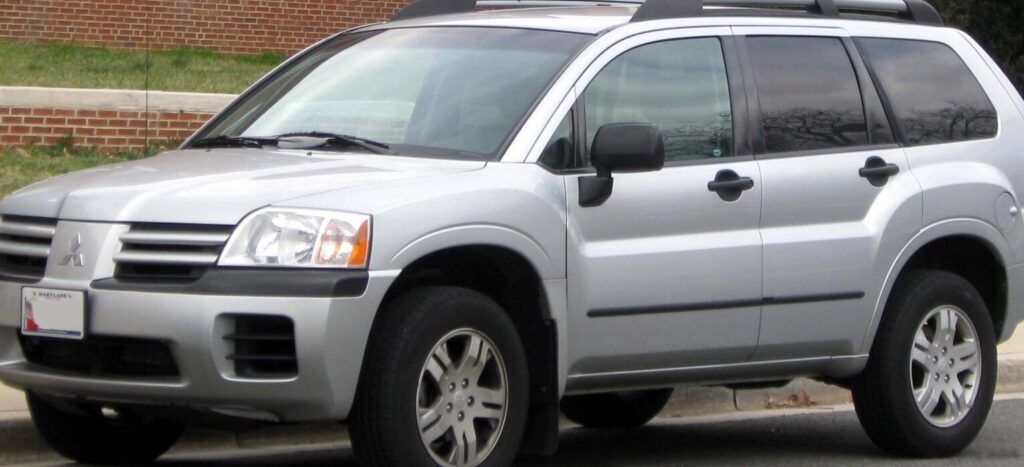
The Mitsubishi Endeavor, produced for the 2004 and 2005 model years, was a mid-size SUV designed to fill a gap in Mitsubishi’s North American lineup. Positioned between the compact Outlander and the larger Montero, the Endeavor aimed to provide a comfortable and capable vehicle for families. The 3.8 i V6 24V 2WD variant, equipped with a 3.8-liter V6 engine and a five-speed automatic transmission, represented a significant portion of Endeavor sales, offering a balance of power and affordability. It was built on the PS platform, shared with the Dodge Durango and Chrysler Aspen, reflecting a period of collaboration between the Mitsubishi and DaimlerChrysler corporations.
Technical Specifications
| Brand | Mitsubishi |
| Model | Endeavor |
| Generation | Endeavor |
| Type (Engine) | 3.8 i V6 24V 2WD (218 Hp) |
| Start of production | 2003 year |
| End of production | 2004 year |
| Powertrain Architecture | Internal Combustion engine |
| Body type | SUV |
| Seats | 5 |
| Doors | 5 |
| Fuel consumption (economy) – urban | 13.9 l/100 km (16.9 US mpg) |
| Fuel consumption (economy) – extra urban | 10.2 l/100 km (23.1 US mpg) |
| Fuel Type | Petrol (Gasoline) |
| Acceleration 0 – 100 km/h | 9.4 sec |
| Acceleration 0 – 62 mph | 9.4 sec |
| Acceleration 0 – 60 mph | 8.9 sec |
| Maximum speed | 180 km/h (111.85 mph) |
| Weight-to-power ratio | 8.2 kg/Hp |
| Weight-to-torque ratio | 5.3 kg/Nm |
| Power | 218 Hp @ 5000 rpm |
| Torque | 339 Nm @ 3750 rpm (250.03 lb.-ft. @ 3750 rpm) |
| Engine layout | Front, Longitudinal |
| Engine Model/Code | 6G75 |
| Engine displacement | 3828 cm3 (233.6 cu. in.) |
| Number of cylinders | 6 |
| Engine configuration | V-engine |
| Cylinder Bore | 95 mm (3.74 in.) |
| Piston Stroke | 90 mm (3.54 in.) |
| Compression ratio | 10:1 |
| Number of valves per cylinder | 4 |
| Fuel injection system | Multi-port manifold injection |
| Engine aspiration | Naturally aspirated engine |
| Valvetrain | OHC |
| Engine oil capacity | 4.3 l (4.54 US qt | 3.78 UK qt) |
| Coolant | 9 l (9.51 US qt | 7.92 UK qt) |
| Kerb Weight | 1795 kg (3957.3 lbs.) |
| Trunk (boot) space – minimum | 1153 l (40.72 cu. ft.) |
| Trunk (boot) space – maximum | 2164 l (76.42 cu. ft.) |
| Fuel tank capacity | 81 l (21.4 US gal | 17.82 UK gal) |
| Length | 4830 mm (190.16 in.) |
| Width | 1870 mm (73.62 in.) |
| Height | 1768 mm (69.61 in.) |
| Wheelbase | 2750 mm (108.27 in.) |
| Front track | 1600 mm (62.99 in.) |
| Rear (Back) track | 1600 mm (62.99 in.) |
| Drivetrain Architecture | The Internal combustion engine (ICE) drives the rear wheels of the vehicle. |
| Drive wheel | Rear wheel drive |
| Number of gears and type of gearbox | 5 gears, automatic transmission |
| Front suspension | Spring Strut |
| Rear suspension | Coil spring |
| Front brakes | Disc |
| Rear brakes | Disc |
| Assisting systems | ABS (Anti-lock braking system) |
| Tires size | P235/65 R17 |
| Wheel rims size | 7J x 17 |
Powertrain & Engine Architecture
The heart of the Endeavor 3.8 i V6 2WD is the 6G75 engine, a 3.8-liter, naturally aspirated V6. This engine, part of Mitsubishi’s 6G7 series, features a cast iron block and aluminum cylinder heads. It utilizes a SOHC (Single Overhead Cam) valvetrain with four valves per cylinder. Fuel delivery is managed by a multi-point fuel injection system, providing adequate fuel atomization for efficient combustion. The engine produces 218 horsepower at 5000 rpm and 250 lb-ft of torque at 3750 rpm. The five-speed automatic transmission, sourced from Mitsubishi, was chosen for its smooth operation and suitability for everyday driving. While not a performance-oriented transmission, it provided acceptable acceleration and cruising ability. The transmission’s gear ratios were tuned for a balance between fuel economy and responsiveness.
Driving Characteristics
The Endeavor 3.8 i V6 2WD offered a comfortable and predictable driving experience. The 3.8-liter V6 provided sufficient power for most driving situations, including highway merging and passing. However, it wasn’t particularly quick, with a 0-60 mph time of around 8.9 seconds. Compared to the higher-output versions of the Endeavor (which were not widely available in the US market), the 3.8-liter engine felt less energetic. The automatic transmission, while smooth, could sometimes feel hesitant during downshifts. The rear-wheel-drive configuration contributed to a more balanced feel compared to the all-wheel-drive models, but it also meant less traction in inclement weather. The suspension was tuned for comfort, resulting in a relatively soft ride, but it could also exhibit some body roll during cornering.
Equipment & Trim Levels
The Endeavor 3.8 i V6 2WD typically came standard with features such as air conditioning, power windows and locks, a CD player, and cloth upholstery. Higher trim levels, such as the Limited, added features like leather upholstery, a sunroof, upgraded audio systems, and alloy wheels. Optional extras included a navigation system and a rear entertainment system. The interior design was functional and straightforward, with a focus on practicality rather than luxury. The dashboard layout was clean and easy to use, with well-placed controls.
Chassis & Braking
The Endeavor’s chassis featured an independent front suspension with coil springs and a multi-link rear suspension, also with coil springs. This setup provided a reasonably comfortable ride, but it wasn’t particularly sporty. The braking system consisted of disc brakes on all four wheels, along with ABS (Anti-lock Braking System) as standard equipment. The brakes were adequate for everyday driving, but they lacked the stopping power of some competitors. The rear-wheel-drive configuration contributed to a slightly more stable braking feel compared to the all-wheel-drive models.
Market Reception & Comparison
The Mitsubishi Endeavor received mixed reviews from automotive critics. While praised for its comfortable ride and spacious interior, it was often criticized for its lack of performance and its somewhat dated design. Compared to competitors like the Honda Pilot and Toyota Highlander, the Endeavor was generally considered to be less refined and less engaging to drive. However, it offered a more affordable price point, making it an attractive option for budget-conscious buyers. Fuel economy was average for its class, with EPA estimates of around 16 mpg city and 23 mpg highway. Reliability was generally considered to be acceptable, but some owners reported issues with the automatic transmission.
Legacy
The Mitsubishi Endeavor was discontinued after only two model years, due in part to slow sales and the changing market dynamics of the mid-size SUV segment. While it didn’t achieve widespread popularity, the Endeavor remains a relatively affordable and capable used SUV. The 6G75 engine is known for its durability and reliability, and the five-speed automatic transmission, while not perfect, is generally considered to be dependable. Today, the Endeavor 3.8 i V6 2WD can be found in the used car market at attractive prices, making it a viable option for buyers seeking a spacious and comfortable SUV on a budget. However, potential buyers should be aware of the possibility of transmission issues and should carefully inspect any vehicle before making a purchase.
