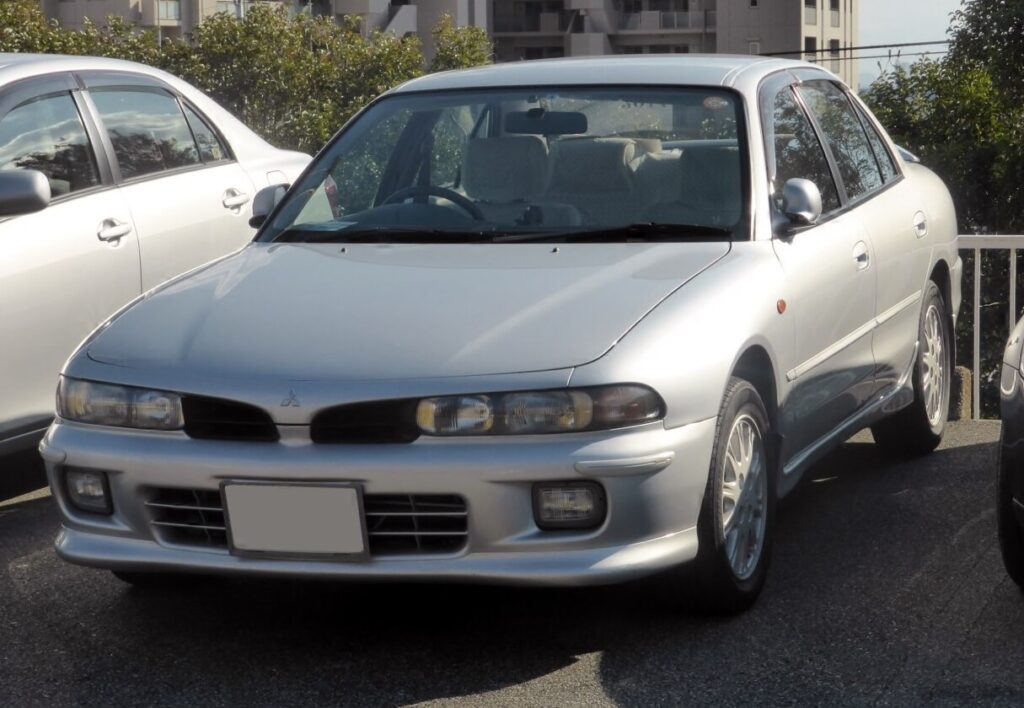
The Mitsubishi Galant VII 2.0 GLSI (E55A), produced between 1992 and 1996, represented a significant evolution in Mitsubishi’s mid-size sedan offerings. Part of the broader Galant VII generation (1992-1996), the E55A chassis code specifically denotes the 2.0-liter gasoline engine paired with a four-speed automatic transmission. This variant occupied a middle ground within the Galant VII lineup, offering a balance between performance, comfort, and affordability, positioned above the base models and below the more powerful and often sport-oriented trims.
Powertrain & Engine Architecture
The heart of the 2.0 GLSI is the Mitsubishi 4G63 inline-four cylinder engine, displacing 1,997 cc (121.86 cubic inches). While the 4G63 engine family is renowned for its robustness and tuning potential (particularly in its turbocharged forms found in the Mitsubishi Lancer Evolution), the naturally aspirated version in the Galant VII GLSI was tuned for smooth, reliable operation rather than outright performance. It produced 137 horsepower at 6000 rpm and 176 Nm (129.81 lb-ft) of torque at 4750 rpm. The engine featured a multi-port fuel injection system, providing precise fuel delivery for improved efficiency and reduced emissions. The valvetrain employed a single overhead camshaft (OHC) design, operating four valves per cylinder.
The automatic transmission used in the 2.0 GLSI is a conventional four-speed unit. While not offering the responsiveness of a manual transmission, it provided ease of use, particularly appealing to buyers prioritizing comfort and convenience. Gear ratios were optimized for everyday driving conditions, prioritizing smooth acceleration and fuel economy over aggressive performance. Specific gear ratios varied slightly depending on the exact production year and regional specifications, but generally aimed for a balance between initial acceleration and highway cruising.
Engine Codes and Variations
While the core 4G63 engine remained consistent, minor variations existed based on the target market. These variations primarily concerned emissions control equipment and slight adjustments to fuel injection mapping. However, the fundamental engine architecture and performance characteristics remained largely unchanged across different regions.
Driving Characteristics
The 1992-1996 Mitsubishi Galant VII 2.0 GLSI with the automatic transmission delivered a comfortable and predictable driving experience. Acceleration from 0 to 60 mph took approximately 9.2-9.7 seconds, and it could achieve a top speed of around 127.38 mph (205 km/h). Compared to the manual transmission versions of the 2.0-liter engine, the automatic resulted in a slight performance decrease due to the inherent power loss within the torque converter and the transmission’s shift programming. However, the automatic offered a more relaxed driving experience, particularly in city traffic.
The automatic transmission’s shift points were calibrated for smooth transitions, but could sometimes feel hesitant during quick acceleration maneuvers. The engine provided adequate power for everyday driving, including highway merging and overtaking, but lacked the responsiveness of the higher-output engines available in other Galant VII trims. The weight-to-power ratio of 9.4 kg/hp indicated a reasonable, though not exceptional, level of performance.
Equipment & Trim Levels
The 2.0 GLSI trim level offered a good level of standard equipment for its time. Typically, it included features such as power windows, power door locks, air conditioning, and an AM/FM stereo. Interior upholstery was generally cloth, with options for upgraded materials available. The dashboard layout was functional and straightforward, prioritizing ease of use over elaborate styling. Optional extras included a sunroof, upgraded audio systems, and alloy wheels. The GLSI trim generally represented a step up from the base models, offering a more refined interior and a greater level of convenience features.
Chassis & Braking
The Galant VII utilized a front-engine, front-wheel-drive layout. The suspension system employed a double wishbone configuration at the front and a spring strut setup at the rear. This suspension design provided a comfortable ride quality while maintaining reasonable handling characteristics. The front brakes were ventilated discs, offering good stopping power, while the rear brakes were typically solid discs. Anti-lock braking system (ABS) was standard equipment on the 2.0 GLSI, enhancing safety by preventing wheel lockup during hard braking. The steering system was a rack and pinion setup with hydraulic power assistance, providing precise and responsive steering feel. The vehicle rode on 195/65 R14 tires mounted on 14-inch wheels.
Market Reception & Comparison
The Mitsubishi Galant VII 2.0 GLSI Automatic was generally well-received by automotive critics as a practical and reliable mid-size sedan. It was praised for its comfortable ride, spacious interior, and reasonable fuel economy (approximately 8.3 l/100 km combined, or 28.3 US mpg). However, some critics noted that the automatic transmission detracted slightly from the engine’s performance, and that the interior styling was somewhat conservative compared to some of its competitors.
Compared to other trims in the Galant VII lineup, such as the VR-4 (with its turbocharged engine and all-wheel drive), the 2.0 GLSI Automatic offered a more affordable and fuel-efficient option. It appealed to buyers who prioritized comfort and practicality over outright performance. Compared to the diesel variants, the 2.0 GLSI offered a smoother and quieter driving experience, but at the expense of fuel economy. The 2.0 GLSI Automatic competed with other mid-size sedans such as the Honda Accord, Toyota Camry, and Nissan Maxima.
Technical Specifications
| Brand | Mitsubishi |
| Model | Galant |
| Generation | Galant VII |
| Type | 2.0 GLSI (E55A) Automatic |
| Start of production | 1992 |
| End of production | 1996 |
| Engine Type | Internal Combustion Engine (Petrol/Gasoline) |
| Body Type | Sedan |
| Number of Seats | 5 |
| Number of Doors | 4 |
| Fuel Consumption (Combined) | 8.3 l/100 km (28.3 US mpg) |
| Fuel Type | Petrol (Gasoline) |
| 0-100 km/h | 9.7 sec |
| 0-60 mph | 9.2 sec |
| Maximum Speed | 205 km/h (127.38 mph) |
| Kerb Weight | 1291 kg (2846.17 lbs) |
| Max Weight | 1760 kg (3880.14 lbs) |
| Engine Displacement | 1997 cm3 (121.86 cu. in.) |
| Number of Cylinders | 4 |
| Engine Configuration | Inline |
| Cylinder Bore | 85 mm (3.35 in) |
| Piston Stroke | 88 mm (3.46 in) |
| Compression Ratio | 10:1 |
| Fuel Injection System | Multi-port Fuel Injection |
| Valvetrain | OHC |
| Power | 137 Hp @ 6000 rpm |
| Torque | 176 Nm (129.81 lb-ft) @ 4750 rpm |
| Transmission | 4-speed Automatic |
| Drive Wheels | Front Wheel Drive |
| Front Suspension | Double Wishbone |
| Rear Suspension | Spring Strut |
| Front Brakes | Ventilated Discs |
| Rear Brakes | Discs |
| Tire Size | 195/65 R14 |
Legacy
The Mitsubishi Galant VII 2.0 GLSI Automatic, while not the most exciting variant in the lineup, proved to be a reliable and durable vehicle. The 4G63 engine, even in its naturally aspirated form, is known for its longevity and relatively simple maintenance requirements. Today, well-maintained examples of the 2.0 GLSI Automatic are becoming increasingly rare, but can still be found in the used car market. They are often sought after by enthusiasts looking for a classic Japanese sedan that offers a comfortable ride and a reasonable level of reliability. While parts availability may be a concern, the 4G63 engine’s widespread use in other Mitsubishi models ensures that many components remain readily accessible. The Galant VII 2.0 GLSI Automatic represents a solid and dependable choice for those seeking a classic mid-size sedan from the 1990s.