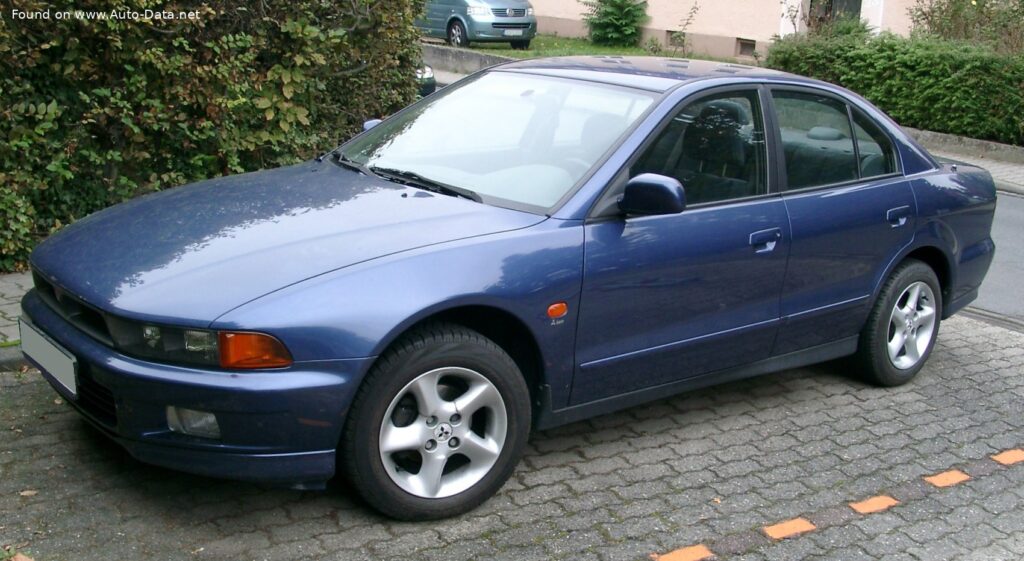
The Mitsubishi Galant VIII 2.5 24V Automatic, produced between 1996 and 2001, represented a significant step forward for Mitsubishi’s mid-size sedan offering. Part of the eighth generation of the Galant (internally designated the 1HX0/A3 platform), this variant occupied a mid-range position within the lineup, offering a balance of performance, comfort, and features. It served as a more upscale alternative to the base model 2.0-liter engines, while remaining more accessible than the later, more performance-focused options like the turbocharged variants available in some markets. The 2.5 24V Automatic was aimed at buyers seeking a refined and reliable family sedan with adequate power for highway cruising and everyday driving.
Powertrain & Engine Architecture
At the heart of the Galant VIII 2.5 24V Automatic lies the 6A13 engine, a 2.5-liter (2498 cc) naturally aspirated V6. This engine is characterized by its all-aluminum construction, contributing to a relatively lightweight design. The “24V” designation refers to the four valves per cylinder (totaling 24 valves), enhancing volumetric efficiency and contributing to improved power output. The 6A13 utilizes a single overhead camshaft (SOHC) valvetrain, a design choice that prioritized simplicity and reliability over the more complex double overhead camshaft (DOHC) setups found in some competing engines.
Fuel delivery is managed by a multi-port fuel injection (MPI) system, ensuring precise fuel atomization and distribution to each cylinder. The engine boasts a compression ratio of 9.5:1, a figure that strikes a balance between performance and the ability to run on readily available gasoline grades. The engine produces 163 horsepower at 5750 rpm and 223 Nm (164.48 lb-ft) of torque at 4500 rpm. Power per liter is a respectable 65.3 hp/l.
The engine is mated to a four-speed automatic transmission. While not the most modern transmission by today’s standards, it was a reliable unit designed for smooth operation and ease of use. The transmission’s gear ratios were tuned to provide a comfortable driving experience, prioritizing acceleration from a standstill and smooth highway cruising. Specific gear ratios varied slightly depending on the market, but generally focused on maximizing fuel efficiency and minimizing engine strain during typical driving conditions.
Engine Code Specifics
The 6A13 engine code is central to identifying this specific powertrain. Mitsubishi used engine codes to differentiate between variations of the same basic engine design. The 6A13 was known for its durability and relatively straightforward maintenance requirements. Unlike some contemporary engines, it did not employ complex variable valve timing systems, simplifying its mechanical design and potentially increasing long-term reliability.
Driving Characteristics
The Galant VIII 2.5 24V Automatic offered a comfortable and refined driving experience. Acceleration from 0-60 mph was achieved in approximately 9.4-9.9 seconds, and it could reach a top speed of 215 km/h (133.59 mph). While not a sports sedan, the V6 engine provided ample power for merging onto highways and overtaking slower traffic. The automatic transmission contributed to a smooth and effortless driving experience, particularly in urban environments.
Compared to the base 2.0-liter models, the 2.5 V6 offered a noticeable improvement in acceleration and overall responsiveness. However, it wasn’t as sporty or engaging as the manual transmission variants or the turbocharged models available in some markets. The automatic transmission, while convenient, did result in some power loss compared to the manual, and its four-speed configuration meant it lacked the close gear ratios of more modern transmissions. The weight-to-power ratio of 8.7 kg/Hp and weight-to-torque ratio of 6.4 kg/Nm reflected a reasonable balance between engine output and vehicle mass.
Equipment & Trim Levels
The Galant VIII 2.5 24V Automatic typically came equipped with a range of standard features designed to enhance comfort and convenience. These included power windows, power door locks, air conditioning, and an AM/FM stereo system. Higher trim levels often added features such as a sunroof, upgraded upholstery (typically cloth or velour), alloy wheels, and a more sophisticated audio system. Leather upholstery was available as an option on some models.
The dashboard layout was functional and ergonomically designed, with easy-to-read gauges and intuitive controls. Interior color schemes typically consisted of neutral tones such as gray, beige, and black. Optional extras included a CD player, cruise control, and a rear window defroster. Safety features included standard anti-lock brakes (ABS), a driver’s airbag, and a passenger’s airbag on later models.
Chassis & Braking
The Galant VIII featured a front-engine, front-wheel-drive layout. The suspension system consisted of independent front suspension with multiple levers and rods, and a multi-link rear suspension, designed to provide a comfortable ride and stable handling. The front suspension geometry was tuned to minimize body roll during cornering, while the rear suspension aimed to absorb bumps and irregularities in the road surface.
Braking duties were handled by ventilated discs on the front wheels and solid discs on the rear wheels. The ABS system helped to prevent wheel lockup during hard braking, enhancing stability and control. Steering was provided by a hydraulic power steering system, offering a balance of assistance and feedback. The Galant VIII 2.5 24V Automatic typically rode on 205/60 R15 tires mounted on 15-inch steel or alloy wheels.
Market Reception & Comparison
The Mitsubishi Galant VIII 2.5 24V Automatic was generally well-received by automotive critics. It was praised for its comfortable ride, spacious interior, and reliable V6 engine. However, some critics noted that its styling was somewhat conservative compared to some of its competitors. Fuel economy was considered average for its class, with combined fuel consumption of around 8 l/100 km (29.4 US mpg).
Compared to other trims in the Galant lineup, the 2.5 V6 Automatic offered a significant performance upgrade over the base 2.0-liter models. It was also more refined and better equipped. However, it was less fuel-efficient and more expensive than the 2.0-liter variants. Compared to competitors like the Honda Accord and Toyota Camry, the Galant offered a unique blend of Japanese reliability and V6 power, but often lacked the brand recognition of its rivals.
Technical Specifications
| Brand | Mitsubishi |
| Model | Galant |
| Generation | Galant VIII |
| Type | 2.5 24V (163 Hp) Automatic |
| Start of production | 1996 |
| End of production | 2001 |
| Engine Type | Internal Combustion engine |
| Body type | Sedan |
| Seats | 5 |
| Doors | 4 |
| Fuel consumption (urban) | 13.3 l/100 km (17.7 US mpg) |
| Fuel consumption (extra urban) | 7.2 l/100 km (32.7 US mpg) |
| Fuel consumption (combined) | 8 l/100 km (29.4 US mpg) |
| Fuel Type | Petrol (Gasoline) |
| Acceleration 0 – 100 km/h | 9.9 sec |
| Acceleration 0 – 62 mph | 9.9 sec |
| Acceleration 0 – 60 mph | 9.4 sec |
| Maximum speed | 215 km/h (133.59 mph) |
| Kerb Weight | 1420 kg (3130.56 lbs) |
| Max. weight | 1880 kg (4144.69 lbs) |
| Engine Displacement | 2498 cm3 (152.44 cu. in.) |
| Number of cylinders | 6 |
| Engine configuration | V-engine |
| Compression ratio | 9.5:1 |
| Fuel injection system | Multi-port manifold injection |
| Number of gears | 4 |
| Gearbox type | Automatic transmission |
Legacy
The Mitsubishi Galant VIII 2.5 24V Automatic has proven to be a relatively reliable vehicle in the used car market. The 6A13 engine is known for its durability, and the automatic transmission, while not cutting-edge, is generally dependable. Common maintenance issues include routine servicing of the cooling system, timing belt replacement (if applicable, depending on model year), and occasional sensor failures. Parts availability is generally good, although some specific components may be becoming increasingly difficult to source. Today, the Galant VIII 2.5 24V Automatic represents an affordable and practical option for buyers seeking a comfortable and reliable mid-size sedan with a V6 engine.