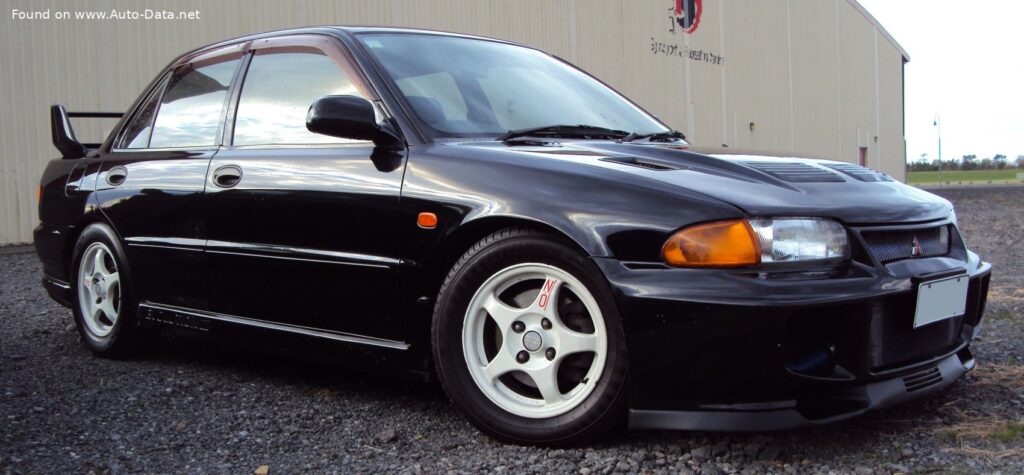
The Mitsubishi Lancer Cedia 1.8i 16V represents a significant evolution in Mitsubishi’s Lancer line, specifically developed for the Japanese domestic market (JDM) and select Asian regions. Launched in 2000 and produced until 2004, the Lancer Cedia, an acronym often interpreted as “Century Diamond,” aimed to elevate the Lancer’s perception from a utilitarian compact car to a more refined and technologically advanced sedan. This particular variant, equipped with the 1.8-liter 16-valve engine delivering 125 horsepower, was a cornerstone of the Cedia lineup, emphasizing efficiency and a smooth driving experience tailored for urban and highway commuting.
Unlike its more performance-oriented siblings like the Lancer Evolution, which gained global fame, the Lancer Cedia focused on comfort, practicality, and advanced engine technology for its segment. It was positioned as a sophisticated compact sedan, offering a blend of modern design, enhanced interior amenities, and pioneering direct injection technology that set it apart from many of its contemporaries in its primary markets. While the Lancer Cedia was not officially sold in the United States, its mechanical underpinnings and technological innovations influenced subsequent global Lancer models, making it a crucial, albeit regionally focused, chapter in the Lancer’s history and a testament to Mitsubishi’s engineering capabilities in the early 2000s.
Powertrain & Engine Architecture: The 4G93 GDI
At the core of the Mitsubishi Lancer Cedia 1.8i 16V lies the advanced 4G93 engine, a 1.8-liter (1834 cubic centimeters or 111.92 cubic inches) inline four-cylinder powertrain. This engine was particularly notable for its adoption of Gasoline Direct Injection (GDI) technology, a relatively sophisticated feature for a compact sedan in the early 2000s. With a high compression ratio of 12.5:1, typical of GDI engines seeking to maximize thermal efficiency, the 4G93 produced a respectable 125 horsepower at 5500 rpm. This output, coupled with 174 Newton-meters (128.34 lb-ft) of torque peaking at a relatively low 3750 rpm, provided the Lancer Cedia with ample power for daily driving and respectable acceleration, particularly in its target markets where fuel efficiency was highly valued.
The 4G93 engine is a naturally aspirated unit, utilizing a Double Overhead Camshaft (DOHC) valvetrain with four valves per cylinder, totaling 16 valves. This configuration ensures efficient breathing and combustion across the rev range, contributing to both performance and fuel economy. Mitsubishi was a pioneer in bringing GDI technology to mass-market vehicles, aiming to deliver superior fuel economy and lower emissions without compromising performance. The direct injection system precisely meters fuel directly into the combustion chamber, allowing for leaner burn strategies and improved power output per liter (68.2 Hp/l in this case). The engine’s layout is front, transverse, driving the front wheels, a standard configuration for compact sedans of its era, optimizing interior space and manufacturing efficiency. The engine oil capacity is 3.8 liters (4.02 US quarts).
The Automatic Transmission
The Lancer Cedia 1.8i 16V was typically paired with a four-speed automatic transmission. This transmission, while not offering the most modern gear count by today’s standards, was designed for smooth and reliable operation. It featured electronically controlled hydraulic actuation for shift selection, contributing to refined gear changes. The gear ratios were optimized for fuel efficiency and comfortable cruising, rather than aggressive acceleration. First gear was relatively short for quick take-off, while higher gears were spaced to maintain low engine speeds at highway speeds. The transmission’s torque converter provided smooth launches and aided in low-speed maneuverability. While a five-speed manual transmission was available on other Cedia models, the four-speed automatic was the predominant choice for this specific 1.8L variant, catering to buyers prioritizing ease of use over outright performance.
Driving Characteristics
The 1.8L GDI engine and four-speed automatic combination in the Lancer Cedia delivered a driving experience focused on refinement and fuel economy. Acceleration was adequate for everyday driving, but noticeably slower than the more powerful 2.0L variants or those equipped with a manual transmission. The GDI engine provided a relatively flat torque curve, meaning usable power was available across a broad range of engine speeds. However, the automatic transmission’s shift points were programmed for efficiency, sometimes resulting in the engine feeling slightly strained during overtaking maneuvers. Compared to the manual transmission, the automatic version offered a more relaxed driving experience, particularly in congested urban environments. The suspension was tuned for comfort, absorbing bumps and imperfections in the road surface effectively. Steering was light and precise, making the Cedia easy to maneuver. Overall, the driving experience was geared towards providing a comfortable and hassle-free commute.
Equipment & Trim Levels
The Mitsubishi Lancer Cedia 1.8i 16V was offered in various trim levels depending on the specific market. Standard equipment typically included power windows and door locks, air conditioning, and a basic audio system. Higher trim levels added features such as alloy wheels, a more sophisticated audio system with CD player, automatic climate control, and upgraded interior upholstery. Interior materials ranged from cloth to more premium fabrics, depending on the trim level. The dashboard layout was functional and user-friendly, with clearly labeled controls. Optional extras could include a sunroof, fog lights, and a rear spoiler. Safety features, such as dual front airbags and an anti-lock braking system (ABS), were often standard or available as options, depending on the market.
Chassis & Braking
The Lancer Cedia 1.8i 16V utilized a MacPherson strut front suspension and a multi-link rear suspension. This setup provided a good balance of ride comfort and handling. The front suspension featured coil springs and a stabilizer bar to reduce body roll during cornering. The rear suspension also employed coil springs and a stabilizer bar. Braking duties were handled by ventilated disc brakes at the front and drum brakes at the rear. ABS was often included as standard equipment or an optional extra. The chassis was designed to provide a stable and predictable driving experience, prioritizing comfort and safety over outright sportiness. The steering system was a rack-and-pinion type, providing precise and responsive steering feel.
Market Reception & Comparison
The Mitsubishi Lancer Cedia 1.8i 16V was generally well-received in its target markets, particularly in Japan and other Asian countries. Critics praised its fuel efficiency, comfortable ride, and advanced GDI technology. However, some reviewers noted that its performance was not as exciting as some of its rivals, particularly those with larger engines or manual transmissions. Compared to the 2.0L Lancer Cedia variants, the 1.8L model offered better fuel economy but less power. Compared to the Lancer Evolution, the Cedia 1.8i 16V was a completely different vehicle, focused on practicality and comfort rather than high-performance driving. The 1.8L GDI engine offered competitive fuel economy compared to conventional port-injected engines of the same displacement. Reliability was generally good, although some owners reported issues with the GDI fuel injectors over time.
Technical Specifications
| Category | Specification |
| General Information | Mitsubishi |
| Model | Lancer |
| Generation | Lancer Cedia |
| Engine Type | 1.8i 16V (125 Hp) |
| Start of Production | 2000 year |
| End of Production | 2004 year |
| Powertrain Architecture | Internal Combustion Engine |
| Body Type | Sedan |
| Performance Specs | Petrol (Gasoline) |
| Power | 125 Hp @ 5500 rpm |
| Power per Liter | 68.2 Hp/l |
| Torque | 174 Nm (128.34 lb-ft) @ 3750 rpm |
| Engine Specs | Front, Transverse |
| Engine Model/Code | 4G93 |
| Engine Displacement | 1834 cm3 (1.8 L / 111.92 cu. in.) |
| Number of Cylinders | 4 |
| Engine Configuration | Inline |
Legacy
The Mitsubishi Lancer Cedia 1.8i 16V, while not a global success, played an important role in the evolution of the Lancer line. Its GDI technology paved the way for future Mitsubishi engines and demonstrated the company’s commitment to fuel efficiency. Today, the Lancer Cedia 1.8i 16V is a relatively affordable used car in markets where it was originally sold. The 4G93 GDI engine is generally considered reliable, although regular maintenance is essential to prevent issues with the fuel injectors. Parts availability can be a challenge in some regions. The Cedia 1.8i 16V remains a popular choice for buyers seeking a comfortable, fuel-efficient, and relatively affordable compact sedan. Its legacy lies in its pioneering use of GDI technology and its contribution to the ongoing development of the Mitsubishi Lancer.