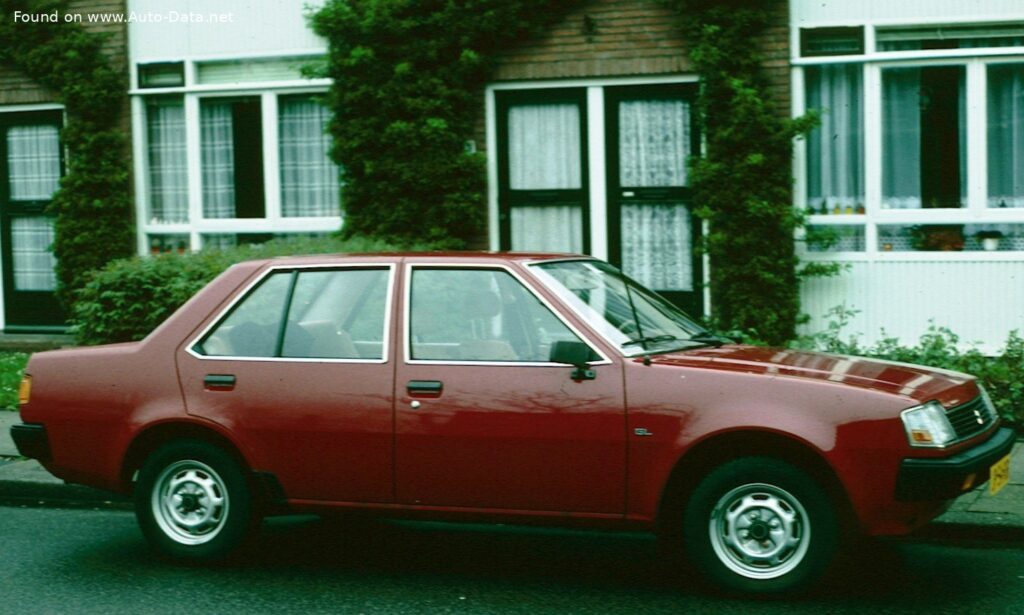
The Mitsubishi Lancer Fiore II 1.4 (70 Hp) represents a significant chapter in the history of Mitsubishi Motors, specifically within the compact sedan segment. Produced from 1983 to 1984, the Lancer Fiore II was the second generation of a distinct model line within the broader Lancer family, primarily aimed at the Japanese Domestic Market (JDM) and select export territories in Asia and Europe. While the Lancer nameplate would later achieve global recognition, particularly in North America, the Fiore II was a more specialized offering, emphasizing economy, practicality, and reliability during a period of increasing demand for fuel-efficient and accessible personal transportation.
Emerging in the early 1980s, the Mitsubishi Lancer Fiore II 1.4 (70 Hp) directly addressed the growing need for compact family sedans that balanced affordability, low running costs, and adequate space. It showcased Mitsubishi’s engineering capabilities, delivering a robust and dependable vehicle designed for congested urban environments and comfortable inter-city travel. This generation of the Lancer refined its predecessor’s mechanical package and adopted the contemporary styling of the era, favoring clean lines and functional aesthetics.
Unlike some of its more aggressively marketed siblings or future performance-oriented derivatives, the Lancer Fiore II was a workhorse, intended as an everyday vehicle. Its relatively modest 1.4-liter engine, producing 70 horsepower, aligned perfectly with its mission: to provide dependable motivation without excessive fuel consumption. Understanding that this specific model may not be widely recognized by American consumers, its underlying principles and engineering significantly contributed to Mitsubishi’s global reputation and eventual success in diverse markets. It was a foundational model that helped solidify the brand’s image as a producer of durable and value-driven automobiles.
Powertrain & Engine Architecture
The Mitsubishi Lancer Fiore II 1.4 (70 Hp) was powered by a naturally aspirated 1.4-liter gasoline engine. In the early 1980s, 70 horsepower from an engine of this size was considered competent for a compact sedan. This powertrain was engineered for efficiency and longevity, crucial characteristics for consumers facing fluctuating fuel prices and growing environmental awareness. Mitsubishi prioritized a smooth, reliable power delivery suitable for daily commuting and typical family use.
The engine’s design likely emphasized simplicity, making it easier and more affordable to maintain. Components were robust, reflecting the Japanese automotive industry’s commitment to quality and durability. While specific torque figures are often unavailable, the engine likely generated sufficient low-end torque for comfortable urban driving and reasonable acceleration without constant high-revving. The naturally aspirated design offered predictable power delivery and lower complexity compared to the less common turbocharged alternatives of the time.
Typically paired with a manual transmission, an automatic transmission was also often available. The 1.4-liter engine allowed the Lancer Fiore II to achieve commendable fuel economy, a significant selling point in its primary markets where economic operation was prioritized. The driving experience would have been characterized by a comfortable ride and predictable handling, perfectly suited to its role as a practical family sedan. The engine was likely of an inline-four configuration, a common layout for engines of this displacement and era. The fuel system would have utilized a carburetor, as fuel injection was still becoming more widespread during this period.
Driving Characteristics
The 1.4-liter, 70 hp engine in the Lancer Fiore II delivered a driving experience focused on practicality rather than performance. Compared to higher-output versions of the Lancer or other models equipped with larger engines, the Fiore II offered more modest acceleration. The automatic transmission, while providing convenience, would have further reduced performance due to inherent power losses and typically wider gear ratios designed for fuel efficiency. The automatic transmission was likely a three or four-speed unit, common for the time, and would have prioritized smooth shifts over rapid acceleration.
In real-world conditions, the Fiore II 1.4 Automatic was best suited for city driving and highway cruising at moderate speeds. Overtaking maneuvers required planning, and the engine needed to be revved to access its full power. The gear ratios were likely optimized for fuel economy, meaning the engine would operate at relatively lower RPMs during highway driving, contributing to a quieter and more comfortable ride. Compared to a manual transmission version, the automatic would have felt less responsive, but offered a more relaxed driving experience, particularly in stop-and-go traffic.
The overall driving experience was geared towards ease of use and dependability. The suspension was tuned for comfort, absorbing bumps and providing a stable ride. While not a sporty vehicle, the Lancer Fiore II offered predictable handling and a sense of security, making it a suitable choice for drivers prioritizing practicality and reliability.
Equipment & Trim Levels
The Mitsubishi Lancer Fiore II 1.4 (70 Hp) was generally positioned as an entry-level or mid-range trim within the Lancer lineup. Standard features typically included basic cloth upholstery, a simple dashboard layout with analog gauges, and a basic AM/FM radio. Manual windows and door locks were common. Air conditioning was often an optional extra, as were features like a rear window defogger and upgraded audio systems.
Interior trim levels varied depending on the market and optional packages. Higher trims might have included upgraded seat fabrics, a more comprehensive instrument cluster, and additional convenience features. Exterior options could include different wheel covers, body-colored bumpers, and upgraded paint colors. The overall focus was on providing essential features at an affordable price point, rather than offering a luxurious or feature-rich experience.
Safety features were relatively basic by modern standards, but included seatbelts for all occupants and a robust unibody construction designed to provide a degree of crash protection. Power steering was sometimes offered as an option, enhancing maneuverability, particularly in urban environments.
Chassis & Braking
The Lancer Fiore II’s chassis was a traditional body-on-frame construction, common for vehicles of this era. The suspension system typically consisted of independent front suspension with MacPherson struts and a solid rear axle with leaf springs. This setup prioritized ride comfort and durability over sporty handling. Stabilizer bars were often omitted or relatively small in diameter to maintain a softer ride.
The braking system generally consisted of drum brakes on all four wheels, although some higher trim levels or export markets might have featured front disc brakes. The braking performance was adequate for the vehicle’s weight and intended use, but not particularly powerful. Power-assisted brakes were not typically standard, requiring more driver effort to achieve effective stopping power.
The steering system was typically a recirculating ball steering system, providing a relatively indirect steering feel. The overall chassis and braking setup were designed to provide a safe and reliable driving experience, prioritizing affordability and ease of maintenance over high performance.
Market Reception & Comparison
Critics generally viewed the Mitsubishi Lancer Fiore II 1.4 (70 Hp) as a competent and reliable compact sedan. It was praised for its fuel efficiency, durability, and affordability. However, it was also noted for its relatively modest performance and basic features. Compared to other trims in the Lancer lineup, such as those equipped with larger engines or more luxurious features, the 1.4 Automatic was positioned as the entry-level option, appealing to budget-conscious buyers.
In terms of fuel economy, the Fiore II 1.4 Automatic typically achieved around 30-35 mpg, which was competitive for the time. Reliability was a strong point, with the engine and transmission proving to be durable and relatively trouble-free. Compared to rivals like the Toyota Corolla and Nissan Sunny, the Lancer Fiore II offered a similar level of practicality and reliability, often at a slightly lower price point.
The automatic transmission, while convenient, did detract from fuel economy and performance compared to the manual transmission version. However, it appealed to drivers who preferred the ease of use and convenience of an automatic.
Technical Specifications
| Brand | Mitsubishi |
| Model | Lancer |
| Generation | Lancer Fiore II |
| Engine Type | 1.4-liter Inline-Four |
| Horsepower | 70 hp |
| Transmission | 3- or 4-speed Automatic |
| Fuel Type | Gasoline (Petrol) |
| Production Years | 1983-1984 |
| Body Type | Sedan |
| Engine Aspiration | Naturally Aspirated |
| Valve Configuration | Overhead Valve (OHV) |
| Fuel System | Carburetor |
| Brakes (Front) | Drum or Disc (depending on trim) |
| Brakes (Rear) | Drum |
| Suspension (Front) | MacPherson Strut |
| Suspension (Rear) | Solid Axle with Leaf Springs |
Legacy
The Mitsubishi Lancer Fiore II 1.4 (70 Hp) powertrain, while not particularly powerful or technologically advanced, proved to be remarkably durable. Many examples remained on the road for years, demonstrating the quality of Mitsubishi’s engineering. In the used car market today, these vehicles are relatively rare, but those that remain are often sought after by enthusiasts and collectors who appreciate their simplicity and reliability.
The engine itself is known for its longevity and ease of maintenance. Parts availability can be a challenge, but many components are interchangeable with other Mitsubishi engines of the same era. The automatic transmission, while not as robust as some other transmissions, is generally reliable if properly maintained.
The Lancer Fiore II’s legacy extends beyond its individual components. It played a crucial role in establishing Mitsubishi’s reputation as a producer of dependable and value-driven automobiles. It laid the groundwork for future generations of Lancers that would achieve greater success in global markets. The Fiore II remains a testament to the principles of sound engineering and practical design, embodying an era when cars were built to last.