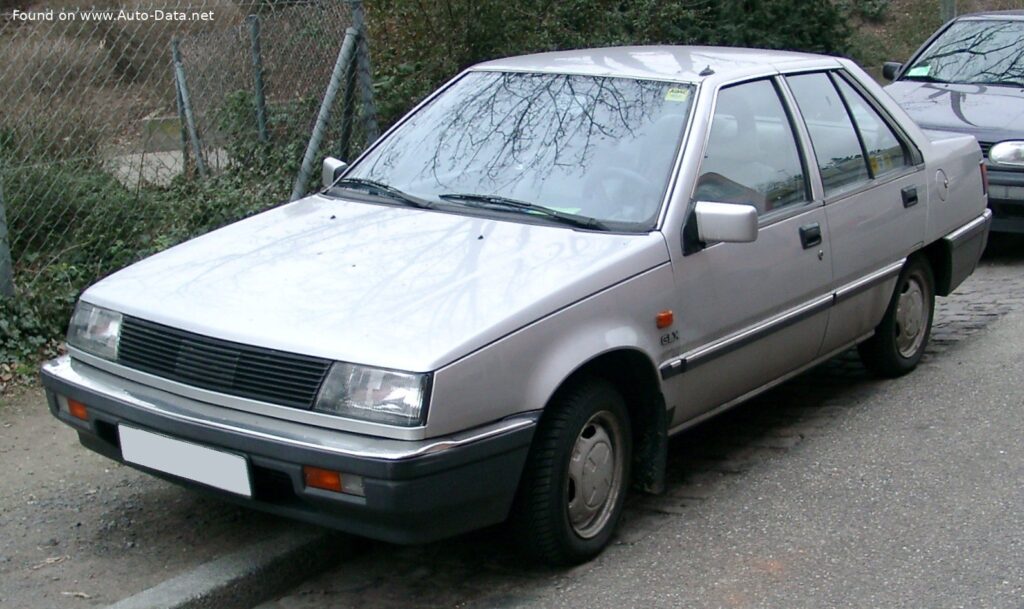
The Mitsubishi Lancer III 1.2 (60 Hp) represents an important iteration in Mitsubishi Motors’ compact car lineage. Introduced in 1986 as part of the C10 series, this generation built upon the Lancer’s reputation for reliability and affordability. Positioned as the entry-level offering in many markets, the 1.2-liter variant prioritized fuel efficiency and low operating costs, making it a popular choice for budget-conscious buyers and families. It competed within a crowded segment against rivals like the Toyota Corolla and Honda Civic, particularly in Asia, Europe, and select regions where smaller engine displacements were favored due to taxation or fuel economy concerns.
Evolution of the Lancer III
The third-generation Lancer, succeeding the A170 series (Lancer II), brought a more contemporary design and improved driving dynamics to the compact car segment. It shared its platform and many components with the contemporary Mitsubishi Mirage (or Colt, depending on the market), allowing for economies of scale. While the Mirage was often sold as a hatchback, the Lancer III primarily focused on the traditional sedan body style, appealing to customers who preferred a separate trunk. Production of the Lancer III was relatively short-lived, ending in 1988 with the arrival of the Lancer IV (C60/C70 series). Despite its brief run, the Lancer III was crucial in maintaining Mitsubishi’s presence in the global compact car market, offering a dependable and no-nonsense vehicle.
Powertrain & Engine Architecture
The Mitsubishi Lancer III 1.2 (60 Hp) was powered by a 1.2-liter (1198 cc) inline-four cylinder gasoline engine. This naturally aspirated engine relied on atmospheric pressure for air intake, a common and cost-effective design for entry-level vehicles of the era. The engine produced a peak output of 60 horsepower. The engine likely utilized a single overhead camshaft (SOHC) configuration with two valves per cylinder, a proven design prioritizing durability and smooth power delivery over high performance. Fuel delivery was likely managed by a carburetor, typical for this class of vehicle and price point in the mid-1980s. The engine’s simplicity contributed to its reliability and ease of maintenance.
Transmission
While a five-speed manual transmission was the most common pairing for the 1.2-liter engine, an automatic transmission was also offered in certain markets. This automatic was typically a three-speed unit, designed for smooth, if not particularly sporty, operation. The automatic transmission prioritized ease of use and comfort, appealing to drivers who preferred a less involved driving experience. The gear ratios were optimized for fuel efficiency and low-speed drivability, rather than rapid acceleration.
Driving Characteristics
The driving experience in the Lancer III 1.2 (60 Hp) was characterized by its practicality and ease of use. Acceleration was modest, with the 60 horsepower engine requiring careful throttle management, especially when fully loaded or climbing hills. The manual transmission allowed drivers to extract the most from the available power, while the automatic provided a more relaxed driving experience. The suspension was tuned for comfort, providing a reasonably smooth ride over typical road surfaces. Handling was predictable, but not particularly sporty. Compared to higher-output Lancer variants, such as those equipped with larger engines, the 1.2-liter model offered significantly less performance, but compensated with superior fuel economy and lower running costs. The focus was on providing reliable and economical transportation for everyday use.
Equipment & Trim Levels
The Mitsubishi Lancer III 1.2 (60 Hp) was typically offered with a relatively basic level of equipment, reflecting its position as the entry-level trim. Standard features generally included cloth upholstery, a simple dashboard layout with analog gauges (speedometer, fuel gauge, temperature gauge), manual windows, and a basic AM/FM radio. Higher trim levels, available in some markets, might have included features such as a tachometer, upgraded upholstery, and optional extras like a cassette player. Safety features were limited by the standards of the time, typically consisting of three-point seatbelts for front occupants and lap belts for rear passengers. The interior was designed for durability and practicality, with hard-wearing materials chosen to withstand daily use.
Chassis & Braking
The Lancer III utilized a traditional front-engine, rear-wheel-drive layout, although front-wheel drive configurations were also available depending on the market. The suspension consisted of MacPherson struts at the front and a solid axle with leaf springs at the rear. This setup prioritized simplicity and durability over sophisticated handling. Braking systems varied depending on the market and trim level. Lower-spec models typically featured drum brakes on all four wheels, while higher-spec models might have included front disc brakes. The braking performance was adequate for the vehicle’s weight and power, but not particularly powerful. Stabilizer bars were often omitted on the base 1.2-liter model to further reduce costs.
Market Reception & Comparison
The Mitsubishi Lancer III 1.2 (60 Hp) received generally positive reviews for its reliability, fuel efficiency, and affordability. Critics acknowledged its modest performance, but recognized that it was well-suited to its intended purpose as an economical daily driver. Compared to other trims in the Lancer lineup, the 1.2-liter model offered the lowest purchase price and running costs, but at the expense of performance and refinement. Against competitors like the Toyota Corolla and Honda Civic, the Lancer III 1.2 offered a competitive package, particularly in markets where fuel economy and low taxation were priorities. Its simplicity and robust construction contributed to its long-term reliability, making it a popular choice among budget-conscious buyers.
Technical Specifications
| Brand | Mitsubishi |
| Model | Lancer |
| Generation | Lancer III |
| Engine Type | 1.2-liter Inline-Four |
| Displacement | 1198 cc |
| Power Output | 60 Hp |
| Fuel Type | Gasoline |
| Engine Aspiration | Naturally Aspirated |
| Transmission | 3-Speed Automatic (also available with 5-Speed Manual) |
| Drivetrain | Front-Wheel Drive (also available in Rear-Wheel Drive) |
| Body Type | Sedan |
| Curb Weight | Approximately 1,800 – 2,000 lbs (816 – 907 kg) |
| Fuel Economy (estimated) | 35-45 mpg (US) |
| Production Years | 1986-1988 |
Legacy
The Mitsubishi Lancer III 1.2 (60 Hp) has left a lasting legacy as a reliable and affordable compact car. While not known for its performance, it earned a reputation for durability and low running costs. Today, finding a well-maintained example is becoming increasingly rare. In the used car market, these Lancers are often sought after by enthusiasts and collectors who appreciate their simplicity and classic styling. The powertrain, while modest by modern standards, proved to be remarkably robust, with many examples still running reliably after decades of service. The Lancer III 1.2 (60 Hp) represents a significant chapter in Mitsubishi’s history, demonstrating the company’s commitment to providing practical and dependable transportation to a global audience.