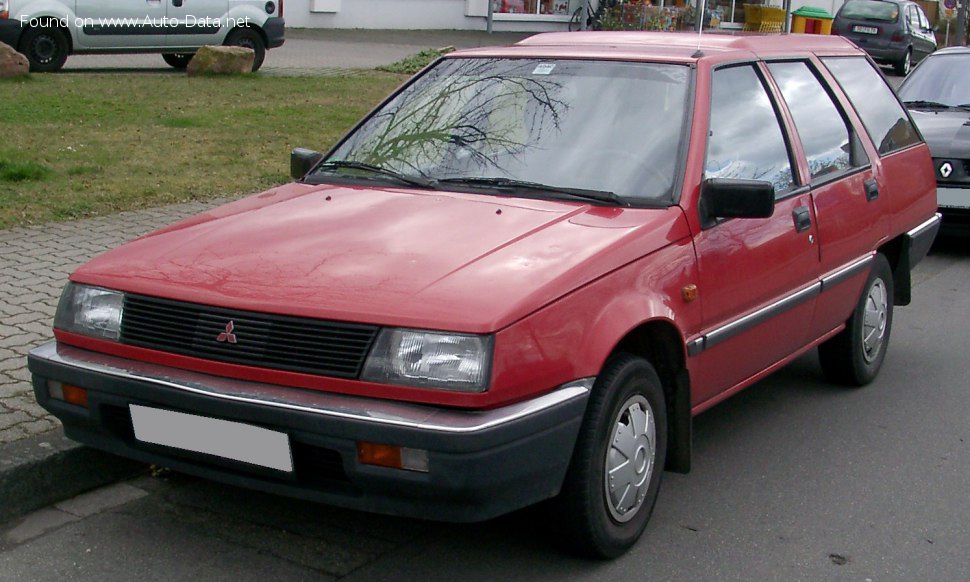
The Mitsubishi Lancer III Wagon 1.5 (75 Hp), produced between 1985 and 1987, represents a significant chapter in the history of compact, practical family transportation. As part of the third-generation Lancer lineup, this station wagon variant was designed to offer an economical and reliable solution for families and small businesses alike. While the Lancer nameplate has enjoyed a long and varied career, including notable high-performance iterations, this specific 1.5-liter model highlights Mitsubishi’s commitment to building durable and accessible vehicles for a global market. Positioned within the highly competitive compact segment, the Lancer III Wagon was a testament to sensible engineering and utilitarian design, carving out its niche as a dependable daily driver.
The Mitsubishi Lancer III Wagon 1.5 (75 Hp): A Global Perspective
The Lancer III, and its wagon derivative, were primarily aimed at the European and Asian markets. In these regions, the compact wagon body style was highly popular due to its practicality and efficient use of space. While Mitsubishi vehicles had a presence in North America through rebadged models sold under the Dodge and Plymouth brands, the Lancer III Wagon wasn’t directly marketed in the United States. Its success lay in providing a no-nonsense, affordable option for buyers seeking a versatile vehicle for everyday use. The Lancer III Wagon competed directly with established European and Japanese rivals, offering a compelling blend of reliability and value.
Engine & Performance
At the heart of the Mitsubishi Lancer III Wagon 1.5 (75 Hp) lay a robust and efficient 1.5-liter (1468 cm³ or 89.58 cubic inches) inline four-cylinder engine. This naturally aspirated unit featured a Single Overhead Cam (OHC) valvetrain with three valves per cylinder, a configuration chosen for its balance of power, fuel economy, and reliability. Fuel delivery was handled by a multi-port manifold injection system, a relatively modern feature for the mid-1980s that offered improved fuel atomization and efficiency compared to earlier carbureted systems.
The engine produced a modest but entirely adequate 75 horsepower at 6000 rpm, with a peak torque of 102 Nm (75.23 lb.-ft.) arriving at a lower 4000 rpm. This power delivery characteristic made the Lancer III Wagon a tractable and easy-to-drive vehicle in urban environments and on longer commutes, prioritizing usable low-to-mid range torque over outright top-end power. With a compression ratio of 9.5:1, the engine was designed to run on readily available gasoline (petrol). Power was sent to the front wheels via a standard 5-speed manual transmission, a common and reliable setup for compact cars of the era. This front-wheel-drive architecture contributed to both interior packaging efficiency and predictable handling characteristics. Weighing in at 1984.16 lbs (900 kg), the Lancer III Wagon boasted a weight-to-power ratio of 12 kg/Hp (or 83.3 Hp per tonne), indicating its focus on economical operation rather than blistering acceleration. While not built for speed, its powertrain was well-suited for its primary role as a dependable family hauler, capable of navigating diverse road conditions with ease.
Design & Features: A Practical Approach
The Mitsubishi Lancer III Wagon adopted a functional and straightforward design, characteristic of Japanese automotive styling in the mid-1980s. Its 5-door station wagon body type emphasized practicality and cargo versatility. Measuring 161.93 inches in length, 64.37 inches in width, and 55.71 inches in height, with a wheelbase of 93.7 inches, the Lancer III Wagon was a compact vehicle that maximized interior space for its footprint. The relatively short wheelbase contributed to maneuverability in tight city spaces, while the overall dimensions ensured it remained a manageable size for parking and navigating congested streets.
Inside, the Lancer III Wagon was configured for five occupants, offering a no-frills but comfortable environment. The focus was clearly on utility, with a generous minimum trunk space of 13.31 cubic feet (377 liters). This made it an attractive option for families needing to transport groceries, luggage, or equipment, a key selling point for any station wagon. The fuel tank capacity of 12.42 US gallons provided a decent range for extended journeys, reinforcing its capability as a reliable long-distance companion. Mechanically, the Lancer III Wagon featured a conventional and proven setup. Both the front and rear suspensions utilized coil springs, providing a balance of ride comfort and handling stability. Stopping power came from disc brakes at the front and drum brakes at the rear, a common and effective combination for vehicles of this class and era. Steering was handled by a rack and pinion system, offering direct and predictable control. The vehicle rode on 175/70 R13 tires, a standard size for compact cars of the period, chosen for their balance of grip, longevity, and cost-effectiveness.
Technical Specifications
| Category | Specification |
| General Information | |
| Brand | Mitsubishi |
| Model | Lancer |
| Generation | Lancer III Wagon |
| Engine Type | 1.5 (75 Hp) |
| Production Start | 1985 year |
| Production End | 1987 year |
| Powertrain Architecture | Internal Combustion Engine |
| Body Type | Station wagon (estate) |
| Seats | 5 |
| Doors | 5 |
| Performance Specs | |
| Fuel Type | Petrol (Gasoline) |
| Weight-to-power ratio | 12 kg/Hp, 83.3 Hp/tonne |
| Weight-to-torque ratio | 8.8 kg/Nm, 113.3 Nm/tonne |
| Engine Specs | |
| Power | 75 Hp @ 6000 rpm |
| Power per liter | 51.1 Hp/l |
| Torque | 102 Nm @ 4000 rpm (75.23 lb.-ft. @ 4000 rpm) |
| Engine Layout | Front, Transverse |
| Engine Displacement | 1468 cm³ (89.58 cu. in.) |
| Number of Cylinders | 4 |
| Engine Configuration | Inline |
| Cylinder Bore | 75.5 mm (2.97 in.) |
| Piston Stroke | 82 mm (3.23 in.) |
| Compression Ratio | 9.5:1 |
| Valves per Cylinder | 3 |
| Fuel Injection System | Multi-port manifold injection |
| Engine Aspiration | Naturally aspirated engine |
| Valvetrain | OHC |
| Space, Volume and Weights | |
| Kerb Weight | 900 kg (1984.16 lbs) |
| Trunk (boot) space – minimum | 377 l (13.31 cu. ft.) |
| Fuel Tank Capacity | 47 l (12.42 US gal) |
| Dimensions | |
| Length | 4113 mm (161.93 in.) |
| Width | 1635 mm (64.37 in.) |
| Height | 1415 mm (55.71 in.) |
| Wheelbase | 2380 mm (93.7 in.) |
| Front Track | 1410 mm (55.51 in.) |
| Rear Track | 1340 mm (52.76 in.) |
| Drivetrain, Brakes and Suspension Specs | |
| Drivetrain Architecture | ICE drives the front wheels |
| Drive Wheel | Front wheel drive |
| Number of Gears & Gearbox Type | 5 gears, manual transmission |
| Front Suspension | Coil spring |
| Rear Suspension | Coil spring |
| Front Brakes | Disc |
| Rear Brakes | Drum |
| Steering Type | Steering rack and pinion |
| Tires Size | 175/70 R13 |
Legacy & Market Impact
The Mitsubishi Lancer III Wagon, particularly the 1.5 (75 Hp) variant, was a quintessential example of Mitsubishi’s strategy during the mid-1980s: to produce reliable, economical, and practical vehicles for a global audience. While not a performance icon, its legacy is built on its reputation for durability and low running costs. In markets across Asia, Europe, and even parts of North America (where the Lancer was often sold as the Dodge or Plymouth Colt), this generation of Lancer, and its wagon variant, served as a workhorse for countless families and small businesses.
In its primary markets, the Lancer III Wagon competed against a formidable array of compact wagons, including the likes of the Toyota Corolla Wagon, Honda Civic Wagon, Nissan Sentra Wagon, and various European offerings such as the Ford Escort Wagon and Opel Kadett Caravan. What set the Lancer apart was its robust build quality, straightforward mechanicals, and often a competitive price point, which appealed to buyers prioritizing long-term ownership and value. The Mitsubishi Lancer III Wagon 1.5 (75 Hp) played a crucial role in solidifying Mitsubishi’s image as a manufacturer of dependable vehicles. It wasn’t about pushing boundaries in design or performance, but rather about consistently delivering on the promise of reliable transportation. This generation helped lay the groundwork for the Lancer’s continued success, proving that a practical, unpretentious vehicle could command significant market share and build lasting customer loyalty. Its impact was less about innovation and more about consistent, solid execution, making it a memorable, albeit understated, part of automotive history.