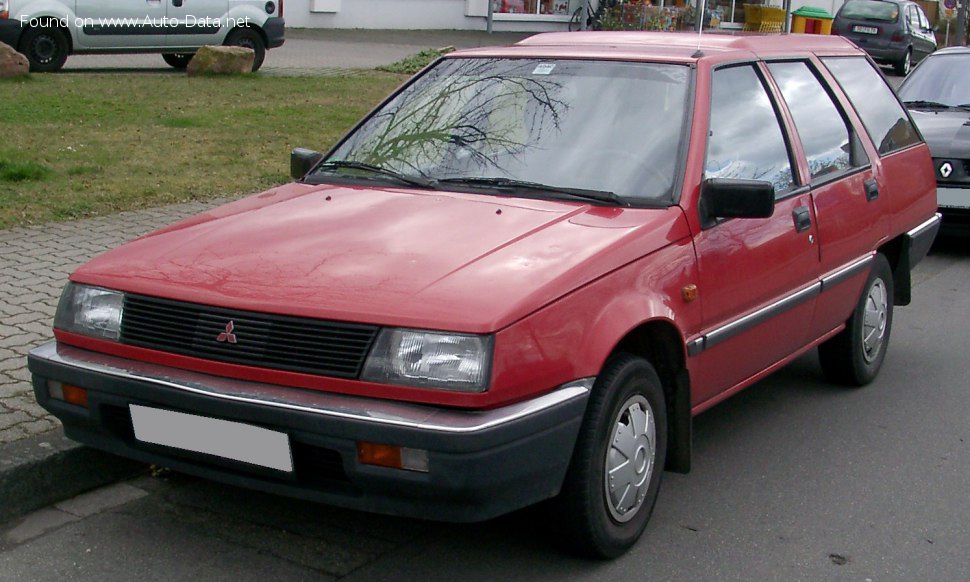
The Mitsubishi Lancer, a nameplate recognized for dependability and adaptability over its decades-long production, has seen numerous versions globally. The Mitsubishi Lancer III Wagon 1.8 (83 Hp) 4×4 is a particularly practical and capable model from the late 1980s. Produced from 1987 to 1989, this generation – internally designated the C50 series – showcased Mitsubishi’s dedication to a compact family vehicle with improved utility and all-weather traction. While the Lancer sedan was common in markets like North America, this 4×4 wagon was primarily sold in Europe, Asia, and Oceania, where its spaciousness and robust drivetrain were highly valued. It established itself as an economical, durable vehicle capable of handling diverse road conditions thanks to its advanced full-time four-wheel-drive system.
Mitsubishi Lancer III Wagon: A Detailed Overview
The Lancer III Wagon represented a significant step in Mitsubishi’s strategy to offer versatile vehicles catering to a broad range of consumer needs. It wasn’t intended to be a performance vehicle, but rather a reliable and practical option for families and individuals requiring a vehicle capable of handling both daily commutes and more demanding tasks. The inclusion of a four-wheel-drive system in a compact wagon was relatively uncommon at the time, setting it apart from many competitors.
Engine & Performance
The Mitsubishi Lancer III Wagon 1.8 (83 Hp) 4×4 was powered by a naturally aspirated 1.8-liter inline-four gasoline engine. This engine prioritized dependability and efficiency over outright speed. Producing 83 horsepower, it provided sufficient power for everyday driving, including commuting, errands, and highway travel. The naturally aspirated design ensured predictable power delivery and simplified maintenance, contributing to the vehicle’s longevity. The engine’s torque curve was well-suited for its intended purpose, providing adequate pulling power even when the wagon was fully loaded.
The defining characteristic of this Lancer Wagon was its sophisticated four-wheel-drive powertrain. Unlike many front-wheel-drive competitors, Mitsubishi equipped this model with a full-time four-wheel-drive system, a relatively advanced feature for the compact passenger car segment in the late 1980s. This system continuously delivered power to all four wheels, significantly improving traction and stability, particularly in challenging conditions like rain, snow, or gravel. For consumers in regions with harsh climates or frequent unpaved roads, the 4×4 system offered a valuable layer of security and capability, allowing the Lancer Wagon to exceed the limitations of a two-wheel-drive vehicle while remaining more fuel-efficient and car-like than larger SUVs.
Design & Features
The design of the Mitsubishi Lancer III Wagon reflected the automotive aesthetics of the late 1980s: functional, angular, and practical. Its station wagon body maximized interior space, offering a spacious cabin and a substantial cargo area – a key selling point for families and those needing ample utility. The exterior featured clean lines and a conservative styling approach, prioritizing aerodynamic efficiency and manufacturing simplicity. While not flashy, the design conveyed a sense of sturdy reliability and understated competence.
The interior was designed with practicality in mind. The layout was ergonomic and straightforward, with easily accessible controls. Seating for five was comfortable for its class, and the rear seats typically folded down to create a large, flat load floor, maximizing cargo versatility. Features, consistent with a compact car of the era, were generally basic but functional, including a standard AM/FM radio, manual windows and mirrors, and a basic heating and ventilation system. Air conditioning was often an optional extra. Safety features were rudimentary by modern standards, consisting primarily of seatbelts and a robust body structure designed to meet the crash standards of the late 1980s. The focus was on fundamental protection rather than advanced safety systems.
The combination of its practical station wagon body and the all-wheel-drive system made the Lancer III Wagon an appealing choice for consumers seeking a vehicle that could handle both urban and challenging rural or winter conditions. Its design embodied Mitsubishi’s commitment to dependable, well-engineered vehicles that met the real-world needs of their owners.
Technical Specifications: Mitsubishi Lancer III Wagon 1.8 (83 Hp) 4×4
| Attribute | Specification |
| Brand | Mitsubishi |
| Model | Lancer |
| Generation | Lancer III Wagon |
| Type (Engine) | 1.8 (83 Hp) 4×4 |
| Start of Production | 1987 |
| End of Production | 1989 |
| Powertrain Architecture | Internal Combustion engine |
| Body type | Station wagon (estate) |
| Fuel Type | Petrol (Gasoline) |
| Power | 83 Hp |
| Engine aspiration | Naturally aspirated engine |
The Mitsubishi Lancer III Wagon 1.8 (83 Hp) 4×4, while not a high-volume seller in all markets, established a legacy as a highly reliable and practical vehicle. Its impact was most significant in regions where its unique combination of compact size, generous cargo space, and all-wheel-drive capability aligned with consumer demands. In Europe, Australia, and parts of Asia, its 4×4 system provided a distinct advantage over two-wheel-drive competitors, earning a reputation for sure-footedness and dependable performance.
Competitors included other compact wagons like the Toyota Corolla Wagon, Honda Civic Wagon, Nissan Sunny/Pulsar Wagon, and European models like the Ford Escort Wagon or Opel Kadett Caravan. However, few rivals offered a full-time 4×4 system in a compact wagon package at a comparable price during the late 1980s. This gave the Lancer a unique selling proposition, attracting buyers who needed more than front-wheel-drive traction but found traditional SUVs too large, expensive, or inefficient. It foreshadowed the crossover SUV trend, demonstrating the appeal of combining passenger car comfort with enhanced all-weather capability.
Historically, this Lancer Wagon contributed to Mitsubishi’s image as an innovator in drivetrain technology, particularly its early adoption and refinement of four-wheel-drive systems in passenger cars. It reinforced the Lancer nameplate’s reputation for durability and value. Even today, many examples of this Lancer Wagon remain in service worldwide, a testament to its robust engineering and long-term reliability. Its enduring presence highlights its historical significance as a dependable, versatile, and capable family vehicle that offered advanced traction long before all-wheel drive became commonplace in compact cars.