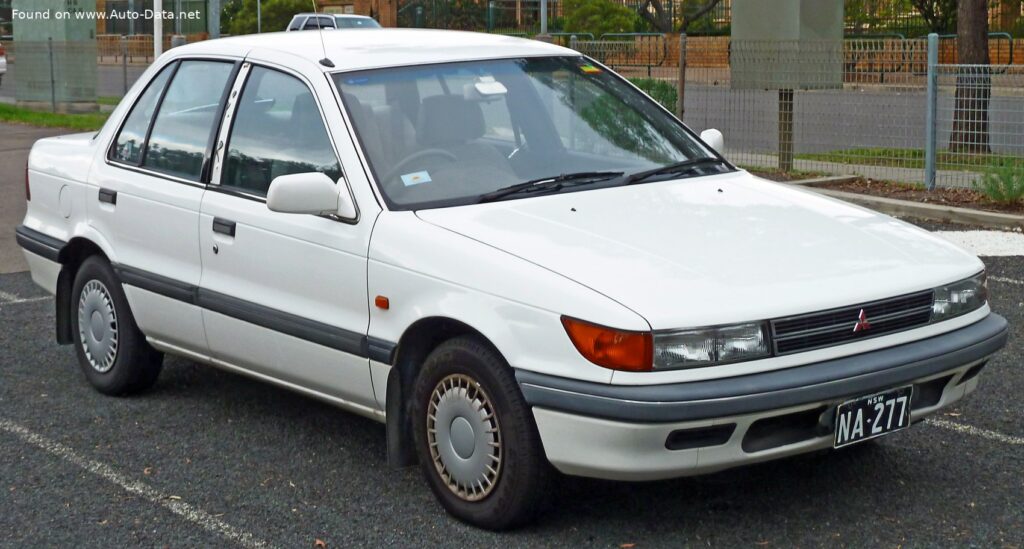
The Mitsubishi Lancer, a nameplate recognized for providing accessible and reliable transportation worldwide, entered its fourth generation with the Lancer IV in 1992. The Mitsubishi Lancer IV 1.3 12V (75 Hp) variant, while not a common sight in the North American market where larger engines were favored, was a cornerstone of Mitsubishi’s compact car lineup in numerous other regions. Produced from 1992 to 1994, this sedan was engineered as a practical, economical, and durable vehicle, appealing to buyers who valued low running costs and dependable performance over luxury or speed. It played a vital role in establishing Mitsubishi’s reputation for building robust vehicles capable of handling diverse road conditions and driving needs, particularly in Asia, Europe, and emerging markets.
Engine & Performance
The Mitsubishi Lancer IV 1.3 12V (75 Hp) featured a powertrain focused on efficiency and usability. At its heart was a 1.3-liter (1299 cm³ or 79.27 cu. in.) inline four-cylinder engine. This naturally aspirated unit employed a Single Overhead Camshaft (OHC) valvetrain with 12 valves, offering a balance between power delivery and mechanical simplicity. Producing 75 horsepower at 6000 rpm and 75.23 lb.-ft. of torque at 4000 rpm, the engine delivered smooth, accessible power suitable for both city commuting and highway driving.
A carbureted fuel system, a cost-effective and reliable solution for compact cars of the early 1990s, ensured consistent operation and relatively easy maintenance. With a compression ratio of 9.5:1, the engine was designed to operate efficiently on standard gasoline. Power was transferred to the front wheels through a 5-speed manual transmission, providing the driver with direct control and contributing to the vehicle’s fuel efficiency. This front-engine, front-wheel-drive layout was typical for compact sedans of the period, offering predictable handling and maximizing interior space. The vehicle achieved a top speed of 101.28 mph (163 km/h). Fuel economy was a key strength, with an estimated 26.1 US mpg in city driving and 39.2 US mpg on the highway, making it an economical choice for families and commuters.
Design & Features
The Mitsubishi Lancer IV showcased a clean, aerodynamic sedan design characteristic of early 1990s automotive styling. Its four-door, five-seat configuration provided practicality for small families or individuals needing ample passenger and cargo space. The exterior dimensions were compact and well-proportioned, measuring 166.73 inches (4235 mm) in length, 65.75 inches (1670 mm) in width, and 55.31 inches (1405 mm) in height. A 96.65-inch (2455 mm) wheelbase contributed to a stable ride and reasonable interior room for its class.
The interior of the Lancer IV prioritized functionality and durability. While luxury features were limited in the base 1.3L variant, the cabin was designed to be ergonomic and user-friendly. The trunk offered 11.9 cubic feet (337 liters) of cargo space, sufficient for everyday needs. The suspension system utilized coil springs at both the front and rear, providing a comfortable ride and adequate handling. Braking was accomplished with disc brakes at the front and drum brakes at the rear, a cost-effective and proven combination for a vehicle of this size and performance. A rack-and-pinion steering system offered direct and responsive feedback. The Lancer IV was equipped with 155/80 R13 tires, prioritizing economy and ride comfort.
Mitsubishi Lancer IV 1.3 12V (75 Hp) – Technical Specifications
| Category | Specification |
| General Information | |
| Brand | Mitsubishi |
| Model | Lancer |
| Generation | Lancer IV |
| Type (Engine) | 1.3 12V (75 Hp) |
| Start of Production | 1992 |
| End of Production | 1994 |
| Powertrain Architecture | Internal Combustion engine |
| Body type | Sedan |
| Seats | 5 |
| Doors | 4 |
| Performance Specs | |
| Fuel consumption (economy) – urban | 26.1 US mpg (9 l/100 km) |
| Fuel consumption (economy) – extra urban | 39.2 US mpg (6 l/100 km) |
| Fuel Type | Petrol (Gasoline) |
| Maximum speed | 101.28 mph (163 km/h) |
| Weight-to-power ratio | 11.7 kg/Hp, 85.2 Hp/tonne |
| Weight-to-torque ratio | 8.6 kg/Nm, 115.9 Nm/tonne |
| Engine Specs | |
| Power | 75 Hp @ 6000 rpm |
| Power per liter | 57.7 Hp/l |
| Torque | 75.23 lb.-ft. @ 4000 rpm (102 Nm) |
| Engine layout | Front, Transverse |
| Engine displacement | 1.3 liters (1299 cm³ / 79.27 cu. in.) |
| Number of cylinders | 4 |
| Engine configuration | Inline |
| Cylinder Bore | 2.8 in. (71 mm) |
| Piston Stroke | 3.23 in. (82 mm) |
| Compression ratio | 9.5:1 |
| Number of valves per cylinder | 3 |
| Fuel injection system | Carburettor |
| Engine aspiration | Naturally aspirated engine |
| Valvetrain | OHC |
| Space, Volume and Weights | |
| Kerb Weight | 1940.07 lbs. (880 kg) |
| Max. weight | 3229.77 lbs. (1465 kg) |
| Max load | 1289.7 lbs. (585 kg) |
| Trunk (boot) space – minimum | 11.9 cu. ft. (337 l) |
| Fuel tank capacity | 13.21 US gal (50 l) |
| Dimensions | |
| Length | 166.73 in. (4235 mm) |
| Width | 65.75 in. (1670 mm) |
| Height | 55.31 in. (1405 mm) |
| Wheelbase | 96.65 in. (2455 mm) |
| Front track | 56.3 in. (1430 mm) |
| Rear (Back) track | 56.3 in. (1430 mm) |
| Drivetrain, Brakes and Suspension Specs | |
| Drivetrain Architecture | The Internal combustion engine (ICE) drives the front wheels of the vehicle. |
| Drive wheel | Front wheel drive |
| Number of gears and type of gearbox | 5 gears, manual transmission |
| Front suspension | Coil spring |
| Rear suspension | Coil spring |
| Front brakes | Disc |
| Rear brakes | Drum |
| Steering type | Steering rack and pinion |
| Tires size | 155/80 R13 |
Legacy & Market Impact of the Mitsubishi Lancer IV
The Mitsubishi Lancer IV, and specifically the 1.3 12V (75 Hp) model, was a significant vehicle for Mitsubishi’s global strategy, despite limited marketing in the United States. In key markets like Asia, Europe, and Latin America, it competed with established compact sedans such as the Toyota Corolla, Honda Civic, Nissan Sentra, Volkswagen Golf, and Opel Astra. The Lancer distinguished itself through its reputation for robust construction, mechanical reliability, and overall value.
This generation of the Lancer reinforced Mitsubishi’s image as a manufacturer of dependable and affordable vehicles. Its efficient engine made it appealing in regions where fuel economy and lower taxes on smaller engines were important considerations. While the Lancer name would later become globally recognized through the high-performance Evolution models, it was vehicles like the Lancer IV 1.3 12V that formed the foundation of the brand, providing an accessible entry point for countless customers. Its legacy is not one of innovation or performance, but of consistent reliability and practicality, establishing it as a true workhorse in the compact sedan segment of the early 1990s. The Lancer IV paved the way for future generations, carrying forward Mitsubishi’s commitment to delivering efficient and reliable transportation solutions worldwide.