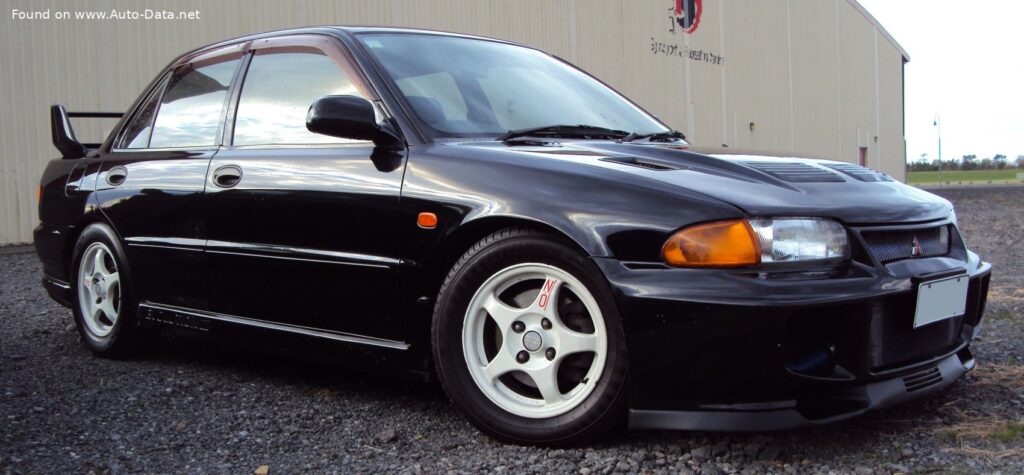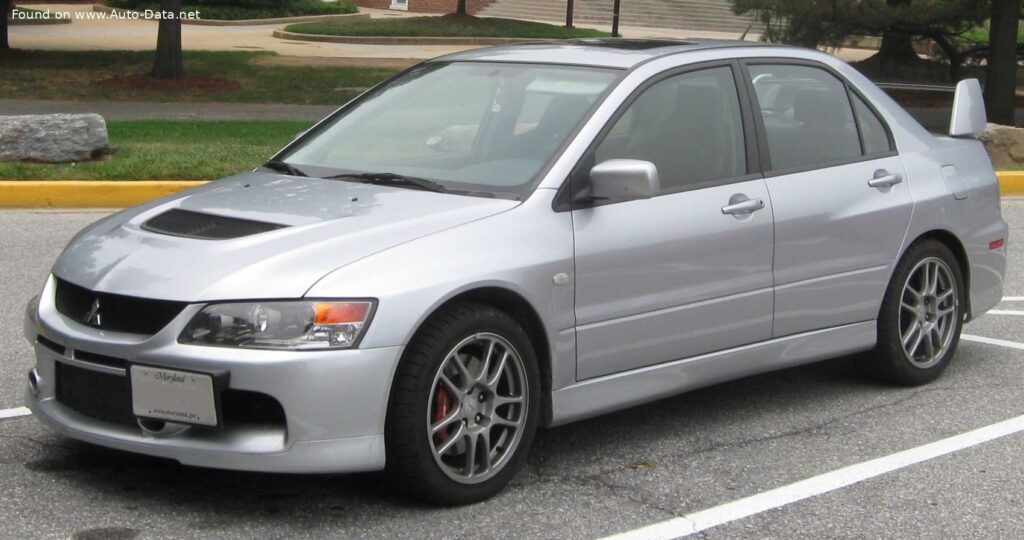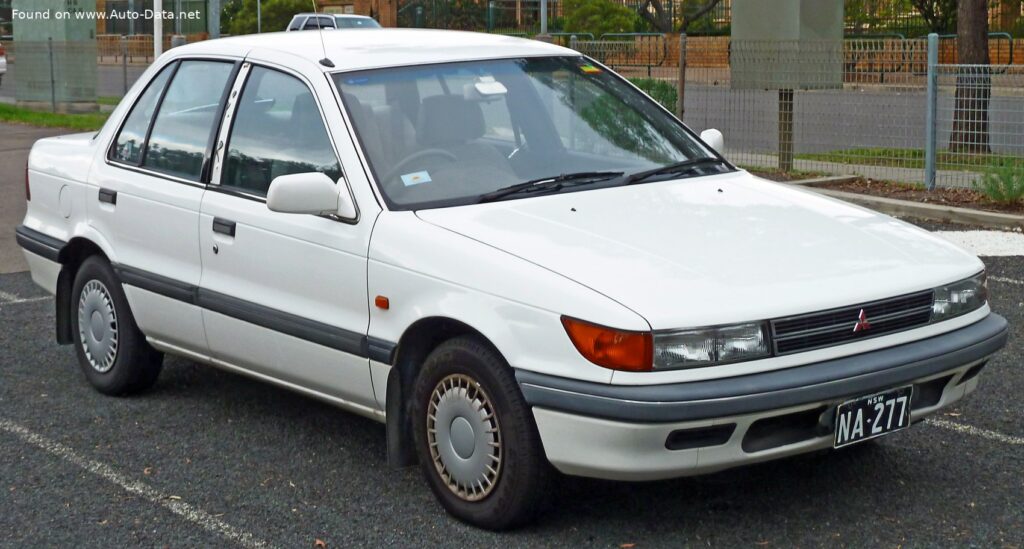
The Mitsubishi Lancer IV 1.5 12V (90 Hp) represents the fourth generation of Mitsubishi’s well-regarded compact car line, establishing a significant presence in the global automotive market. Produced from 1989 to 1992, this iteration, known internally as the C60 series, continued the Lancer’s tradition of offering practical, economical, and reliable transportation. Often marketed under different names in various regions—notably as the Mirage in North America—the Lancer IV solidified Mitsubishi’s position in the highly competitive compact sedan segment worldwide. This particular variant, powered by a 1.5-liter 12-valve engine, was a popular choice due to its balance of fuel efficiency and adequate performance for daily driving.
Evolution of the Mitsubishi Lancer IV
The Lancer nameplate boasts a long history with Mitsubishi, originating in 1973. The fourth generation, introduced at the beginning of the 1990s, featured a more aerodynamic and contemporary design compared to its predecessors. It was designed to appeal to a broad demographic, from first-time car buyers to small families seeking an affordable and dependable vehicle. The Mitsubishi Lancer IV was a demonstration of Japanese engineering of the era, prioritizing efficiency, build quality, and user-friendliness. Its role was crucial in many markets, serving as a core model that supported Mitsubishi’s sales volumes alongside larger offerings.
Engine & Performance
The heart of the Mitsubishi Lancer IV 1.5 12V (90 Hp) was the robust 4G15 inline-four engine. This naturally aspirated 1.5-liter (1468 cm³ or 89.58 cu. in.) gasoline engine was engineered for reliability and economical operation, characteristics highly valued in its market segment. Featuring an OHC (Overhead Camshaft) valvetrain and three valves per cylinder (two intake, one exhaust), it was a modern design for its time, optimizing airflow for both power and efficiency.
The engine produced 90 horsepower at 6000 rpm, a competitive figure for a compact sedan of its displacement in the early 1990s. Torque output was 126 Nm (92.93 lb.-ft.) at 3000 rpm, providing good low-end responsiveness for city driving. Power was delivered to the front wheels via a standard 5-speed manual transmission, a common and efficient setup for compact cars.
While not a performance car, the Lancer IV 1.5 12V offered adequate acceleration for its class. It could accelerate from 0 to 60 mph in approximately 11.1 seconds (0-100 km/h in 11.7 seconds) and reach a top speed of 105.63 mph (170 km/h). These figures underscored its primary mission as a practical commuter. Fuel economy was a strong point, with a combined consumption of around 33.6 US mpg (7 l/100 km), making it an attractive option for budget-conscious buyers. The multi-port manifold injection system contributed to both efficiency and smoother operation compared to older carbureted designs.
Design & Features
The Lancer IV adopted a clean, unpretentious sedan body style, prioritizing practicality and interior space within a compact footprint. Measuring 166.73 inches in length, 65.75 inches in width, and 55.31 inches in height, it was designed for maneuverability in urban environments while comfortably seating up to five occupants. The 96.65-inch wheelbase contributed to a stable ride quality, and a minimum turning circle of 34.12 feet made it easy to navigate tight spaces.
The exterior styling was typical of late 1980s and early 1990s Japanese design—a smooth, rounded aesthetic focused on aerodynamic efficiency. While not flashy, its design was functional and aged relatively well. Inside, the Lancer IV offered a straightforward and ergonomic cabin. The focus was on durability and ease of use, with controls intuitively placed. Trunk space was a respectable 11.9 cu. ft. (337 liters), sufficient for groceries or weekend luggage.
The Lancer IV featured a conventional but effective suspension setup with coil springs at both the front and rear, providing a comfortable ride for its class. Braking was handled by front discs and rear drums, a common configuration for economy cars of the era. A notable safety feature for a compact vehicle in 1989 was the inclusion of ABS (Anti-lock Braking System), which enhanced braking control under challenging conditions. The car rode on 175/70 R13 tires, mounted on 13-inch wheel rims, emphasizing economy and ride comfort over outright performance.
Mitsubishi Lancer IV Technical Specifications
| Category | Specification |
| Brand | Mitsubishi |
| Model | Lancer |
| Generation | Lancer IV |
| Type (Engine) | 1.5 12V (90 Hp) |
| Production Start | 1989 |
| Production End | 1992 |
| Powertrain Architecture | Internal Combustion Engine |
| Body Type | Sedan |
| Seats | 5 |
| Doors | 4 |
| Fuel Consumption (Urban) | 8.6 l/100 km | 27.4 US mpg |
| Fuel Consumption (Extra Urban) | 4.9 l/100 km | 48 US mpg |
| Fuel Consumption (Combined) | 7 l/100 km | 33.6 US mpg |
| Fuel Type | Petrol (Gasoline) |
| Acceleration 0 – 60 mph | 11.1 sec |
| Acceleration 0 – 100 km/h | 11.7 sec |
| Maximum Speed | 170 km/h | 105.63 mph |
| Weight-to-Power Ratio | 11.4 kg/Hp | 87.8 Hp/tonne |
| Weight-to-Torque Ratio | 8.1 kg/Nm | 122.9 Nm/tonne |
| Power | 90 Hp @ 6000 rpm |
| Power per Liter | 61.3 Hp/l |
| Torque | 126 Nm @ 3000 rpm | 92.93 lb.-ft. @ 3000 rpm |
| Engine Layout | Front, Transverse |
| Engine Model/Code | 4G15 |
| Engine Displacement | 1468 cm³ | 1.5 l | 89.58 cu. in. |
| Number of Cylinders | 4 |
| Engine Configuration | Inline |
| Cylinder Bore | 75.5 mm | 2.97 in. |
| Piston Stroke | 82 mm | 3.23 in. |
| Compression Ratio | 9.2:1 |
| Number of Valves per Cylinder | 3 |
| Fuel Injection System | Multi-port manifold injection |
| Engine Aspiration | Naturally aspirated engine |
| Valvetrain | OHC |
| Kerb Weight | 1025 kg | 2259.74 lbs. |
| Max. Weight | 1465 kg | 3229.77 lbs. |
| Max Load | 440 kg | 970.03 lbs. |
| Trunk (Boot) Space – Minimum | 337 l | 11.9 cu. ft. |
| Fuel Tank Capacity | 50 l | 13.21 US gal |
| Length | 4235 mm | 166.73 in. |
| Width | 1670 mm | 65.75 in. |
| Height | 1405 mm | 55.31 in. |
| Wheelbase | 2455 mm | 96.65 in. |
| Front Track | 1430 mm | 56.3 in. |
| Rear (Back) Track | 1430 mm | 56.3 in. |
| Minimum Turning Circle | 10.4 m | 34.12 ft. |
| Drivetrain Architecture | Front-wheel drive, Internal Combustion Engine |
| Drive Wheel | Front wheel drive |
| Number of Gears and Gearbox Type | 5 gears, manual transmission |
| Front Suspension | Coil spring |
| Rear Suspension | Coil spring |
| Front Brakes | Disc |
| Rear Brakes | Drum |
| Assisting Systems | ABS (Anti-lock braking system) |
| Steering Type | Steering rack and pinion |
| Tires Size | 175/70 R13 |
| Wheel Rims Size | 13 inches |
Legacy & Market Impact of the Mitsubishi Lancer IV
The Mitsubishi Lancer IV, and specifically the 1.5 12V (90 Hp) variant, played a significant role in Mitsubishi’s global strategy during the late 1980s and early 1990s. It was a reliable, economical, and straightforward compact car that successfully competed in a crowded automotive segment. Its competitors varied by market but typically included the Honda Civic, Toyota Corolla, Nissan Sentra (Sunny in some markets), and Mazda 323. Against these rivals, the Lancer IV stood out for its solid build quality, competitive features, and reputation for durability.
While not as celebrated as its performance-oriented Lancer Evolution successors, the Lancer IV laid the foundation for Mitsubishi’s brand image as a producer of dependable vehicles. Its widespread availability across Europe, Asia, and other international markets established its recognition as a global player. For many, it represented an accessible entry point into car ownership, offering a sensible balance of cost, running expenses, and practical utility.
The Lancer IV’s legacy lies in its contribution to Mitsubishi’s reputation for engineering competence and value. It was a practical, unassuming sedan that excelled at its intended purpose: providing reliable and efficient transportation. Its simplicity and robust mechanicals meant that many examples continued to serve their owners for years, a testament to its fundamental quality. Today, while not a collector’s item in this trim, the Lancer IV is remembered as an integral part of Mitsubishi’s automotive history, demonstrating the brand’s ability to produce globally competitive compact cars that met the needs of the everyday driver.